Sunday, January 25, 2026
Advertise with us
Support us
Write for us
No Result
View All Result
claws
  • Home
  • About Us
    • Director General
    • Additional Director General
    • Jottings by Director General Emiritus
    • CLAWS Membership
    • Faculty
  • Publication
    • Web Articles
    • Issue Briefs
    • Manekshaw Papers
    • Newsletter
    • Essay
    • CLAWS Journal
    • Scholar Warrior
    • Books
    • Intern Articles
    • External Publications
  • Research Areas
    • Global & Regional Security
      • China
      • Pakistan
      • Afghanistan
      • South Asia
      • Indo Pacific
      • US, EU & Russia
      • MENA
      • CAR
    • National Security
      • National Security Strategy
      • Nuclear Deterrence
      • Non Traditional Threats
      • Intelligence
      • Terrorism & Internal Security
      • Grey Z & IW
      • Security Laws
    • Military Studies
      • Military Doctrine
      • Military Strategy
      • Peace Keeping Ops
      • Military History
      • Military Logistics
      • Out of Area Contingency Ops
      • Leadership
    • Military Technology & Defence Acquisition
      • Military Technology
      • Defence Acqn
      • Budgets & Finance
      • Defence Infrastructure
      • Human Resources
    • Multi Domain Studies
      • Jointmanship & Integration
      • Space
      • Cyber
      • Spl Operations
      • Energy & Environment
      • Defence Eco System
      • Defence Diplomacy
      • HADR
  • Web Archive
  • Events
    • Seminars
    • Webinars/RTD
  • PROMEX
  • University Cell
    • About The Initiative
    • Admission: Eligibility and Procedure
    • Guides | Supervisors in the PhD Programme:
    • Important Information
    • Administration
  • Careers
  • Contact
  • Home
  • About Us
    • Director General
    • Additional Director General
    • Jottings by Director General Emiritus
    • CLAWS Membership
    • Faculty
  • Publication
    • Web Articles
    • Issue Briefs
    • Manekshaw Papers
    • Newsletter
    • Essay
    • CLAWS Journal
    • Scholar Warrior
    • Books
    • Intern Articles
    • External Publications
  • Research Areas
    • Global & Regional Security
      • China
      • Pakistan
      • Afghanistan
      • South Asia
      • Indo Pacific
      • US, EU & Russia
      • MENA
      • CAR
    • National Security
      • National Security Strategy
      • Nuclear Deterrence
      • Non Traditional Threats
      • Intelligence
      • Terrorism & Internal Security
      • Grey Z & IW
      • Security Laws
    • Military Studies
      • Military Doctrine
      • Military Strategy
      • Peace Keeping Ops
      • Military History
      • Military Logistics
      • Out of Area Contingency Ops
      • Leadership
    • Military Technology & Defence Acquisition
      • Military Technology
      • Defence Acqn
      • Budgets & Finance
      • Defence Infrastructure
      • Human Resources
    • Multi Domain Studies
      • Jointmanship & Integration
      • Space
      • Cyber
      • Spl Operations
      • Energy & Environment
      • Defence Eco System
      • Defence Diplomacy
      • HADR
  • Web Archive
  • Events
    • Seminars
    • Webinars/RTD
  • PROMEX
  • University Cell
    • About The Initiative
    • Admission: Eligibility and Procedure
    • Guides | Supervisors in the PhD Programme:
    • Important Information
    • Administration
  • Careers
  • Contact
No Result
View All Result
CLAWS
No Result
View All Result
Home Intern Articles

India’s Pursuit of Self-Sufficiency in Rare Earth and Critical Minerals: South Caucasus as an Option

Mohd FurkanbyMohd Furkan
January 25, 2026
in Intern Articles
A A
0
Post Views: 258

Driven by the demands of energy transition and high-tech applications in defence and renewable energy, the world is moving rapidly towards adopting new technologies. The emerging technology in modern computing, artificial intelligence, and the green energy sector have, in turn, intensified the demand for critical and rare-earth minerals. The US Geological Survey defines seventeen metallic elements as rare-earth minerals. The industrial importance of an element makes it a critical element for specific country. India, under its National Critical Mineral Mission 2025, has identified 30 elements as critical minerals, which include seventeen rare-earth minerals. India is actively seeking self-sufficiency in critical and rare-earth minerals; pursuing new avenues for mining and processing domestically, as well as seeking avenues abroad. Recently, India has shown interest in mining critical minerals in South America. In this regard, given the geographical proximity, India may be well served to look towards the South Caucasus for critical and rare-earth minerals.

South Caucasus region comprises three sovereign republics: Azerbaijan, Armenia and Georgia. Historically, the region is known for its energy resources, especially in the Absheron peninsula in Azerbaijan. However, the solid mineral wealth in the South Caucasus region provides a reliable alternative for the world’s leading industrial countries to manoeuvre their strategy without relying on a few states, like China, Japan, United States, Singapore, United Kingdom, thereby potentially reducing the risk of geopolitical confrontation and supply chain disruption.

All three countries hold a significant amount of rare-earth and critical minerals. For instance, Armenia has 2.24 billion tonnes of Copper-molybdenum ore, and Azerbaijan has 95 million tons of ore reserves of copper, zinc and lead. The provinces of Syunik, Vayots Dzor, Gegharkunik, and Lori in Armenia are rich in rare earth elements and critical minerals. In Azerbaijan, the East Zangazur, Nakhchivan, Karabakh,  and Dashkesan provinces hold deposits of critical and rare earth minerals. Georgia also holds critical minerals; however, due to its relatively small size compared to its peers in the South Caucasus, it has limited capacity for mining and quarrying activities, and therefore, no reliable data is available.

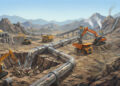
Around eight major entities are involved in mining and quarrying in the South Caucasus. However, apart from Azerbaijan, where state-led enterprises are part of mining and quarrying, in Armenia and Georgia, hardly any of the mining and quarrying company is locally owned. Instead, various arms of locally registered but primarily foreign corporations are active. Russian [3 firms: Zangezur Copper Molybdenum Combine (ZCMC) (Armenia), GeoProMining Gold (Armenia), RMG (Rich Metals Group) (Georgia)], American [2 firms: Lydian Armenia (Armenia), Global Gold Corporation (Armenia)], and British [1 firm: Anglo Asian Mining PLC (Azerbaijan)]Companies operate in the region.

Russian-owned companies are the primary players in the region. However, the ongoing Ukraine-Russia conflict has also impacted the Russian presence in the region. The US American and European Union sanctions on Russian entities have forced Russian owners of mining firms to either change hands to new entities or abandon operations; for instance, VTB Bank had to suspend operations at the Teghut mine in Armenia.

The South Caucasus region, home to two active conflicts, has also been gripped by resource extraction and its mismanagement, further escalating the conflicts. The Nagorno-Karabakh issue gained momentum around a mining-led environmental movement, which later escalated into a full-blown conflict between Armenian and Azerbaijani nationals. The conflicts in the region have enabled foreign corporations to control, extract, process, and export the region’s mineral wealth. For example, out of the four prominent mining companies in Armenia, only Zangezur Copper Molybdenum Combine has a 21.8 per cent holding by the Armenian Government; the rest are either owned by Russian Individuals, British, or American Companies.

A similar profile is also evident in neighbouring Azerbaijan. After gaining full-fledged control of Karabakh, mining and quarrying activity resumed in the western provinces under Azerbaijani control. However, Anglo Asian Mining, a British company is mining in western Azerbaijan, and Chinese firms (Sinosure and Sinosteel) are in the pipeline to expand their mining operations. In Georgia, a similar pattern is visible; only one out of the three prominent mining companies is Georgian-owned.

Furthermore, a dearth of local demand for the extracted ore and minerals often forces its transportation to another place for a better price. The majority of the rare earth and critical minerals extracted in the South Caucasus end up in advanced, technologically capable countries. Herein, only a handful of countries are major export destinations; for example, a significant part of the extracted mineral is exported to China, Russia, Kazakhstan, and Bulgaria. Therefore, the mineral export profile highlights a lack of diversity of markets for the countries in the region. In this backdrop, India may emerge as a significant market for the South Caucasian economies.

India is emerging as a significant player on the global stage, particularly in the renewable and green energy sector, India possesses the technological capabilities and the required capital for investing in mining and quarrying activities in the South Caucasus region. Indian firms, such as National Mineral Development Corporation  (NMDC) Limited, are actively engaged in mining in South America, Australia, and Africa. Davit Antonyan, Senior Associate Fellow, Applied Policy Research Institute of Armenia, points out, “Indian conglomerates such as Reliance and Hindalco could play a pivotal role in this [mining] effort”. As such, apart from the public sector companies, Indian private firms may also be interested in and benefit from mining in the South Caucasus.

India also needs to couple this impetus with further developing its refining and processing capabilities, as well as ensuring robust connectivity with the region, and vertical and horizontal integration across the entire supply chain to fully utilise its capacity from the mine to the energy system. Further, to secure the supply chain for rare and critical earth minerals, India should use its diplomatic leverages in neutral countries like Armenia and Georgia to actively engage in mining sector. India also needs to engage with Azerbaijan diplomatically to open new avenue for economic co-operation which would be mutually beneficial in mining and querying sector.

Previous Post

Book Review : A General’s Odyssey: Giving Up is Not an Option

Mohd Furkan

Mohd Furkan

Mohd Furkan is a doctoral researcher in International Relations and Geopolitics at the MMAJ Academy of International Studies, Jamia Millia Islamia, New Delhi. His PhD work examines the “Geopolitics of Energy: A Case Study of Azerbaijan”, with a broader scholarly interest in energy security, regional geopolitics, and strategic affairs in Eurasia and Central Asia.

Leave a Reply Cancel reply

Your email address will not be published. Required fields are marked *

Support Us Donate Now

Web Updates

🚀 Applications Open | CLAWS Research Internship Programme – Winter Session

Promotion Exam Correspondence Pre Course (PROMEX)

FMMEC 2025 | Essay Competition | Results

Guidelines to Publish with CLAWS

Application Form – Study Mtrl for DSSC 2026

[NEW] Application Form for membership for PROMEX (PART B or D)

  • Trending
  • Comments
  • Latest
Russia-Ukraine War: Lessons from an Electronic Warfare (EW) Perspective

Russia-Ukraine War: Lessons from an Electronic Warfare (EW) Perspective

May 31, 2025
Results | Field Marshal Manekshaw Essay Competition – 2024

Field Marshal Manekshaw Essay Competiton 2025

May 23, 2025
From Sword Clashes to Drone Strikes: A History of Changing Battlefields

From Sword Clashes to Drone Strikes: A History of Changing Battlefields

July 31, 2025
Op Sindoor 2.0: Why & How India Must Prepare for the Next Round?

Op Sindoor 2.0: Why & How India Must Prepare for the Next Round?

May 21, 2025
From Sword Clashes to Drone Strikes: A History of Changing Battlefields

From Sword Clashes to Drone Strikes: A History of Changing Battlefields

15
The Arakan Army and Its Impact on India: Rising Tensions Along the Eastern Frontier 

The Arakan Army and Its Impact on India: Rising Tensions Along the Eastern Frontier 

5

Thwarting  Pakistan’s Nefarious Designs in Bangladesh

4
The Primacy of Mind in Modern Conflict: Defending India Against Disinformation and Cognitive Warfare

The Primacy of Mind in Modern Conflict: Defending India Against Disinformation and Cognitive Warfare

3
India’s Pursuit of Self-Sufficiency in Rare Earth and Critical Minerals: South Caucasus as an Option

India’s Pursuit of Self-Sufficiency in Rare Earth and Critical Minerals: South Caucasus as an Option

January 25, 2026
Book Review : A General’s Odyssey: Giving Up is Not an Option

Book Review : A General’s Odyssey: Giving Up is Not an Option

January 24, 2026
A Disrupted World in 2026 Preparing India for an Uncertain, Ambiguous, and Contested Global Order

A Disrupted World in 2026 Preparing India for an Uncertain, Ambiguous, and Contested Global Order

January 24, 2026
Beyond the Kinetic: Deconstructing Warfare in the Socio-Technical-Cognitive Battlespace

Beyond the Kinetic: Deconstructing Warfare in the Socio-Technical-Cognitive Battlespace

January 24, 2026

Popular Stories

  • Russia-Ukraine War: Lessons from an Electronic Warfare (EW) Perspective

    Russia-Ukraine War: Lessons from an Electronic Warfare (EW) Perspective

    0 shares
    Share 0 Tweet 0
  • Field Marshal Manekshaw Essay Competiton 2025

    0 shares
    Share 0 Tweet 0
  • From Sword Clashes to Drone Strikes: A History of Changing Battlefields

    0 shares
    Share 0 Tweet 0
  • Op Sindoor 2.0: Why & How India Must Prepare for the Next Round?

    0 shares
    Share 0 Tweet 0
  • Scholar Warrior Spring 2025

    0 shares
    Share 0 Tweet 0

About us

CLAWS

The Centre for Land Warfare Studies (CLAWS), New Delhi, India is an independent think tank on strategic studies and land warfare. The mandate of CLAWS covers national security issues, conventional military operations and sub-conventional warfare.

Follow Us

Browse by Category

  • Articles
  • Autumn 2019
  • Autumn 2020
  • Books
  • Chanakya Defence Dialogue
  • CLAWS Focus
  • CLAWS Journal
  • Essay
  • Events
  • External Publications
  • FMMEC
  • Intern Articles
  • Issue Briefs
  • Jottings by Director General Emiritus
  • Manekshaw Papers
  • Newsletter
  • Round Tables
  • Scholar Warrior
  • Seminars
  • Uncategorized
  • Web Updates
  • Winter 2019
  • YouTube Podcast

Recent News

India’s Pursuit of Self-Sufficiency in Rare Earth and Critical Minerals: South Caucasus as an Option

India’s Pursuit of Self-Sufficiency in Rare Earth and Critical Minerals: South Caucasus as an Option

January 25, 2026
Book Review : A General’s Odyssey: Giving Up is Not an Option

Book Review : A General’s Odyssey: Giving Up is Not an Option

January 24, 2026
  • Site Map
  • Tenders
  • Advertise With Us
  • Terms of use
  • Privacy Policy
  • Other Think Tanks

© 2008-2024 Centre for Land Warfare Studies (CLAWS).

No Result
View All Result
  • Home
  • About Us
    • Director General
    • Additional Director General
    • Jottings by Director General Emiritus
    • CLAWS Membership
    • Faculty
  • Publication
    • Web Articles
    • Issue Briefs
    • Manekshaw Papers
    • Newsletter
    • Essay
    • CLAWS Journal
    • Scholar Warrior
    • Books
    • Intern Articles
    • External Publications
  • Research Areas
    • Global & Regional Security
      • China
      • Pakistan
      • Afghanistan
      • South Asia
      • Indo Pacific
      • US, EU & Russia
      • MENA
      • CAR
    • National Security
      • National Security Strategy
      • Nuclear Deterrence
      • Non Traditional Threats
      • Intelligence
      • Terrorism & Internal Security
      • Grey Z & IW
      • Security Laws
    • Military Studies
      • Military Doctrine
      • Military Strategy
      • Peace Keeping Ops
      • Military History
      • Military Logistics
      • Out of Area Contingency Ops
      • Leadership
    • Military Technology & Defence Acquisition
      • Military Technology
      • Defence Acqn
      • Budgets & Finance
      • Defence Infrastructure
      • Human Resources
    • Multi Domain Studies
      • Jointmanship & Integration
      • Space
      • Cyber
      • Spl Operations
      • Energy & Environment
      • Defence Eco System
      • Defence Diplomacy
      • HADR
  • Web Archive
  • Events
    • Seminars
    • Webinars/RTD
  • PROMEX
  • University Cell
    • About The Initiative
    • Admission: Eligibility and Procedure
    • Guides | Supervisors in the PhD Programme:
    • Important Information
    • Administration
  • Careers
  • Contact

© 2008-2024 Centre for Land Warfare Studies (CLAWS).