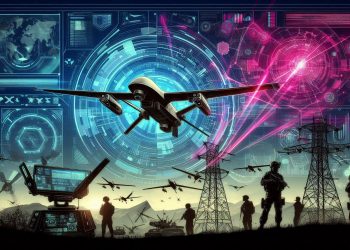

The future of warfare is no longer confined to land, air, and sea. It has expanded into cyberspace, outer space, and the electromagnetic spectrum, giving rise to what is now termed Multi-Domain Warfare (MDW). In today’s rapidly evolving security environment, this form of warfare represents the ability to conduct synchronized operations across multiple domains to achieve a decisive advantage over adversaries. The essence of MDW lies in seamless integration, information dominance, and real-time decision-making across all theaters of operation.
Understanding the Essence of Multi-Domain Warfare
Multi-domain warfare is built on the foundation of interoperability and convergence. It is not simply about having strong capabilities in each domain but rather about connecting them through an integrated command and control system. The ability to fuse intelligence from satellites, drones, radar systems, and cyber networks into a single decision-making ecosystem defines its strength.
The U.S. Department of Defense has been one of the early adopters of this approach, particularly through its Joint All-Domain Command and Control (JADC2) framework, which seeks to integrate the Army, Navy, Air Force, Space Force, and Cyber Command into a unified combat network. Similarly, the United Kingdom’s Strategic Command, France’s SCORPION program, and China’s Strategic Support Force (SSF) have developed doctrines that emphasize real-time coordination across multiple domains.
Why Multi-Domain Warfare Matters Today
In the modern strategic environment, MDW is not an optional capability but a necessity. Conflicts are no longer linear or geographically constrained. The Russia–Ukraine war has demonstrated that information warfare, space assets, cyber disruption, and drone-based precision strikes can collectively redefine battlefield outcomes. The war has shown that even smaller nations can leverage MDW-like tactics through asymmetric tools such as drones, electronic warfare, and AI-driven targeting.
Equally important is the Indo-Pacific region, where the rise of China’s People’s Liberation Army (PLA) has introduced new complexities. Beijing’s strategy of “intelligentized warfare” integrates AI, quantum computing, and space-based surveillance to ensure information superiority. The PLA Strategic Support Force has become a cornerstone of this doctrine, uniting cyber, space, and electronic warfare under a single command to enable cross-domain synergy. This capability is particularly concerning for India and its allies, as it reflects China’s push for dominance in non-kinetic forms of warfare.
Global Overview of Multi-Domain Warfare Capabilities
The global race toward multi-domain dominance is being shaped by technological superiority and digital transformation. Below is an overview of how leading powers are advancing their MDW capabilities:
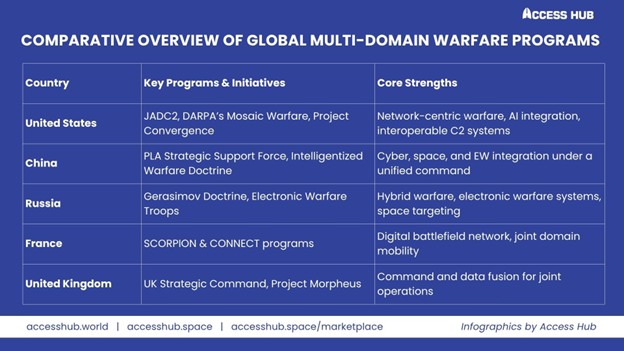
These programs collectively demonstrate how modern militaries are transitioning from traditional force structures to interconnected, data-driven ecosystems.
The Indian Perspective: Current Status and Challenges
India’s geopolitical environment, surrounded by two nuclear-armed adversaries, China and Pakistan, makes the case for multi-domain warfare particularly urgent. The Indian Armed Forces have traditionally operated in silos, with limited interoperability between the Indian Army, Indian Air Force, and Indian Navy. However, efforts are now underway to move toward integration and jointness.
Current Initiatives
- Integrated Theatre Commands (ITCs): India’s government is pushing to establish theatre commands that will bring together the three services under unified operational structures. This reform, once implemented, will be the foundation for MDW readiness.
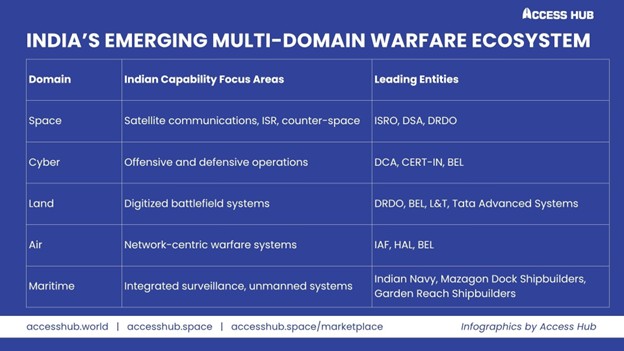
- Defense Space Agency (DSA) and Defense Cyber Agency (DCA): Established in 2019 under the Headquarters Integrated Defense Staff (IDS), these organizations are critical enablers of MDW. The DSA oversees military satellite programs and counter-space strategies, while the DCA focuses on cyber defense and offensive cyber operations.
- Indigenous Defense Ecosystem: Organizations such as the Defense Research and Development Organisation (DRDO) and Bharat Electronics Limited (BEL) are developing indigenous sensors, electronic warfare systems, and command-control solutions to enhance cross-domain capabilities.
- Private Sector Involvement: Indian companies like Tata Advanced Systems, Larsen & Toubro Defense, Hindustan Aeronautics Limited (HAL), and Data Patterns are increasingly contributing to next-generation radar, AI-enabled surveillance, and autonomous systems for the defense ecosystem
Gaps and Constraints
While India has made visible progress, significant challenges remain. The absence of a fully unified command structure limits rapid decision-making. Interoperability across communication networks and data fusion systems remains inadequate. The country also faces issues of technological dependency, particularly in microelectronics, advanced AI, and quantum computing.
India’s defense budget for FY 2025-26, which stands around USD 73 billion, allocates only a limited portion to R&D and emerging technologies. Comparatively, the U.S. defense innovation budget through DARPA and DIU exceeds USD 15 billion, reflecting the disparity in resource allocation. India’s Innovations for Defence Excellence (iDEX) initiative, though promising, is still in its early stages of scaling.
Steps India Needs to Take to Strengthen Multi-Domain Warfare Capabilities
1. Develop a National Multi-Domain Strategy
India needs a cohesive MDW doctrine that aligns its defense modernization, technology innovation, and command structure reforms. This doctrine must prioritize digital integration and interoperability among all services.
2. Accelerate Joint Command Formation
The creation of theatre commands should be fast-tracked. A Joint All-Domain Operations Command (JADOC) could act as the nerve center, linking the Army, Navy, Air Force, Space, and Cyber domains under one umbrella.
3. Invest in Emerging Technologies
India must invest aggressively in:
- AI and Machine Learning for battlefield analytics.
- Quantum Communication for secure networks.
- Electronic Warfare for signal intelligence dominance.
- Autonomous Systems for surveillance and logistics.
4. Strengthen Public-Private Partnerships
India’s defense startups, such as ideaForge, Tonbo Imaging, and Astrome Technologies, are innovating in unmanned systems, AI-based vision technologies, and communication networks. Expanding partnerships through iDEX and Defence India Startup Challenge (DISC) can accelerate MDW readiness.
5. Enhance International Collaboration
India should leverage its strategic partnerships with the U.S., France, Japan, and Israel to co-develop technologies and share operational doctrines. The INDUS-X initiative between India and the U.S. is a step in this direction, focusing on co-development of defense technologies.
6. Build Space and Cyber Resilience
With increasing anti-satellite weaponization and cyber vulnerabilities, India must develop robust backup networks, redundancy in space-based systems, and autonomous satellite clusters for resilience.
The Road Ahead
Multi-domain warfare will define the future of military superiority. India’s adversaries, particularly China, have already established integrated command architectures and technological ecosystems that can disrupt traditional battlefield dynamics. To remain competitive, India must transform its military modernization into a cohesive, technology-driven framework.
The transition from platform-centric warfare to network-centric warfare is underway, but to achieve true MDW readiness, India must embrace a data-centric, interoperable, and agile command model. A focused approach on indigenous innovation, backed by international collaboration, can position India as a leading power in this new era of warfare.
Conclusion
Multi-domain warfare is not just about possessing diverse capabilities; it is about mastering the art of convergence. India’s defense ecosystem has laid the groundwork through agencies like DSA, DCA, and DRDO, but the real challenge lies in operational integration and technological depth. The next decade will determine whether India can transition from a reactive defense posture to a proactive, multi-domain-ready force capable of deterring and defeating adversaries across every domain of conflict.