
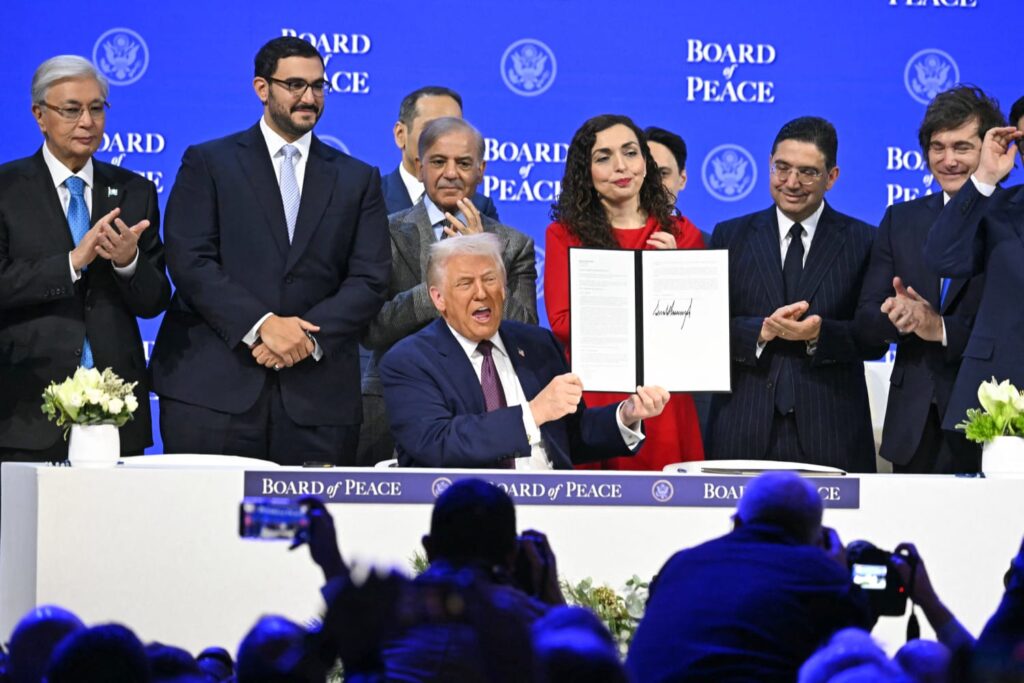
The U.S. Ambassador to India formally extended an invitation to Prime Minister Narendra Modi, on behalf of the U.S. President Donald Trump on January 18, to join the Board of Peace for “building lasting peace” in Gaza.
Despite the initial pause and caution, at least 25 countries, including Pakistan, Türkiye, Saudi Arabia, Israel, UAE, Qatar, and Egypt, have signed on to the board, with reports suggesting a potential signing ceremony on January 22 at the World Economic Forum at Davos.
Unveiled as part of the Gaza peace plan, this board is supposed to play a pivotal role in the implementation of the second phase of Gaza ceasefire, including providing strategic guidance, mobilising resources, and ensuring accountability in the Gaza peace process. While rooted in Trump’s 20 point Gaza Plan, this Board of Peace is not to be confused with the Gaza Executive Board– a separate group under the broader umbrella of the Board of Peace which will focus on the on-ground deliverables in Gaza.
The US invite, while mentioning the Gaza peace plan, does not limit the scope of this board to Gaza or West Asia alone.
“It is my great honour to invite you, as Prime Minister of the Republic of India, to join me in a critically historic and magnificent effort to solidify peace in the Middle East, and at the same time to embark on a bold new approach in resolving global conflict,” the letter said.
Further, a charter accompanying the letter, which the media has since gained access to, has further fuelled suspicion that the BoP could soon expand its scope to other conflicts and emerge as an alternative peacekeeping architecture to the U.N., with Trump at its apex.
As India buys time before responding to Trump’s invite, experts warn that New Delhi’s response must be rooted in a pragmatic consideration of its own multilateral strategy, while keeping in mind the Trumpian nature of the structure and its mandate, and the push for a redesign of global governance.
What is the Board of Peace?
The Board of Peace or the BoP, as approved by the United Nations Security Council Resolution 2803, has been described as a “transitional administration with international legal personality that will set the framework and coordinate funding for the redevelopment of Gaza.” The November resolution places BoP as a central authority but also defines its scope as one limited to Gaza. However, the charter accompanying the invitation sent out by Trump to 60 countries reportedly has no mention of Gaza, fuelling debate on its overarching ambitions to intervene in conflicts globally.
Role of the Chairman
As per The Times of Israel, which accessed and verified the charter document, and the White House statement, the board will function under the chairmanship of President Donald Trump- not the U.S. President but specifically Trump – who will also be the inaugural representative of the U.S. in the board. The charter, which has 35 mentions of the word Chairman, weaves the power of this position in every functional aspect of the board. The document gives the Chairman exclusive authority to “create, modify or dissolve subsidiary entities” as needed pursuant to the Board’s mission and also interpret and apply the charter as seen fit. From the composition of the executive board, deciding which country joins, who stays, when and where the BoP convenes, what it discusses, to approving the decisions of Member States, having the tie breaking vote, serving as the final authority on the interpretation of the charter, picking a successor, and even approving the official seal– the BoP is effectively a Trump show.
The Executive Board
The White House also shared details about the founding Executive Board. On the board are U.S. Secretary of State Marco Rubio, US Special Envoy Steve Witkoff, Trump’s son-in-law and billionaire businessman Jared Kushner, former British Prime Minister Tony Blair, CEO of one of the world’s largest investment firms, Apollo Global Management, Marc Rowan, current President of the World Bank, Ajay Banga, and US Deputy NSA Robert Gabriel. While the statement says it is composed of “leaders with experience across diplomacy, development, infrastructure, and economic strategy”, it presents more as a grouping of Trump’s trusted confidants and loyalists, some of whom happen to have very deep pockets. The composition of the board to include actors beyond state representatives like billionaires also reflects Trump’s p
The Board will be led by a Chief Executive, nominated by the chairman and confirmed by a majority vote of the executive body. For the first three months, the Executive Board will hold meetings every two weeks and subsequently, the meetings will be held on a monthly basis. Decisions will be made by a majority and will go into effect immediately, but can be vetoed by the Chairman at any time.
Membership
The BoP presents as an exclusive, invite only membership club, where States invited by the Chairman can join, once they agree to be bound by the charter. The membership to the BoP is structured almost like a streaming service- a free trial is limited to three years, subject to renewal by the Chairman, but a billion dollar cash buy-in within the first year of the charter’s entry into force can get you a permanent spot on the Board. Much like membership, termination too is decided by the Chairman, subject to a veto by a two-thirds majority of the Member States. Apart from this, termination can also occur upon the expiration of the three-year term and the refusal of renewal by the Chairman, or a withdrawal by the Member State.
Each member state gets one vote and voting meetings will convene at least annually and at additional times and location, as seen fit by the Chairman. Non-voting regular meetings will also be held with the Executive Board
The members will be represented by the Head of State or Government or can elect an alternate high-ranking official to represent them at such meetings, subject to approval by the Chairman. The charter states that while the members will support and assist with the Board of Peace operations, the BoP has no jurisdiction in the members’ internal territory nor does it mandate the Member State to participate in peace-building missions without their consent.
Funding
As per the charter, the funds for this mechanism will come on a voluntary basis from Member States, non-member States, organistions and “other sources.” How the funding is utlitised will be decided by the Executive board.
While the funding aspect is presented as voluntary contributions, the preamble of the charter clearly states that peace is only possible with “sustained, results-oriented partnership, grounded in shared burdens and commitments.”
Function
According to the charter, the Board of Peace is envisioned as an international body tasked with stabilising conflict-affected regions, facilitating transitions to lawful and functional governance, and supporting long-term peace. Its mandate extends beyond conflict resolution to include peace-building activities conducted in line with international law, as well as the formulation and sharing of governance and conflict-management practices that can be adapted by states and communities seeking stability. The charter stipulates that the organisation becomes operational once at least three states formally consent to its terms. States that are unwilling to adopt the charter in full may still engage with the Board as non-voting participants, but only with the approval of the Chairman, and until such time as they formally accept the charter’s provisions.
Fellow Invitees and the Global Response
The US president has invited 60 countries including India, Russia, China, Israel, Australia, France, Britain, Saudi Arabia, Germany, Pakistan, Jordan, Greece, Cyprus, Turkey, Egypt, Paraguay, and Albania to join the board. Initially, countries responded with caution trying to buy time to see who bites. The scepticism is natural. Many may not want a peace architecture built around US dominance and Trump’s unpredictability but can’t afford the risks of an outright refusal.
However, acceptances have begun pouring in with major West Asian countries as well as Pakistan agreeing to be part of the board.
As of Wednesday, January 21, Israel, the UAE, Saudi Arabia, Qatar, Turkiye, Pakistan, Indonesia, Jordan, Egypt, Azerbaijan, Hungary, Kosovo, Morocco, Argentina, Vietnam, Kazakhstan, and Belarus have expressed intentions of joining the BoP.
Media reports suggest that Canada’s prime minister has every “intention” to respond positively to the invite but they will not be paying for a seat on the BoP. In Russia, the Kremlin is reported to be “studying every detail of the offer” but has not hinted on how it is likely to respond. The invite to Russia has also raised considerable doubt for countries like the UK and Ukraine who have expressed concern at the prospect of working alongside Russia.
China, another invitee, while has not made any formal comments, did state that they were conducting a thorough review of the charter but would defend the international system with the UN at its core.
Experts have argued that the invitation is not just an offer to join a new structure but more of a litmus test for loyalty to the US. This has all but been confirmed with Trump’s reaction to French rejection of the offer. France stated they don’t intend to respond positively to the offer, with some officials telling media outlets that the board raises serious questions about respecting the role of the United Nations.
In response, the US president has threatened punitive tariffs on France, saying “I’ll put a 200 per cent tariff on his wines and champagnes. And he’ll join. But he doesn’t have to join.”
This framing of presenting alignment as a choice but attaching costly consequences to refusal is the fundamental threat such a structure poses.
Viability of the Board
Almost exactly one year ago, on January 20, 2025, Trump declared he wants his legacy to be that of a “peacemaker” and a “unifier”. His frustrations with the UN, the traditional peace-making authority, were not hidden from anyone. In his first UNGA address post re-election, he called the UN ineffective when compared to his own peace-making efforts. For Trump, the idea of peace was not rooted in international procedure but in the art of deal making.
Yet, when, as per his own admission, his wide ranging peace-making efforts did not receive the validation he hoped for, his idea of peace changed. Trump made clear that he was no longer inclined to operate within the traditional expectations attached to mediation. In January, the U.S. withdrew from 66 global forums, including UN bodies, further reinforcing the American rejection of such forums.
Finally, in text messages to the Norwegian President, Trump said that since he didn’t get the Nobel Peace Prize “for having stopped 8 Wars,” he “no longer feel(s) an obligation to think purely of Peace, although it will always be predominant, but can now think about what is good and proper for the United States of America.”
The recalibration of Trump’s logic, rooted in a U.S. first, peace second ideology, frames the structure and function of the Board of Peace.
Traditional peacebuilding organisations have relied on procedure, diffusion of power, and accountability. The BoP marks a distinct shift in that structure, operating more like a private enterprise than a multilateral organisation. Not only does the charter position the U.S. at the apex of this peacebuilding experiment, it concentrates all influential authority centrally with the Chairman. Trump’s unpredictability, recent disregard for the international rule of law, as seen in Venezuela, and the globe’s collective inability to restrain his disruptive ways, makes this structure inherently unstable. With the formal incorporation of investors and financiers into the Executive Board and allowing permanent influence to be bought for dollars, the structure privatises world peace, risking conflict resolution being commercialised and the prospect of lasting peace more evasive.
Finally, the BoP by design is vague. It almost deliberately omits describing a scope, which is what is fuelling speculations of its mandate going beyond Gaza into other global conflicts. This allows it to arbitrarily intervene in situations, without appropriate stakeholder representation, raising further questions on its credibility and lends to the instability of a geopolitical order already in flux.
With several countries joining in, and the UN resolution allowing for this board, at least till 2027 within the context of Gaza, the likelihood of its consolidation is high. However, if the broader scope of this experiment fructifies, we could be seeing a US controlled invite-only club of peace where nation states and private players lobby for influence and peace belongs to the highest bidder.
Still the long term viability of such a structure remains questionable, with the biggest question being – what about a post Trump world. Trump’s current term as US president ends in 2029 but that doesn’t mean an end to his chairmanship in this structure. New reporting suggests that Trump could hold the position for life, if he so chooses, making him the central authority even if the 2029 elections don’t go his way. Still, in the eventuality that a democratic government takes office or Trump is out of the picture permanently, what happens to this apparatus that is so centrally constructed around his personality and influence? Does the structure’s influence outlive him or does it end with him. The answer remains unclear, but experts have argued that such a structure could crumble under its own absurdity.
What Are India’s Options
Calling India to join “the most impressive and consequential Board ever assembled,” the U.S. president has handed India a double edged sword wrapped in an invite. India understands that acceptance or rejection carry strategic costs with uncertain consequences and thus the hierarchy seems to be weighing its options carefully before responding.
At face value, India, like other invited countries, has three potential options, should it choose to join. The first option is to accept the charter, pay the billion-dollar cash buy-in and secure a permanent seat on the board. This is the most ambitious option. It would place India at the core of a potentially emerging global governance structure at an early stage, giving us the option to shape the conversation structurally rather than respond to it from the periphery. Further, being involved in what has been deemed as the only viable option to peace in Gaza, alongside our West Asian allies, shows our commitment to peace and could perhaps counterbalance Pakistan’s growing influence in the region. Finally, joining a multinational structure alongside Pakistan, while Indian experts have warned against, could signal that our interests are not influenced by Pakistani presence, reinforcing our strategic autonomy and de-hyphenating India’s global positioning from Pakistan. The symbolic messaging of this move also carries the potential to generate some political goodwill with the American leader, who is big on public display of alignment.
However, this is a rather simplistic and myopic view of the situation. For starters, having skin in the game, in such a significant way, comes with high costs. As a permanent member, India could face pressures to contribute financially, endorse political messaging that goes against its own policy, and even face operational demands like contributing troops to the International Stabilisation Force. This could risk a departure from India’s carefully balanced West Asia policy and historic support for the two-state solution. Further the lack of Palestinian representation in this process has raised the concern that India’s involvement could endorse an outcome that is “externally imposed and weak on legitimacy.” Despite India’s repeated backing of Trump’s Gaza plan, experts have argued that joining the BoP could fundamentally alter our engagement with Palestine.
The assumption of US goodwill and its boost to the stalled Indo-U.S. endeavours would be short term at best. Trump’s volatile behaviour as seen in the aftermath of Op SINDOOR too, comes with no guarantees. Further, the pay off, even after a billion dollar contribution, would be one vote with limited influence on agenda setting. The veto, and final decision making powers would remain concentrated with the Chairman. Ultimately, rubber stamping a structure with a lopsided power dynamic, giving the US and Trump unprecedented powers in shaping global outcomes, would mark a shift in our policy of non-alignment and risks complicating India’s relationship with other partners and reducing our strategic flexibility.
The second option would be to join as a free, time-bound member, while accepting the charter. This presents a watered down version of the risks and opportunities from the first option, while still giving India space in a room where consequential decisions are made and the flexibility to decide how we participate. We still get one vote, but the risk of unpredictable demands, including boots on the ground, stays.
The third option – joining without paying or agreeing to the charter, gives us an ear to the door but not much else. This has the lowest risk, allows India to retain its autonomy but the trade-off is influence.
Regardless of how we choose to participate, one major concern remains. Experts have argued that the broader ambition of the BoP to intervene in conflicts beyond Gaza could drag India into conflicts we have no business being and even invite the BoP to intervene on internal matters like the Kashmir issue- a declared red line for India where we have categorically rejected foreign intervention. India could consider still accepting the charter, but with a caveat that our internal matters are left untouched should the scope of the board expand beyond Gaza.
The fourth option is outright rejection. Given Trump’s response to France, outright rejection may be a costly affair for India, even if conveyed delicately. We are in the process of negotiating an important trade deal with the US and could see spillover from such a move.
Any decision India makes should be calibrated against the realities of the rapidly evolving world order yet rooted in international law and clearly defined mandates. Our response shouldn’t be rushed by the pouring commitments to BoP. Committing to open-ended, ad hoc structures risks drawing India into entanglements it has deliberately and strategically avoided. We also must exercise strategic foresight, seeing how such an institution could pan out in a post Trump world and weight our options accordingly. At the same time, there’s a need for New Delhi to undertake a hard reassessment of its multilateral strategy, and weigh new options without compromising the strategic autonomy that has long underpinned India’s foreign policy.