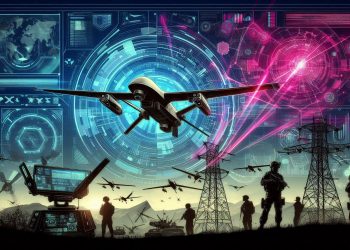

The present USA-Israel- Iran war bought to the front the impact of AI and how everyone become part of the warfare by the extensive use of Internet and social media in the conduct of war. How every one of us have become part of a conflict- Knowingly or Unknowingly is what the current conflicts in the world have taught us. How the weaponisation of everyone by the data which is continuously being handled- 24 by 7 without respite is taking place is what constitutes the foundation of Radical War. The fact that how data is used to seek our attention and once aur attention is gained we are controlled and Data weaponizes us.
The use of Data as a combat element highlights how the war is legitimised, put into action, contested, how it emotionally affects us, historically noted down and how it fades away from our memory is what is being used in the present wars. All these spheres of warfare are being managed through the digitalising of our access to information and shaping our perceptions. The definition of war is becoming vague as far as evident in the different types of war being fought. War being a form of political violence has a bearing on how the awareness about the violence is created, interpreted by the society and etched in our memories/ internalised shaping our future perception. This warfare is known as the Radical War.
Radical War can be defined as the interaction between the connected technology, human participation and the politics of violence. This is achieved by representation and use of sophisticated weapon platforms producing psychological mystification. The algorithms and the coding are influencing a common man without his realising the impact of his indulgence in data of various type. It alters how the meaning on war is generated and it is understood.
The Eco System of war is such that all the users are parts of the war and subject to warfare. Gone are the days when soldiers were the main participants. The blurring of the identity of the combatant and the civilian is what defines this warfare. Mapping the crisis of representationis a dilemma as the war is in a continuous state of flux with the media expanding the same onto online and distant locations. The coordinates of the war are ever expanding. The audience have become the nodes in a network that is constantly creating and consuming data being generated by the media.
The new war ecology and the deep ‘mediatization’ of everyday life and the corresponding interpretative framework that shapes military assessments are creating a boundary less Battlefield which cannot be defined. This is very important to understand as the earlier archival and analogous war history is not the norm but the present battlefield is creating a new history which cannot be defined and hence erased from memories.
Radical War is changing the pattern of interpretation of war which earlier relied on written records, pics, memoirs etc which is now being interpreted by evidence which can be contemporary and near real time. This interpretation is due to the immense amount of data which is shaping up the narrative and blurring up the timing of the evidence which is being generated at a rapid pace by the fact that all the participants being a node have the capability to contribute to the narrative.The memorialisation of the past itself gets crystallised by the present as the memories are uneven, contested, silenced, modulated and effected by personal experience and influenced by the digital present. It becomes a strategy of forgetting and changing narrative which will influence the war.
The memorialisation in the digital present is a unique phenomenon as info is made available leading to increased reflectivity and immediate remembrance. Then of course online moments have historical distance from the event and hence reshape and reframe the commemoration. The digitalisation removes the barrier between the past and the present and moves it to the present. The Schematisation of war gets contaminated by the 21st century images and distort the traditional space of remembrance and memory. The online lens thus breathes fresh air into older modes of remembrances. The ever-expanding digital media ecology thus influences these spaces. Radical War leads to repositioning of the past within the present leading to an impulse to commemorate and leads to politics of polarisation, division and exclusion. The Radical war is used to contort narratives and it is being carried out by the networking platforms where the memory is triumphing over the history by virtue of the changing digital infrastructure.
In order to maintain control over the ecology of war is an important part of the war and the social media companies have no control over the content. The importance of machine learning and AI is evident as it can be used to monitor these undercurrents. The battle is between those who are interested in publishing and those in censoring. The multiplicity of competing visions leads to unquantifiable info loops and the archives get weaponised ready to be used as a lethal weapon by any of the participants who have become the combatants. The remembering and forgetting are an important part of the Radical Warfare which leads to a rapid spread of post truth and post trust agenda. It challenges the way in which the knowledge is constructed. The data itself gets lost and corrupted and there is no confidence in anything held digitally. In the new war ecology false information spreads faster and the agenda transforms so rapidly that the State and other combatants have to react fast to counter the changed narrative.
Radical War is not military centred and hence cannot be compartmentalised. It is not a conventional war but a control of the designs of information infrastructure which disorients the military. It is the merging of the military and public domain. The military need to overcome the hierarchical and unresponsive civil military structure and evolve new paradigms to confront this warfare. This is a major issue in all the armies since the civil-military domains need very mature handling and all the more in times of conflict. Infrastructure gives the option of managing the narrative and gives the capacity to influence the decision making. However, since most of the infrastructure is controlled by Civilian agencies like Google, Microsoft etc and the change in hierarchy of control needs military flexibility and acceptance which is a huge paradigm shift. A sense of challenge needs to be faced as the analogous and sedimented battles have been replaced by the continuously evolving battlefield. Concept of Radical War raises the question as to where does the war ends? The answer is Radical War is always pulsating, live, evolving, being reproduced, recast and reframed with history, memory and contemporary events developing weaponised content. The Radical War is an unending war which creates uninterrupted attack and counterattack with the digital combatants developing the narratives continuously. Since war is affected by these digital interactions the digital archive creation, evolving and erasure/modification becomes a critical strategy in the present warfare. This particular transition in the warfare also has an impact on peace-making as it is not possible to have an unending war in place. It is an indicator of changing strategic and battle scenario and it is important that all the military leaders and planners brace themselves to face this paradigm shift in warfare.