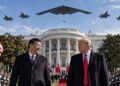

India-US relations have swung in the span of eighteen months, from a warm White House summit to a 50% tariff wall,and now it is trying to find its way back. United States Trade Representative (USTR) Jamieson Greer’s New Delhi visit, from 23rd to 24th June, featured critical meetings with Union Minister of Commerce and Industry Piyush Goyal and other senior Indian officials, with one goal in mind: to finalise the Interim Agreement that will lead to the broader India-US Bilateral Trade Agreement (BTA).
India’s Foreign Secretary Vikram Misri stated just a few days ago, on the sidelines of the G7 summit, that the agreement is in its final stages. Both Prime Minister Narendra Modi and President Donald Trump instructed that the agreement be concluded “at the earliest possible.” The mid-July deadline is now what Greer’s visit must deliver on.
What the Interim Agreement Actually Says
The February Joint Statement is sufficient to indicate the structure of the agreement, despite the final agreement being under consideration. India is committed to eliminating or reducing taxes on all US industrial items and a variety of agricultural products, including dried distillers’ grains, red sorghum, nuts, fruits, soybean oil, and alcoholic beverages. India further consented to mitigate non-tariff barriers concerning US medical gadgets and agricultural products.
In return, the US dropped the extra 25% tariff and reduced the reciprocal tax to 18%. The White House Fact Sheet also stated that the US “intends to take into account, in the BTA negotiations, India’s request that the United States continue to work to reduce tariffs on Indian products”, keeping the possibility of more reductions as BTA talks move ahead.
Moreover, India is committed to buying $500 billion of US goods over five years, including energy (LNG and crude oil), aircraft and aircraft parts, precious metals, technology, data centre equipment and coking coal. The two sides also promised to develop a “clear pathway” to strong digital trade standards under the broader BTA.
The 1% That Is Everything
US Ambassador to India Sergio Gor made headlines last month when he highlighted that the deal is “99% done.” But that 1% remaining is where the tension lies. Agriculture, Genetically Modified crops and dairy market access are some of the areas where India has resisted opening its markets for decades.
The US has aimed for broader agricultural concessions, and the February framework reflects the same, with India agreeing to reduce tariffs on a “wide range” of food and agricultural products. But the specifics, like which crops, which safeguards, and what volumes, are exactly what should be worked around during this visit.
Digital trade is another live pressure point. India’s Digital Personal Data Protection Act of 2023 creates data localisation obligations that US tech giants view as an obstruction. Washington is seeking “free flow of data” commitments in the BTA, whereas New Delhi sees this as impinging on national sovereignty and privacy. The February Joint Statement talks about “addressing discriminatory or burdensome practices” and “setting a clear pathway”, which is deliberately evasive, indicating that this discussion will also be considered in the broader BTA negotiations.
How much each team gains on these final points of pressure will determine whether Greer’s visit turns into a breakthrough or just another round of kicking the can.
Sectoral Stakes: Winners and a Few Nerves
At 18%, India is already better placed than several regional competitors. Vietnam and Bangladesh face 20% tariffs, whileChina sits at 30% to 35%. For Indian exporters in textiles and apparel, gems and jewellery, pharmaceuticals, and engineering goods, which operate on thin margins, this competitive edge matters enormously. The reduction from 50% to 18% has led to a recovery in export volumes.
The technology factor is equally significant. The Initiative on Critical and Emerging Technology (iCET ) framework deepens cooperation in semiconductors, artificial intelligence, quantum computing, and advanced manufacturing. A 2026 joint statement on AI establishes requirements for supply chain resilience and “Make in India” R&D centres. The SHANTI Act of 2025 opens pathways for US private sector investment in India’s Small Modular Reactor (SMR) nuclear energy programme. These are long-term investments that no tariff rate can cover.
A serious concern is concentrated among Indian farmers and MSMEs. Opening agriculture to US imports will risk the livelihoods of millions of smallholders who are the core of India’s political economy. This structural constraint determines India’s negotiating posture.
The Mid-July Deadline
Commerce Minister Goyal’s mid-July target for concluding the first phase of the BTA is now the frame within which Greer’s visit must be assessed. Negotiator-level discussions were held in New Delhi from 2nd June to 4th June. An Indian trade delegation visited Washington in April. Greer’s ministerial-level visit is designed to provide political impetus to bridge the remaining gaps.
If the Interim Agreement is finalised and signed by mid-July, it will give both governments something concrete to act upon. American manufacturers will gain Indian market access, and Indian exporters will have tariff certainty.
If it is not finalised, then worry is not about the collapse but the drift – a return to the uncertainty and trust deficit of 2025. The US has launched Section 301 enquiries into Indian trade practices, adding a parallel pressure route. If this adds on to bad conclusions before the deal is signed, Washington is left with a new set of tariff threats regardless of the Interim Agreement structure.
Conclusion
India-US partnership is viewed as both a genuine strategic convergence between the two largest democracies and the persistent friction of two highly assertive governments prioritising their own national interests. The events of the past year have shown that the frictions cannot override the strategic logic that holds India and the United States together.
What Greer and Goyal negotiate this week will not resolve every tension in the partnership. Agriculture, dairy, data localisation, and tariff levels will remain points of discussion well into the comprehensive BTA talks. However, a successfully concluded Interim Agreement would be more valuable than any specific tariff concession; it might restore a measure of predictability and good faith in the partnership.