Wednesday, September 23, 2026
Advertise with us
Support us
Write for us
No Result
View All Result
claws
  • Home
  • About Us
    • Director General
    • Additional Director General
    • Jottings by Director General Emiritus
    • CLAWS Membership
    • Faculty
  • Publication
    • Web Articles
    • Issue Briefs
    • Manekshaw Papers
    • Newsletter
    • Essay
    • CLAWS Journal
    • Scholar Warrior
    • Books
    • Intern Articles
    • External Publications
  • Research Areas
    • Global & Regional Security
      • China
      • Pakistan
      • Afghanistan
      • South Asia
      • Indo Pacific
      • US, EU & Russia
      • MENA
      • CAR
    • National Security
      • National Security Strategy
      • Nuclear Deterrence
      • Non Traditional Threats
      • Intelligence
      • Terrorism & Internal Security
      • Grey Z & IW
      • Security Laws
    • Military Studies
      • Military Doctrine
      • Military Strategy
      • Peace Keeping Ops
      • Military History
      • Military Logistics
      • Out of Area Contingency Ops
      • Leadership
    • Military Technology & Defence Acquisition
      • Military Technology
      • Defence Acqn
      • Budgets & Finance
      • Defence Infrastructure
      • Human Resources
    • Multi Domain Studies
      • Jointmanship & Integration
      • Space
      • Cyber
      • Spl Operations
      • Energy & Environment
      • Defence Eco System
      • Defence Diplomacy
      • HADR
  • Web Archive
  • Events
    • Seminars
    • Webinars/RTD
  • PROMEX
  • University Cell
    • About The Initiative
    • Admission: Eligibility and Procedure
    • Guides | Supervisors in the PhD Programme:
    • Important Information
    • Administration
    • Application Fee: Batch – 10 Onwards
  • Careers
  • Contact
  • Home
  • About Us
    • Director General
    • Additional Director General
    • Jottings by Director General Emiritus
    • CLAWS Membership
    • Faculty
  • Publication
    • Web Articles
    • Issue Briefs
    • Manekshaw Papers
    • Newsletter
    • Essay
    • CLAWS Journal
    • Scholar Warrior
    • Books
    • Intern Articles
    • External Publications
  • Research Areas
    • Global & Regional Security
      • China
      • Pakistan
      • Afghanistan
      • South Asia
      • Indo Pacific
      • US, EU & Russia
      • MENA
      • CAR
    • National Security
      • National Security Strategy
      • Nuclear Deterrence
      • Non Traditional Threats
      • Intelligence
      • Terrorism & Internal Security
      • Grey Z & IW
      • Security Laws
    • Military Studies
      • Military Doctrine
      • Military Strategy
      • Peace Keeping Ops
      • Military History
      • Military Logistics
      • Out of Area Contingency Ops
      • Leadership
    • Military Technology & Defence Acquisition
      • Military Technology
      • Defence Acqn
      • Budgets & Finance
      • Defence Infrastructure
      • Human Resources
    • Multi Domain Studies
      • Jointmanship & Integration
      • Space
      • Cyber
      • Spl Operations
      • Energy & Environment
      • Defence Eco System
      • Defence Diplomacy
      • HADR
  • Web Archive
  • Events
    • Seminars
    • Webinars/RTD
  • PROMEX
  • University Cell
    • About The Initiative
    • Admission: Eligibility and Procedure
    • Guides | Supervisors in the PhD Programme:
    • Important Information
    • Administration
    • Application Fee: Batch – 10 Onwards
  • Careers
  • Contact
No Result
View All Result
CLAWS
No Result
View All Result
Home Articles

Bombers over the Rose Garden: Xi Jinping in Washington and the Logic of Great-Power Rivalry

Ashu MaanbyAshu Maan
September 23, 2026
in Articles
A A
0
Post Views: 107

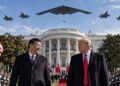
Xi Jinping arrives in Washington today for a three-day state visit. Beijing’s foreign ministry confirmed that this is his first state visit to the American capital since 2015 and his second meeting with Donald Trump this year, as both economies try to steady a relationship strained by trade, technology and security disputes. Commentators will pore over the handshakes, the state dinner and the communiqué. A realist reading asks a simpler question. What does the visit reveal about the distribution of power between the reigning hegemon and its challenger, and about the strategies each employs to shift that distribution in its favour?

The article’s thesis is straightforward. This summit does not mark a turning point towards partnership. It marks a managed pause in a structural security competition. Both capitals want time, not friendship, and the choreography of the visit announces as much.

Children In Beijing, Bombers In Washington

When Trump landed in Beijing in May, some 300 uniformed children waved American and Chinese flags and chanted a welcome in Mandarin, while skyscrapers lit up with greetings. China did deploy the customary honour guard, but the defining images were young faces and cultural warmth: an exercise in soft power.

Washington has chosen a different register. The White House says that tomorrow’s arrival ceremony will feature 479 personnel from every branch of the armed forces and will end with a flyover by a B-2 Spirit and four F-22 Raptors. The B-2 can penetrate air defences with nuclear or conventional payloads and the US flew it against Iran in 2025 and again this year. Trump staged the same spectacle for Vladimir Putin in Alaska last year, when a B-2 and four F-35s flew overhead as the two leaders met on the tarmac.

The contrast is not accidental. Hans Morgenthau called this a “policy of prestige”: states display power in order to impress others with the power they possess. Each host has foregrounded its comparative advantage. A rising power has every incentive to reassure and seduce, projecting benign intent while it accumulates capabilities. This is the old Dengist counsel to hide one’s strength and bide one’s time, updated for the television age. An incumbent hegemon, by contrast, reminds its challenger of the military balance, and of the global reach that no other state can yet match. The bomber that can strike anywhere on earth tells the Chinese delegation that Washington still holds escalation dominance, whatever the trade figures say.

A sceptic will object that Trump simply loves spectacle, and that the flyover signals vanity rather than strategy. That is partly true. But leaders do not select symbols at random, and states read signals whatever the sender intends. Beijing, for its part, hardly depends on soft power alone. Its sharpest instrument is the control of rare earths, which is economic hard power dressed in civilian clothes. The children in Beijing and the bombers in Washington both project power. They simply address different audiences with different currencies.

Artificial Intelligence: A Race That Resists Arms Control

Artificial intelligence sits prominently on the agenda. AI will be a leading topic of discussion between Trump and XI amid warnings of existential danger and mounting calls for regulation. Remarkably, those calls come from the very firms building the technology. Frontier laboratories have demonstrated systems with formidable offensive cyber capabilities, and their leaders have sounded the alarm. Anthropic’s chief executive, Dario Amodei, has published an essay urging a global slowdown in AI development, and senior scientists at OpenAI and Google DeepMind have voiced similar fears.

The Trump administration pulls in two directions. At the United Nations, Trump dismissed AI regulation as a “globalist scheme” and pledged that America would win the race to superintelligence. Yet the same report says Treasury Secretary Scott Bessent will present an agreement for a US–China hotline on AI incidents, modelled on existing military communication channels.

Beijing shares the anxiety, though for its own reasons. In a signed article on 13 September, Minister of State Security Chen Yixin identified six categories of AI risk, ranging from threats to political security and cyberattacks to data theft, technological monopoly and the transformation of warfare. He singled out American frontier models for hacking capabilities that could endanger China’s critical infrastructure. Yet he also called AI “a new track for major power strategic rivalry.” That phrase is the key. Both sides fear the technology, but each fears the other more.

This is the security dilemma in its purest form, and it explains why an AI treaty will prove far harder to achieve than nuclear arms control. Nuclear diplomacy rested on conditions that AI lacks. Warheads and launchers could be counted and verified by satellites and on ground inspectors; AI capabilities reside in code and model weights that no inspector can easily observe. The state held a monopoly over nuclear weapons, whereas private firms drive AI. Mutual assured destruction produced a stable deterrent equilibrium, whereas AI promises compounding, relative gains that could hand the leader a decisive edge. As Joseph Grieco argued, states in an anarchic system worry less about absolute gains than about who gains more, and AI magnifies that worry. Recent disputes, including allegations that Chinese firms mined American models to train their own, only deepen the distrust.

Even the nuclear precedent took a near-catastrophe: Washington and Moscow installed their hotline only after the Cuban missile crisis. Both governments now recognise shared risks around cyber capabilities and loss of control, but disagree sharply over whether AI governance can be insulated from wider rivalry. Realistically, one can expect modest confidence-building measures, such as a hotline or narrow curbs on proliferation to non-state actors, and nothing resembling a binding regime.

The Wider Agenda: Trade, Taiwan And Iran

The economic agenda carries the most immediate deadline. The Busan trade truce expires in November, putting both sides under pressure to extend the pause on tariff escalation and rare-earth controls, and to define a roughly $30 billion basket of “non-sensitive” goods for a new Board of Trade. Washington wants purchases of soybeans, energy and Boeing aircraft; Beijing wants assurance that export controls will not target it indiscriminately.

The liberal proposition that interdependence pacifies finds little support here. Both sides treat interdependence as a weapon. China throttles rare-earth supplies; America restricts chips. Beijing seeks time to consolidate its technological and industrial position, while Washington pursues symbolic wins over structural reform.

Taiwan remains the most dangerous issue. American allies in Asia fear Trump may soften support for the island to secure economic gains, after he described a pending arms package worth up to $14 billion as a “negotiating chip”. A hegemon that trades security commitments for agricultural contracts erodes the credibility on which its alliance system depends. The war involving Iran, and China’s support for Tehran, adds a further layer of friction.

From Non-Alignment To Multi-Alignment

Beneath these specifics lies the structural reality. China is the only state with the population, wealth and technological base to challenge American primacy, and it frames its ambition in the language of a “multipolar world”. That rhetoric needs careful consideration. The system is, in material terms, bipolar. Mearsheimer’s logic predicts that a rising China will seek hegemony in Asia, as the United States once did in the Western Hemisphere, and that Washington will strive to prevent it. Calls for multipolarity serve Beijing as a tool of delegitimation against a unipolar incumbent.

This competition will nevertheless order the rest of the world differently from the Cold War. Then, states sorted themselves into three camps: NATO, the Warsaw Pact and the Non-Aligned Movement. Two ideologically sealed blocs faced each other, with a third group abstaining. Today, abstention gives way to multi-alignment. States selectively cooperate with or against Washington and Beijing, issue by issue, according to national interest. India sits in the Quad with America while engaging in BRICS and the Shanghai Cooperation Organisation. Brazil practises multi-alignment deliberately. The Gulf monarchies buy American arms and sell oil to China. Similarly, Southeast Asian states have expanded ties with several major powers across different domains rather than choosing sides.

Two forces make this possible. Economic interpenetration means that China is the largest trading partner for much of the world, while America remains its principal security guarantor. Washington’s own tariffs on allies, meanwhile, push partners to diversify. Yet realism counsels caution. Multi-alignment is a luxury of relative peace. As Jennifer Lind notes, if the system is truly bipolar, middle powers can diversify their economic ties but cannot defer security choices forever. A crisis over Taiwan would collapse the space for manoeuvre almost overnight.

Conclusion

At their Beijing meeting, the two leaders coined the phrase “constructive strategic stability”. Mikko Huotari of the Mercator Institute described the result more candidly as a strategic stalemate in which neither side needs a breakthrough, only time. That assessment captures the summit’s likely outcome: an extended truce, purchase pledges, perhaps an AI hotline, and no settlement on Taiwan, technology controls or the rules of the AI race.

The bomber over the Rose Garden will say more about this relationship than any joint statement. Great powers can dine together, trade together and even agree to talk on a hotline. What they cannot do, in an anarchic system, is stop measuring each other.
Tags: ChinaUS
Previous Post

China’s AI Plans: Redefining the World Order Through Artificial Intelligence

Ashu Maan

Ashu Maan

Ashu Maan is an Associate Fellow at the Centre for Land Warfare Studies. He was awarded the VCOAS Commendation card on Army Day 2025. He is currently pursuing his PhD from Amity University, Noida in Defence and Strategic Studies. He has previously worked with Institute of Chinese Studies. He has also contributed a chapter on “Denuclearization of North Korea” in the book titled Drifts and Dynamics: Russia’s Ukraine War and Northeast Asia. His research includes India-China territorial dispute, the Great Power Rivalry between the United States and China, and China’s Foreign Policy.

Leave a Reply Cancel reply

Your email address will not be published. Required fields are marked *

Support Us Donate Now

Web Updates

CLAWS MAHE PHD PGME | B – 9 Shortlisted Candidates

Field Marshal Manekshaw Essay Competiton 2026

Promotion Exam Correspondence Pre Course (PROMEX)

Guidelines to Publish with CLAWS

Application Form – Study Mtrl for DSSC 2026

[NEW] Application Form for membership for PROMEX (PART B or D)

  • Trending
  • Comments
  • Latest
Russia-Ukraine War: Lessons from an Electronic Warfare (EW) Perspective

Russia-Ukraine War: Lessons from an Electronic Warfare (EW) Perspective

May 31, 2025
Field Marshal Manekshaw Essay Competiton 2026

Field Marshal Manekshaw Essay Competiton 2026

April 23, 2026
Results | Field Marshal Manekshaw Essay Competition – 2024

Field Marshal Manekshaw Essay Competiton 2025

May 23, 2025
Op Sindoor 2.0: Why & How India Must Prepare for the Next Round?

Op Sindoor 2.0: Why & How India Must Prepare for the Next Round?

May 21, 2025
From Sword Clashes to Drone Strikes: A History of Changing Battlefields

From Sword Clashes to Drone Strikes: A History of Changing Battlefields

15
The Arakan Army and Its Impact on India: Rising Tensions Along the Eastern Frontier 

The Arakan Army and Its Impact on India: Rising Tensions Along the Eastern Frontier 

5

Thwarting  Pakistan’s Nefarious Designs in Bangladesh

5
India’s Pursuit of Self-Sufficiency in Rare Earth and Critical Minerals: South Caucasus as an Option

India’s Pursuit of Self-Sufficiency in Rare Earth and Critical Minerals: South Caucasus as an Option

3
Bombers over the Rose Garden: Xi Jinping in Washington and the Logic of Great-Power Rivalry

Bombers over the Rose Garden: Xi Jinping in Washington and the Logic of Great-Power Rivalry

September 23, 2026
China’s AI Plans: Redefining the World Order Through Artificial Intelligence

China’s AI Plans: Redefining the World Order Through Artificial Intelligence

September 22, 2026
Deepening Russia – China ‘No Limits’ Ties in Light of Western Sanctions on Russia and Its Implications for India

Deepening Russia – China ‘No Limits’ Ties in Light of Western Sanctions on Russia and Its Implications for India

September 21, 2026
From Surveillance to Precision Strikes: India’s path to AI Driven – Indigenous Loitering Munitions and Drone Warfare

From Surveillance to Precision Strikes: India’s path to AI Driven – Indigenous Loitering Munitions and Drone Warfare

September 17, 2026

Popular Stories

  • Russia-Ukraine War: Lessons from an Electronic Warfare (EW) Perspective

    Russia-Ukraine War: Lessons from an Electronic Warfare (EW) Perspective

    0 shares
    Share 0 Tweet 0
  • Field Marshal Manekshaw Essay Competiton 2026

    0 shares
    Share 0 Tweet 0
  • Field Marshal Manekshaw Essay Competiton 2025

    0 shares
    Share 0 Tweet 0
  • Op Sindoor 2.0: Why & How India Must Prepare for the Next Round?

    0 shares
    Share 0 Tweet 0
  • From Sword Clashes to Drone Strikes: A History of Changing Battlefields

    0 shares
    Share 0 Tweet 0

About us

CLAWS

The Centre for Land Warfare Studies (CLAWS), New Delhi, India is an independent think tank on strategic studies and land warfare. The mandate of CLAWS covers national security issues, conventional military operations and sub-conventional warfare.

Browse by Category

  • Articles
  • Autumn 2019
  • Autumn 2020
  • Books
  • Chanakya Defence Dialogue
  • CLAWS Focus
  • CLAWS Journal
  • Essay
  • Events
  • External Publications
  • FMMEC
  • Intern Articles
  • Issue Briefs
  • Jottings by Director General Emiritus
  • Manekshaw Papers
  • Newsletter
  • Round Tables
  • Scholar Warrior
  • Seminars
  • Uncategorized
  • Web Updates
  • Winter 2019
  • YouTube Podcast

Recent News

Bombers over the Rose Garden: Xi Jinping in Washington and the Logic of Great-Power Rivalry

Bombers over the Rose Garden: Xi Jinping in Washington and the Logic of Great-Power Rivalry

September 23, 2026
China’s AI Plans: Redefining the World Order Through Artificial Intelligence

China’s AI Plans: Redefining the World Order Through Artificial Intelligence

September 22, 2026
  • Site Map
  • Tenders
  • Advertise With Us
  • Terms of use
  • Privacy Policy
  • Other Think Tanks

© 2008-2026 Centre for Land Warfare Studies (CLAWS).

No Result
View All Result
  • Home
  • About Us
    • Director General
    • Additional Director General
    • Jottings by Director General Emiritus
    • CLAWS Membership
    • Faculty
  • Publication
    • Web Articles
    • Issue Briefs
    • Manekshaw Papers
    • Newsletter
    • Essay
    • CLAWS Journal
    • Scholar Warrior
    • Books
    • Intern Articles
    • External Publications
  • Research Areas
    • Global & Regional Security
      • China
      • Pakistan
      • Afghanistan
      • South Asia
      • Indo Pacific
      • US, EU & Russia
      • MENA
      • CAR
    • National Security
      • National Security Strategy
      • Nuclear Deterrence
      • Non Traditional Threats
      • Intelligence
      • Terrorism & Internal Security
      • Grey Z & IW
      • Security Laws
    • Military Studies
      • Military Doctrine
      • Military Strategy
      • Peace Keeping Ops
      • Military History
      • Military Logistics
      • Out of Area Contingency Ops
      • Leadership
    • Military Technology & Defence Acquisition
      • Military Technology
      • Defence Acqn
      • Budgets & Finance
      • Defence Infrastructure
      • Human Resources
    • Multi Domain Studies
      • Jointmanship & Integration
      • Space
      • Cyber
      • Spl Operations
      • Energy & Environment
      • Defence Eco System
      • Defence Diplomacy
      • HADR
  • Web Archive
  • Events
    • Seminars
    • Webinars/RTD
  • PROMEX
  • University Cell
    • About The Initiative
    • Admission: Eligibility and Procedure
    • Guides | Supervisors in the PhD Programme:
    • Important Information
    • Administration
    • Application Fee: Batch – 10 Onwards
  • Careers
  • Contact

© 2008-2026 Centre for Land Warfare Studies (CLAWS).