Monday, October 19, 2026
Advertise with us
Support us
Write for us
No Result
View All Result
claws
  • Home
  • About Us
    • Director General
    • Additional Director General
    • Jottings by Director General Emiritus
    • CLAWS Membership
    • Faculty
  • Publication
    • Web Articles
    • Issue Briefs
    • Manekshaw Papers
    • Newsletter
    • Essay
    • CLAWS Journal
    • Scholar Warrior
    • Books
    • Intern Articles
    • External Publications
  • Research Areas
    • Global & Regional Security
      • China
      • Pakistan
      • Afghanistan
      • South Asia
      • Indo Pacific
      • US, EU & Russia
      • MENA
      • CAR
    • National Security
      • National Security Strategy
      • Nuclear Deterrence
      • Non Traditional Threats
      • Intelligence
      • Terrorism & Internal Security
      • Grey Z & IW
      • Security Laws
    • Military Studies
      • Military Doctrine
      • Military Strategy
      • Peace Keeping Ops
      • Military History
      • Military Logistics
      • Out of Area Contingency Ops
      • Leadership
    • Military Technology & Defence Acquisition
      • Military Technology
      • Defence Acqn
      • Budgets & Finance
      • Defence Infrastructure
      • Human Resources
    • Multi Domain Studies
      • Jointmanship & Integration
      • Space
      • Cyber
      • Spl Operations
      • Energy & Environment
      • Defence Eco System
      • Defence Diplomacy
      • HADR
  • Web Archive
  • Events
    • Seminars
    • Webinars/RTD
  • PROMEX
  • University Cell
    • About The Initiative
    • Admission: Eligibility and Procedure
    • Guides | Supervisors in the PhD Programme:
    • Important Information
    • Administration
    • Application Fee: Batch – 10 Onwards
    • FEE STRUCTURE: 2026 BATCH – 9 ONWARDS
  • Careers
  • Contact
No Result
View All Result
CLAWS
No Result
View All Result
Home Articles

Balendra Shah’s UN Speech: Between Climate Change Justice and Himalayan Geopolitics                                                                                             

Dhanapriya Devi ChungkhambyDhanapriya Devi Chungkham
October 19, 2026
in Articles
A A
0
Views: 78

In the last three months, Nepal has witnessed two climate change-induced events. In late August, “a cascade of rocks, mud, and water” destroyed towns, roads, and bridges and killed more than 1,400 people, with 5,200 still missing. In October 2026, the country witnessed another flash flood in Gorkha district. Again, lives and property were damaged.  Dozens of homes, bridges, and hundreds of people were affected. While much less in scale, the constant eruption of flash floods points to a general pattern of climate-induced changes in the region.  Scientists have warned about climate change-linked extreme weather events for decades. In 2021, the Intergovernmental Panel on Climate Change (IPCC) warned that extreme weather events are going to become worse in upcoming decades. These extreme weather events are not just natural disasters but rather a result of hundreds of years of human emissions of greenhouse gases. 

While humans have emitted greenhouse gases in industrial proportions for 150-plus years now, not all states are equally responsible for these historical emissions into our global ecosystem. Global South states, small and poor economies like Nepal, have an extremely small carbon footprint (per capita) in comparison to the Western states. But they have to face the brunt of such extreme weather events. It is this inequality in terms of historical responsibility and outcomes that makes the issue of climate change an international political issue. Nepal PM’s recent UN General Assembly speech highlighted some of these issues that relate to climate justice and lack of global urgency in addressing this issue. His speech also highlighted the need for a regional Himalayan initiative by Nepal, India and China, as the Himalayan-Trans Himalayan region remains one of the most vulnerable ecosystems on the planet, prone to landslides, flash floods and cloudbursts. These ecosystems support almost 2 billion people in South Asia, thereby making the region prone to extreme weather events. The speech perfectly captures the tensions that exist in the global order between geopolitics and issues like justice. Any effective measure that aims to enhance cooperation over climate change issues must tread carefully amid the current regional and geopolitical dynamics.

Climate Justice and Global South

The major theme in Balendra Shah’s UN speech was climate justice. The call for justice reverberated throughout the speech. “Climate change cannot just remain”, according to Shah, “a beautiful phrase in a United Nations document”. Climate action involves not just post-disaster relief operations but also proactive support to the vulnerable small state who played no historical role in this disaster. Global Environment Facility and the Loss and Damage Fund remain woefully “inadequate”, according to Shah. This demand must not be seen as charity but rather as demanding responsibility and reparation from those states who have disproportionately gained from carbon emissions. He further posited that the states of South Asia “did not warm” the globe but are paying the disproportionate price for the same. 

Calls for Multilateralism and Regional Initiatives: Between Geopolitics and Justice

Another major part of the speech was Nepal’s insistence on the role of multilateralism in addressing the climate change issue. The world order is currently mired in American unilateralism. Trump administration has bypassed not only allies but also most of the post-Cold War multilateral institutions. From global trade to the Paris Agreement, every multilateral arrangement is under assault. Trump administration’s abdication of global climate change initiatives goes much beyond non-participation in the Paris Agreement. The administration has withdrawn from global financial commitments towards climate change and also aims to withdraw from the United Nations Framework Convention on Climate Change (UNFCCC).  Domestically, the administration has further dismantled green energy initiatives like EV mandates. 

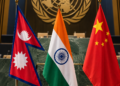
Beyond the global multilateral frameworks under the UN, Nepal also called for the Himalayan Climate Resilience Mechanism (HCRM) that must include Himalayan states like Nepal, India and China. Such initiatives must be there that allow these states to share satellite data and critical real-time information regarding any major climate change event. The climate change impact does not limit itself to the borders of a state. Therefore, “cooperation, rather than a frontier of fragmented information” is a requirement. This call for coordination across the Himalayan international borders is an acceptance of the realities of geopolitics. Nepal is a small power that is wedged between two giants, China and India, who rival each other in the Himalayan region and beyond. The balancing act in this speech is a stark reminder that the issue of climate justice can never be disentangled from geopolitics. 

Way Forward: Prospects and Challenges to Cooperation in Himalayan Region

Climate change impacts most of the Global South states in a disproportionate manner. Especially, small and Island states are most vulnerable to extreme weather events as they have less capacity. Historically, these smaller states have played almost no role in the current climate crisis, but some (like small island states) might even cease to exist. In this situation, the call for climate justice by the PM of Nepal was a much-needed call for urgent action. India and Nepal share longstanding bilateral ties. This includes bilateral cooperation on climate and environmental issues. Joint Committee on Water Resources (JCWR) is one such bilateral arrangement where both states work to mitigate the problem of floods in rivers that are shared by both. The JCWR has provisions for cooperating on flood forecasting, inundation and embankment, and management of the Kosi and Gandak rivers. Beyond that, experts from both countries constantly share data regarding major rivers and their tributaries while also working on joint hydropower projects. But complex structural dynamics between India and China make the HRCM proposal a much more difficult project to realise. And herein lies the perpetual challenge of aligning geopolitical interests with justice in international politics. Any Himalayan-wide initiative will only function when India and China come on board and agree to share satellite data with each other. 
Tags: ClimateEnergy & EnvironmentGeopoliticsUN Speech
Previous Post

India–US Relations — Strategic Partnership or Strategic Friction?

Dhanapriya Devi Chungkham

Dhanapriya Devi Chungkham

Dhanapriya Devi Chungkham is currently serving as a Research Assistant at the Centre for Land Warfare Studies (CLAWS), New Delhi. She completed her PhD from Centre of Indo-Pacific Studies, School of International Studies (JNU). Her research focuses primarily on security and strategic studies of India’s eastern frontier, with particular interest in the Act East Policy, India-Myanmar relations, borderland dynamics, Northeast India and the evolving geopolitical landscape of Southeast Asia and the Indo-Pacific. She specialises in fieldwork-based research and qualitative methodologies.

Leave a Reply Cancel reply

Your email address will not be published. Required fields are marked *

Support Us Donate Now

Web Updates

Field Marshal Manekshaw Essay Competiton 2026

Promotion Exam Correspondence Pre Course (PROMEX)

Guidelines to Publish with CLAWS

Application Form – Study Mtrl for DSSC 2026

[NEW] Application Form for membership for PROMEX (PART B or D)

  • Trending
  • Comments
  • Latest
Russia-Ukraine War: Lessons from an Electronic Warfare (EW) Perspective

Russia-Ukraine War: Lessons from an Electronic Warfare (EW) Perspective

May 31, 2025
Field Marshal Manekshaw Essay Competiton 2026

Field Marshal Manekshaw Essay Competiton 2026

April 23, 2026
Results | Field Marshal Manekshaw Essay Competition – 2024

Field Marshal Manekshaw Essay Competiton 2025

May 23, 2025
The Silent High Ground: India’s Space Warfare Imperative

The Silent High Ground: India’s Space Warfare Imperative

October 1, 2026
The Silent High Ground: India’s Space Warfare Imperative

The Silent High Ground: India’s Space Warfare Imperative

32
From Sword Clashes to Drone Strikes: A History of Changing Battlefields

From Sword Clashes to Drone Strikes: A History of Changing Battlefields

15
The Arakan Army and Its Impact on India: Rising Tensions Along the Eastern Frontier 

The Arakan Army and Its Impact on India: Rising Tensions Along the Eastern Frontier 

5

Thwarting  Pakistan’s Nefarious Designs in Bangladesh

5
Balendra Shah’s UN Speech: Between Climate Change Justice and Himalayan Geopolitics                                                                                             

Balendra Shah’s UN Speech: Between Climate Change Justice and Himalayan Geopolitics                                                                                             

October 19, 2026
India–US Relations — Strategic Partnership or Strategic Friction?

India–US Relations — Strategic Partnership or Strategic Friction?

October 19, 2026
The New Era of Zero-Click Spyware: Exploiting Digital Advertising

The New Era of Zero-Click Spyware: Exploiting Digital Advertising

October 19, 2026
Can AI Help Build Weapons? What the Anthropic Yemen Report Really Shows?

Can AI Help Build Weapons? What the Anthropic Yemen Report Really Shows?

October 19, 2026

Popular Stories

  • Russia-Ukraine War: Lessons from an Electronic Warfare (EW) Perspective

    Russia-Ukraine War: Lessons from an Electronic Warfare (EW) Perspective

    0 shares
    Share 0 Tweet 0
  • Field Marshal Manekshaw Essay Competiton 2026

    0 shares
    Share 0 Tweet 0
  • Field Marshal Manekshaw Essay Competiton 2025

    0 shares
    Share 0 Tweet 0
  • The Silent High Ground: India’s Space Warfare Imperative

    0 shares
    Share 0 Tweet 0
  • Op Sindoor 2.0: Why & How India Must Prepare for the Next Round?

    0 shares
    Share 0 Tweet 0

About us

CLAWS

The Centre for Land Warfare Studies (CLAWS), New Delhi, India is an independent think tank on strategic studies and land warfare. The mandate of CLAWS covers national security issues, conventional military operations and sub-conventional warfare.

Browse by Category

  • Articles
  • Autumn 2019
  • Autumn 2020
  • Books
  • Chanakya Defence Dialogue
  • CLAWS Focus
  • CLAWS Journal
  • Essay
  • Events
  • External Publications
  • FMMEC
  • Intern Articles
  • Issue Briefs
  • Jottings by Director General Emiritus
  • Manekshaw Papers
  • Newsletter
  • Round Tables
  • Scholar Warrior
  • Seminars
  • Uncategorized
  • Web Updates
  • Winter 2019
  • YouTube Podcast

Recent News

Balendra Shah’s UN Speech: Between Climate Change Justice and Himalayan Geopolitics                                                                                             

Balendra Shah’s UN Speech: Between Climate Change Justice and Himalayan Geopolitics                                                                                             

October 19, 2026
India–US Relations — Strategic Partnership or Strategic Friction?

India–US Relations — Strategic Partnership or Strategic Friction?

October 19, 2026
  • Site Map
  • Tenders
  • Advertise With Us
  • Terms of use
  • Privacy Policy
  • Other Think Tanks

© 2008-2026 Centre for Land Warfare Studies (CLAWS).

No Result
View All Result
  • Home
  • About Us
    • Director General
    • Additional Director General
    • Jottings by Director General Emiritus
    • CLAWS Membership
    • Faculty
  • Publication
    • Web Articles
    • Issue Briefs
    • Manekshaw Papers
    • Newsletter
    • Essay
    • CLAWS Journal
    • Scholar Warrior
    • Books
    • Intern Articles
    • External Publications
  • Research Areas
    • Global & Regional Security
      • China
      • Pakistan
      • Afghanistan
      • South Asia
      • Indo Pacific
      • US, EU & Russia
      • MENA
      • CAR
    • National Security
      • National Security Strategy
      • Nuclear Deterrence
      • Non Traditional Threats
      • Intelligence
      • Terrorism & Internal Security
      • Grey Z & IW
      • Security Laws
    • Military Studies
      • Military Doctrine
      • Military Strategy
      • Peace Keeping Ops
      • Military History
      • Military Logistics
      • Out of Area Contingency Ops
      • Leadership
    • Military Technology & Defence Acquisition
      • Military Technology
      • Defence Acqn
      • Budgets & Finance
      • Defence Infrastructure
      • Human Resources
    • Multi Domain Studies
      • Jointmanship & Integration
      • Space
      • Cyber
      • Spl Operations
      • Energy & Environment
      • Defence Eco System
      • Defence Diplomacy
      • HADR
  • Web Archive
  • Events
    • Seminars
    • Webinars/RTD
  • PROMEX
  • University Cell
    • About The Initiative
    • Admission: Eligibility and Procedure
    • Guides | Supervisors in the PhD Programme:
    • Important Information
    • Administration
    • Application Fee: Batch – 10 Onwards
    • FEE STRUCTURE: 2026 BATCH – 9 ONWARDS
  • Careers
  • Contact

© 2008-2026 Centre for Land Warfare Studies (CLAWS).