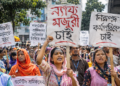

Since October this year, Bangladesh has seen a fresh wave of unrest among garment workers. Workers have been protesting, demanding an increase in minimum monthly wages. As of now, around 150 sites have shut down. The prominent textile hubs in Savar, Ashulia, and Gazipur are the hardest-hit regions. Garments are the most significant industry for Bangladesh’s economy in terms of growth, employment and exports. The industry makes up around 10 per cent of the country’s GDP. According to the Bangladesh Garment Manufacturers and Exporters Association (BGMEA), since 2012-2013, Ready-Made Garments (RMGs) have contributed around 80 per cent to Bangladesh’s overall exports. The garment industry generates around 4 million direct jobs in the country. In short, the garment industry provides an economic lifeline to the country.
The nature and size of the industry create several structural challenges for the country. Firstly, the country’s economy is clearly overdependent on this industry. Bangladesh depends on this industry to earn crucial forex reserves. Secondly, this overdependence makes the country vulnerable to fluctuations in the global market. Especially, any fluctuation in demand from Europe and the US directly impacts the country’s economic stability. Thirdly, this fragility is further compounded by weak domestic regulations that lead to regular disasters and domestic unrest.
Domestic stability in Bangladesh is vital for India’s regional security interests. Since the COVID crisis, the country has been facing severe economic challenges. Previously, the fragility of the economy was one of the primary factors that drove popular protests against Sheikh Hasina in Bangladesh. Such domestic disturbances disrupt and derail India-Bangladesh relations. A large setback to the economy also has the potential to trigger a humanitarian crisis in the country, leading to renewed migration to India. This challenges India’s border communities, their cultural and land rights and border security. In the past, Indian states like Assam, Meghalaya and West Bengal have borne the brunt of the migration inflow from Bangladesh.
This article aims to explore the structural fragility of the Bangladeshi economy in light of ongoing protests. In doing so, the article also explores how this creates a security challenge for India. Finally, the possible long-term policy implications and solutions have also been discussed.
Bangladeshi Economy’s Overdependence on Garment Industry and Western Markets
Bangladesh is overdependent on the garment industry and RMG exports. In this section, we look at the export, forex reserves, major markets and employment data from the last 5 years to understand the dependence and vulnerability of the Bangladeshi economy.
RMG exports were a meagre 3.8 per cent of the total exports from Bangladesh in the fiscal year 1983-1984. Since then, the share of RMG exports has increased steadily. In the last five years, the average share of RMG exports is around 81 per cent (See Table 1). The export data is a testament to the strong growth and competitiveness of the Bangladeshi garment industry. Despite intense competition from other Asian powerhouses like China, Vietnam, and India, Bangladesh was the second-largest textile manufacturing country by export value in 2014.
Table 1: Bangladeshi Garment Exports in the Last Five Years
| Year | Total RMG Export (in million US dollars) | Percentage of Total Export |
| 2021-22 | 42613.15 | 81.82 |
| 2022-23 | 38142.10 | 82.15 |
| 2023-24 | 36151.31 | 81.29 |
| 2024-25 | 39346.97 | 81.49 |
| 2025-26 | 38701.15 | 80.62 |
Source: Bangladesh Garment Manufacturers and Exporters Association (BGMEA)
The industry also directly employs around 4 million people. Such large-scale employment has huge implications for social stability, especially for women who constitute more than 50 per cent of the workforce in the country’s garment industry. This provides a constant source of income to millions of families. Naturally, any disruption will harm the livelihood opportunities of the 10s of millions of Bangladeshi workers and their family members who directly or indirectly depend on this industry.
The economy is not just vulnerable in terms of employment and export overdependence but also in terms of export destination. The European Union (EU), the United States (US) and the United Kingdom were the market for around 80 per cent of Bangladeshi exports in the first quarter of the current fiscal year. Therefore, Bangladeshi garment exports are heavily dependent on Western markets. This geographical limitation has negatively impacted the garment industry in the country in the past during the COVID-19 crisis. The above-described factors make the Bangladeshi economy vulnerable, as any fluctuation in the demand and supply cycles in major Western economies will disrupt the economy. This structural dependence is worsened by the weak regulatory mechanism, history of worker unrest and these protests spilling into widespread anger against the government.
History of Fragility of Garment Industry: Implications for Bangladeshi Economy and Domestic Stability
Worker unrest is not a new phenomenon in the country. Workers in the garment industry have historically received nominal wages and a weak social safety net. The industry, in order to remain competitive, pays meagre wages to the workers. Bangladesh garment industry’s competitive edge depends on its cheap labour workforce. Naturally, this creates friction between the workers and their employers. This clash often spills into the wider domestic politics in the country. Historically, governments have always been mindful of these protests and their potential threats to political stability.
The country has witnessed several widespread unrests and protests over wage and workplace safety-related demands over the last decade. The 2010s witnessed regular protests in industrial zones like Ashulia, Gazipur and Savar demanding better living wages. The industrial disaster at Rana Plaza in 2013 further highlighted the vulnerability of the country’s garment industry. In April 2013, over 1,100 garment workers died when Rana Plaza, which housed several garment production facilities, collapsed. This incident, often called the Rana Plaza disaster, highlighted the weak regulations around worker safety in the garment units where workers work long, gruelling hours. Plenty of such units used to operate either illegally or did not follow the government regulations. 2023 also witnessed widespread countrywide protests when “negotiations over a new minimum wage for garment workers” spilt into the streets. The capital saw clashes between workers and policy/factory owners.
These protests often became widespread anti-government protests, with opposition parties trying to foment anti-India sentiments. In October 2026, amidst the ongoing garment worker protests, the far-right opposition parties like the National Citizen Party (NCP) organised protests in the capital over price rises and the power crisis. In these protests, anti-India slogans like “‘Dilli na Dhaka? Dhaka, Dhaka” (Delhi or Dhaka? Dhaka, Dhaka) were raised. The slogans were raised during the demand for the resignation of Bangladeshi Home and Energy ministers. A similar pattern can be observed around anti-Hasina protests, when Bangladeshi social media, opposition and mass media were filled with conspiracy theories regarding RAW and India’s role in the crackdown against protesters.
Implications for India
One of the talking points, since the removal of Sheikh Hasina, in the Indian media and policy world has been about India potentially benefiting from Bangladesh’s garment industry collapse. This strand of policy literature argues that India can become a bigger garment powerhouse if it can take advantage of the situation in Bangladesh. While, in terms of economic logic, this makes sense, strategically this outlook has some major shortcomings.
India has a long history of being the major destination for Bangladeshi migrants in the last five decades. While exact numbers are contentious, what is well established is that India already hosts a huge number of illegal migrants from Bangladesh. This creates a challenge for border ethnic indigenous and tribal communities in states like Assam, as they face pressure on their resources and traditional land rights. Large-scale migration has changed the demographic balance in some of the border districts in Assam and West Bengal. This destabilises India’s eastern and northeastern states. In the past, Assam has witnessed a prolonged and often violent movement against the migration issue. In West Bengal, this was a major issue during the last elections as both central and state governments clashed over the fencing issue. In short, the issue challenges India’s territorial integrity and sovereignty while harming peace among the borderland communities.
Debates around India potentially gaining from either Bangladesh’s garment industry collapse or slowdown ignore the strategic importance of a stable Bangladesh. Looking at previous patterns, one can discern that any potential collapse of the industry that employs millions of people will have an adverse impact on India’s national security. A stable Bangladesh economy is in India’s direct interests.
Way Forward
In light of the migration challenges from Bangladesh via porous India-Bangladesh borders, what should be India’s strategy? Firstly, one needs to distinguish between the short-term and long-term goals in order to develop a coherent strategy towards Bangladesh. In the short term, border management and border security are important. But that cannot be a long-term strategy. In the long term, India needs to find ways to form stable relations with the country’s leadership and non-governmental actors. This involves developing channels with multiple stakeholders like industries, regardless of the political divide. Dependence on one party or leader is not a prudent strategy. India, instead of looking at the country’s garment industry as a competitor, must acknowledge the fact that the development and economic growth of Bangladesh is vital to India’s eastern and northeastern border security and continental ambitions in Southeast Asia. After recognition, both countries must employ value chain integration for apparel and textile production both at bilateral and regional levels. In this context, India can also employ the BIMSTEC forum to develop a regional-level initiative. A recent RIS policy paper points out that already “44.8 per cent of intra-BIMSTEC exports in the [textile and apparel] sector are associated with regional value chains”. A major component of this regional-level trade is the strong India-Bangladesh textile trade. The trade networks already exist for such a policy. Instead of treating Indian and Bangladeshi garment and textile industries as a zero-sum game competition, the policy should be about creating a win-win scenario where both India and Bangladesh achieve mutually beneficial outcomes. Consistent Bangladeshi growth and stability are good for Indian security interests.