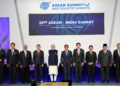

Prime Minister Narendra Modi travelled to Manila on 16 and 17 November 2026 at the invitation of President Ferdinand R. Marcos Jr. to attend the 23rd ASEAN-India Summit and the 21st East Asia Summit (EAS), both hosted by the Philippines as ASEAN Chair for 2026. The visit also produced the seventh Quad Leaders’ Summit, the first at that level in two years. In his departure statement, PM Modi placed ASEAN at the heart of India’s Act East Policy and at the centre of the MAHASAGAR vision. For India-Philippines relations, the visit raises a sharper question. Whether Manila served as a platform for regional diplomacy or did it also serve as a partner?
The Bilateral Meeting
PM Modi met H.E. Ferdinand R. Marcos Jr., the President of the Republic of the Philippines, on the sidelines of the ASEAN Summit. PM Modi acknowledged and appreciated the Philippines for its ASEAN chairship and acknowledged its role as India’s country coordinator in ASEAN since 2024. Both the leaders noted increased momentum under the Strategic Partnership established in August 2025 across defence and security, space, railway infrastructure, fintech, and trade and investment. This bilateral meeting on the sidelines did not lead to any major MOUs or agreements.
The ASEAN-India Summit
In his Opening Remarks during the 23rd India-ASEAN Summit, PM Modi highlighted the significance of the theme “Navigating Our Future, Together” as India and ASEAN hold ‘nearly one-fourth of the world’s population.’ He emphasised India’s commitment to the unity and centrality of ASEAN and underscored the importance of the ASEAN Community Vision 2045 and Viksit Bharat 2047 to meet the shared aspirations of the people of both India and ASEAN. India tabled nine proposals which included a long-term maritime cooperation plan, joint cyber forensics training, technical exchanges on nuclear energy, cooperation in critical minerals, an ASEAN-India Space Hackathon and free e-visas for ASEAN tourists. The leaders adopted the ASEAN-India Joint Statement on Cooperation in Disaster Management which reaffirmed the ASEAN-India Comprehensive Strategic Partnership and stressed that it builds on existing frameworks such as the ASEAN-India Plan of Action (2026–2030), the ASEAN Agreement on Disaster Management and Emergency Response (AADMER), and India’s MAHASAGAR vision. Despite this, the review of the ASEAN-India Trade in Goods Agreement (AITIGA) remains unfinished. The 23rd ASEAN Economic Ministers-India Consultation in September 2026 ‘acknowledged the complexities inherent in the negotiations, reflecting the diverse interests and sensitivities of all Parties’ and urged the officials to intensify negotiations.
The East Asia Summit
At the 21st East Asia Summit, PM Modi called for a ‘Free, Open, Inclusive, and Rules-based Indo-Pacific’. Furthermore, he stressed on the ‘seas as the lifelines of shared prosperity’ and announced a launch of ‘Seafarers’ Safety Initiative to ‘enhance cooperation in joint training and emergency response.’ Additionally, PM Modi proposed the East Asia Summit Cyber Crime Conference at India’s National Forensic Sciences University, East Asia Summit Maritime Heritage Festival at Lothal and East Asia Summit University Heads Conclave at Nalanda. The leaders adopted the EAS Declaration on Navigating Our Future, Together: Stability and Renewal.
The Quad
In addition to the ASEAN-India Summit and the East Asia Summit, Manila also witnessed the Quad’s leaders summit marking the tenth anniversary of the Free and Open Indo-Pacific vision. The leaders reaffirmed Quad as a force for ‘good and a partnership of action, committed to peace, stability, and prosperity’ and opposed ‘destabilizing or unilateral actions that seek to change the status quo, including by force or coercion, which escalate tensions and undermine regional peace and stability.’ The tangible outcomes of this Summit include, Quad Business Leaders’ Forum announced for early 2027, stressed on the importance of AI accelerator, welcomed the Indo-Pacific Maritime Surveillance Collaboration and acknowledged the progress under the Quad Partnership for Cable Connectivity and Resilience and Quad Cybersecurity Cooperation.
Assessment: Platform or Partner?
The primary question being assessed in this article is whether Manila served as a platform for regional diplomacy or did it also serve as a partner? The answer is that as a platform, Manila delivered. Within two days, India was a part of three joint statements and proposed new initiatives as well. In two days, Manila offered India so much regional reach in so short a span.
But as a partner, the record is thinner as the bilateral relationship received one sideline meeting which listed sectors rather than outcomes. The gap is explained by the nature of the Philippines’ value to India. Under these circumstances, Manila matters less as a trading partner and more as a position vis-à-vis ASEAN Chair, country coordinator and frontline state in the South China Sea. The pattern also reflects a familiar asymmetry. India’s normative support, for a rules-based order, for freedom of navigation and now for seafarer safety, arrives quickly and costs little as compared major bilateral announcements especially with respect to defence when it comes to the Philippines. Material commitments, whether in defence, trade or payments, move slowly.
What is notable is that the ASEAN chairship now passes to Singapore, and with-it part of Manila’s positional weight as well. In 2027, India and ASEAN will also mark 35 years of dialogue relations, so, for India-ASEAN partnership to be more efficacious, the SEA nations must mean more than a convenient venue.
Probably, a way to convert momentum into substance could be a follow-on for BrahMos, AITIGA review or investment in the fintech sector for a concrete digital payment linkage. PM Modi’s visit to Manila has been twice, in 2017 and 2026, but both these times it was within a summit frame. Therefore, the next visit could be a bilateral one with more agreements signed and tangible outcomes. It is affirmative that Manila proved an excellent platform in November 2026 but the test for 2027 is whether India treats it as a partner.