
Abstract
Health security is becoming inseparable from national security. Countries that can supply affordable medicines, vaccines and technical support now have an important form of influence that sits alongside economic and military power. India is well placed to use this advantage. Its pharmaceutical manufacturing base, vaccine capacity and experience of serving price-sensitive markets give it the means to support public health beyond its borders.
This article examines how India can turn that capability into a diplomatic capital. It compares India’s partnership-oriented model with China’s infrastructure-led approach, identifies the technological and institutional gaps that still hold India back, and sets out a practical agenda for research, manufacturing, regulation, skills and coordinated health diplomacy. The central argument is simple—when assistance is reliable, affordable, and designed to strengthen local systems, healthcare cooperation can create durable trust.
Power Without Pressure
Soft power is often described as the ability to persuade rather than compel. In practice, it grows when other countries see a nation as useful, credible, and dependable. Culture and political values matter, but so does the ability to solve real problems. Few problems are more immediate than access to medicines, diagnostics and vaccines.
The COVID-19 pandemic made this clear. It exposed fragile supply chains, unequal access to medical products, and the strategic cost of relying on a small number of suppliers. Health capacity moved from the margins of foreign policy to its centre. For India, this change created an opening to use an existing industrial strength in a more deliberate way.
India’s size has sometimes made its smaller neighbours wary of its intentions. Traditional tools of statecraft remain necessary, but they can also reinforce the idea that regional leadership is mainly about pressure and dominance. Healthcare cooperation offers a different language. A shipment of essential medicines, a training program for regulators or a long-term partnership between hospitals can demonstrate value without demanding political submission in return.
Why Biopharmaceuticals Matter
Biopharmaceuticals are medicines ‘made with biological processes and living systems rather than chemical synthesis alone’. The category includes vaccines, biosimilars, monoclonal antibodies and newer cell- and gene-based therapies. Developing and producing them requires more than factories. It depends on research platforms, skilled people, reliable cold chains, quality laboratories, and regulators that can work at international standards.
That combination of science, manufacturing, and public purpose is what makes the sector strategically important. A country that can deliver these products at scale can contribute to health security, support emergency response and build institutional relationships that endure long after a crisis has passed.
Two Models of Medical Diplomacy
China’s overseas health engagement has often been linked to state financing and large, visible projects such as hospitals, diagnostic centres, pharmaceutical parks and equipment facilities. This can produce quick results, but systems built around Chinese technology, personnel and maintenance may also create long-term dependence. Questions about finance, data, servicing, and policy autonomy can follow.
India’s approach is generally less centres on turnkey infrastructure. Its comparative strength lies in affordable medicines, workforce training, regulatory cooperation, and links between institutions. The most useful version of this model works with a partner country’s existing health system and helps local organisations do more for themselves.
Table 1: A Simplified Comparison of the Two Approaches
| Dimension | China-led Model | India-led Opportunity |
| Typical offer | Large infrastructure, equipment and integrated delivery | Medicines, training, regulation and institutional partnerships |
| Primary advantage | Speed, visibility and scale | Affordability, adaptability and local ownership |
| Main concern | Financial, technical or maintenance dependence | Fragmented delivery and uneven follow-through |
| Strategic test | Can projects remain sustainable after handover? | Can India provide predictable, high-quality support at scale? |
Where India Still Falls Short
India’s strength in generics does not automatically translate into leadership in advanced biologics. The country still has limited depth in novel drug discovery, sophisticated biologic platforms, and cell and gene therapies. Dependence on imported equipment, reagents, specialised chemicals and active ingredients also leaves the sector exposed when trade or logistics are disrupted.
Regulation remains another constraint. Multiple authorities, overlapping responsibilities and uneven coordination can slow research, approvals and commercial scale-up. Gaps in advanced manufacturing, testing laboratories and cold-chain infrastructure make it harder to respond quickly during emergencies or meet demanding export standards.
Research funding and the links between universities and industry also need attention. Strong science does not become a product on its own. Researchers, manufacturers, clinicians, regulators, and investors need practical routes for sharing risk and moving promising work from the laboratory into production.
Finally, health diplomacy itself is spread across several ministries and agencies. Without a common plan, medical exports, grants, training and emergency assistance can look like separate activities rather than parts of one long-term strategy.
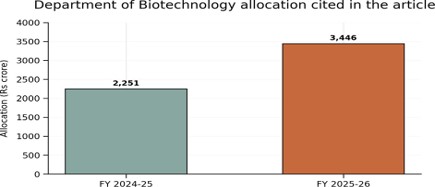
Figure 1: Allocations
Why China Moved Faster
China identified biotechnology as a strategic industry early and supported it through long-term planning, public investment, research parks and large manufacturing clusters. Consistent funding, closer links between universities and firms, and a centralised system for project execution helped it build capability in innovative drugs and advanced platforms.
India followed a different path. Its success came mainly from generics, cost-efficient production, and export-led growth. That model created enormous value, but it did not require the same level of investment in original discovery or high-end biological platforms. The challenge now is not to abandon India’s affordability advantage, but to add deeper innovation to it.
A Practical Agenda for India
- Invest in High-End Research. Build mission-led public-private centres for biologics and advanced therapies. Translational grants shared intellectual-property frameworks and technology partnerships can help research cross the gap between laboratory and market.
- Secure Critical Inputs. Diversify suppliers of reagents, specialty chemicals and equipment; support domestic substitutes where feasible; and use long-term agreements or strategic reserves for inputs that cannot be replaced quickly.
- Scale Manufacturing and Quality Infrastructure. Develop shared facilities, accredited testing laboratories, cold-chain capacity and well-governed clusters that meet international manufacturing standards.
- Make Regulations Faster and More Coherent. Create a coordinated pathway for biologics, strengthen reviewer capacity, and pursue mutual recognition or regulatory cooperation with trusted partners without weakening safety standards.
- Build the Talent Pipeline. Expand fellowships and industry-linked training for bioprocess engineers, clinical researchers and regulators. Curricula should reflect the skills that employers, and public agencies actually need.
- Coordinate Health Diplomacy. A standing inter-agency unit could align exports, grants, technical assistance and emergency support, while setting clear rules for balancing overseas commitments with domestic needs.
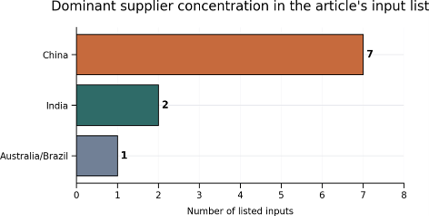
Figure 2: Count Derived From the Ten Strategic Inputs Listed Above
The Supply-Chain Question
The input list in the original draft points to a significant concentration risk. China is identified as the dominant supplier or processor for seven out of the ten listed items, while India leads in mica and barytes. Australia and Brazil are listed for iron ore. This does not by itself measure market share or immediate vulnerability, but it illustrates why a biotechnology strategy cannot be separated from chemicals, minerals, equipment and trade policy.
Table 2: Strategic Inputs Reproduced
| Input | Health or Industrial Use | Supplier Named in Draft |
| Bismuth | GI medicines; intermediates | China |
| Fluorspar | Fluorinated APIs; specialty chemicals | China |
| Lithium | Medicines; fine chemicals | China processing; Australia and Chile mining |
| Rare earths | Imaging; diagnostics; catalysts | China |
| Antimony | Catalysts; intermediates | China |
| Gallium and germanium | Sensors; diagnostic devices | China |
| Processed graphite | Laboratory equipment; electrodes | China |
| Mica | Tablet coatings; packaging | India |
| Barytes | X-ray contrast; chemicals | India |
| Iron ore | Machinery; steel equipment | Australia and Brazil; India is a major producer |
Leadership Through Reliability
Biotechnology will not replace military, economic, or diplomatic power. It can, however, make India’s regional leadership more acceptable and useful. Affordable products matter, but reliability matters just as much. Partners will judge India by whether supplies arrive on time, quality remains consistent, training continues after announcements and cooperation survives changes in political attention.
This is where the idea of Vasudhaiva Kutumbakam can become more than a slogan. If India combines national capability with shared health security, it can align strategic interest with public benefit. The result would not be charity, nor an attempt to create dependence. It would be a network of countries that are better prepared because they have worked with India.
Conclusion
Healthcare has become an important field of international competition and cooperation. India already possesses many of the foundations needed to lead: a large pharmaceutical base, experience with affordable production and credibility across much of the developing world. Its opportunity is to move from being known mainly as a supplier to being valued as a long-term partner in health security.
That transition will require deeper research, stronger regulation, resilient supply chains, advanced manufacturing, and better coordination across government. It will also require discipline. External commitments must remain credible even when domestic pressures rise.
If India can meet that test, biotechnology may become one of its most effective instruments of statecraft. In an age of contested influence, medicines and medical partnerships can create something that coercion rarely lasts in trust.