Wednesday, December 3, 2025
Advertise with us
Support us
Write for us
No Result
View All Result
claws
  • Home
  • About Us
    • Director General
    • Additional Director General
    • Jottings by Director General Emiritus
    • CLAWS Membership
    • Faculty
  • Publication
    • Web Articles
    • Issue Briefs
    • Manekshaw Papers
    • Newsletter
    • CLAWS Journal
    • Scholar Warrior
    • Books
    • Essay
    • Intern Articles
    • External Publications
  • Research Areas
    • Global & Regional Security
      • China
      • Pakistan
      • Afghanistan
      • South Asia
      • Indo Pacific
      • US, EU & Russia
      • MENA
      • CAR
    • National Security
      • National Security Strategy
      • Nuclear Deterrence
      • Non Traditional Threats
      • Intelligence
      • Terrorism & Internal Security
      • Grey Z & IW
      • Security Laws
    • Military Studies
      • Military Doctrine
      • Military Strategy
      • Peace Keeping Ops
      • Military History
      • Military Logistics
      • Out of Area Contingency Ops
      • Leadership
    • Military Technology & Defence Acquisition
      • Military Technology
      • Defence Acqn
      • Budgets & Finance
      • Defence Infrastructure
      • Human Resources
    • Multi Domain Studies
      • Jointmanship & Integration
      • Space
      • Cyber
      • Spl Operations
      • Energy & Environment
      • Defence Eco System
      • Defence Diplomacy
      • HADR
  • Web Archive
  • Events
    • Seminars
    • Webinars/RTD
  • PROMEX
  • University Cell
    • About The Initiative
    • Admission: Eligibility and Procedure
    • Guides | Supervisors in the PhD Programme:
    • Important Information
    • Administration
  • Careers
  • Contact
  • Home
  • About Us
    • Director General
    • Additional Director General
    • Jottings by Director General Emiritus
    • CLAWS Membership
    • Faculty
  • Publication
    • Web Articles
    • Issue Briefs
    • Manekshaw Papers
    • Newsletter
    • CLAWS Journal
    • Scholar Warrior
    • Books
    • Essay
    • Intern Articles
    • External Publications
  • Research Areas
    • Global & Regional Security
      • China
      • Pakistan
      • Afghanistan
      • South Asia
      • Indo Pacific
      • US, EU & Russia
      • MENA
      • CAR
    • National Security
      • National Security Strategy
      • Nuclear Deterrence
      • Non Traditional Threats
      • Intelligence
      • Terrorism & Internal Security
      • Grey Z & IW
      • Security Laws
    • Military Studies
      • Military Doctrine
      • Military Strategy
      • Peace Keeping Ops
      • Military History
      • Military Logistics
      • Out of Area Contingency Ops
      • Leadership
    • Military Technology & Defence Acquisition
      • Military Technology
      • Defence Acqn
      • Budgets & Finance
      • Defence Infrastructure
      • Human Resources
    • Multi Domain Studies
      • Jointmanship & Integration
      • Space
      • Cyber
      • Spl Operations
      • Energy & Environment
      • Defence Eco System
      • Defence Diplomacy
      • HADR
  • Web Archive
  • Events
    • Seminars
    • Webinars/RTD
  • PROMEX
  • University Cell
    • About The Initiative
    • Admission: Eligibility and Procedure
    • Guides | Supervisors in the PhD Programme:
    • Important Information
    • Administration
  • Careers
  • Contact
No Result
View All Result
CLAWS
No Result
View All Result
Home Articles

Left Wing Extremism Annual Report Card 2018-19: Hits and Misses

Tejusvi ShuklabyTejusvi Shukla
November 16, 2019
in Articles
A A
0
Post Views: 201

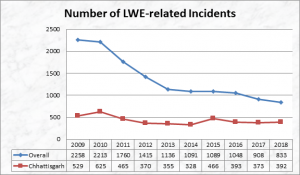
The Ministry of Home Affairs released its Annual Report for 2018-19 last month. The overall decline in the number of incidents of Maoist violence for the ninth consecutive year depicted an improving picture of India’s Internal Security situations. An overall drop of 8.3 per cent was recorded in the incidents of violence since last year with the number of casualties dropping by over 8.7 per cent. The positive developments in various welfare projects, including the Road Requirement Project, installation of Mobile Towers enhancing connectivity, as well as operationalisation of new schools in affected districts, seemed further encouraging. All this considered, a closer reading of the same report also trigger some very pertinent questions that might be of concern for the concerned authorities.
Chhattisgarh: Hotbed eclipsed by national statistics?

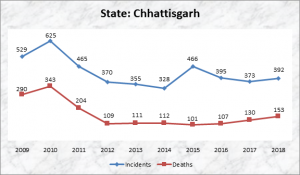
Of all the Maoist affected districts in the country, Chhattisgarh (particularly the Bastar Division) continues to remain the hotbed of Maoist violence. Government presence in the region has improved over the years, but some figures continue to raise concerns. Although an overall dip in the number of incidents has been noticed, both the number of incidents and the casualties have risen in Chhattisgarh since last year. Unlike Chhattisgarh, Jharkhand, which is the second most affected state, recorded roughly half the number of incidents of violence comparatively. Another report published after almost a year’s delay by National Crime Records Bureau points towards a similar story. Its Annual Report of 2017-18 points out that the number of registered cases of Maoists-related violence (652 incidents in 2017-18) still far outnumber the collective number of incidents by other insurgents and terrorists in the country (377 incidents in 2017-18). Of these, 492 cases were reported from Chhattisgarh.

In fact, the decadal trend from the figure shows that the number of incidents has roughly oscillated between the 300-500 brackets in Chhattisgarh, with no steep decline, as opposed to the national trend. This trend could be deciphered in different deductions. One, that Maoist-influence in Chhattisgarh continues to present a challenging threat despite an overall national crackdown. Two, apart from testifying the continued stronghold of the Maoists, in a contrary view, the surging clashes also hint towards the extremists’ desperation for visibility in the event of a national crackdown.
The same report also points out that of all the seized explosives in the same year, only 0.1 per cent could be seized from the Naxals and insurgents combined. Provided that the Naxals use IEDs as their major instrument for carrying out violent attacks, such a limited seizure raises obvious questions. In a conversation with this author on this subject, a scholar mentioned that this is not even the “tip of the iceberg” of explosives that the Maoists own. It must not be forgotten in this context that most of the recent incidents in the past one year primarily involved the use of IEDs.

Slowed Infrastructural Progress: 2017-18 Vs 2018-19
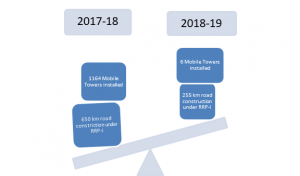
Regarding the Road Requirement Project, while an appreciable construction of 650 km of roads was undertaken in 2017-18, only 255 km of roads got constructed in 2018-19 (dip by 60.8 per cent). This slowed construction of roads with the project currently over 630 km short of achieving its target of 5422 km stands unanswered. Similarly, while over 1164 towers were installed in 2017-18, the reasons for the installation of only 6 the following year are worth examination. Over 2335 Mobile Towers have been operationalised so far as part of Phase I of the Project. The Phase II envisages the installation of 4072 towers.
Welcome Steps: Welfare Schemes and SF’s Capability Enhancement
As welcome steps, the operationisation of new schools in affected areas was a primary development. A total of seven new Kendriya Vidyalas along with six new Jawahar Navaodaya Vidyalayas in worst affected districts, including in Gadchiroli (Maharashtra) and Kondagaon (Chhattisgarh) came up since last year. Capability enhancement of the Security Forces including the Central Armed Police Forces and State Police Forces through better intelligence sharing, fortification of Police Stations, and inter-state coordination continued.
Another very important development involved the diversion of forest land for development of infrastructure under the “14 specified categories” this year. It has been extended up to 40 hectares from 5 hectares, which may impact the local situations in a manner that would require a deeper analysis. The implementation and local acceptance of this development shall be a thing deserving constant observance.
Overall, the LWE-presence has been contracting and developmental infrastructure is gradually being put in place. Intelligence sharing has improved the SF activities on ground, and improving inter-state coordination is benefiting the crackdown. Initiatives regarding encouraging the local languages among SFs by local administration among other progressive steps helped improve communication with the local population. Amidst all of this, the only issue of concern comes from the interiors of Chhattisgarh, which need to be looked at individually with much more urgency. And this must be done before the overall national figures completely eclipse the alarming ones coming from this continued Naxal-epicentre, leading to any undesirable re-emergence.

References:-

1. Union Ministry of Home Affairs, Annual Report 2018-19. Available at: https://mha.gov.in/sites/default/files/AnnualReport_English_01102019.pdf

2. Union Ministry of Home Affairs, Annual Report 2017-18. Available at: https://mha.gov.in/sites/default/files/MINISTRY%20OF%20HOME%20AFFAIR%20AR%202017-18%20FOR%20WEB.pdf

3. National Crime Records Bureau, Crime in India 2017. Available at: http://ncrb.gov.in/StatPublications/CII/CII2017/pdfs/CII2017-Full.pdf

4. Graphs and Charts Prepared by the Author from the data collated from MHA.

Tags: India’s National Security ChallengesInternal SecurityLWE
Previous Post

Arakan Army’s threat to ‘Act East’: India’s Options

Next Post

Grey Zone Conflicts and Informationisation in the Indian Context : Challenges, Capabilities and Way Ahead

Tejusvi Shukla

Tejusvi Shukla

Next Post

Grey Zone Conflicts and Informationisation in the Indian Context : Challenges, Capabilities and Way Ahead

Leave a Reply Cancel reply

Your email address will not be published. Required fields are marked *

Support Us Donate Now

Web Updates

FMMEC 2025 | Essay Competition | Results

IIFOMAS | CLAWS | Essay Competition

CLAWS MAHE PHD PGME CALL FOR ADMISSIONS: PHD BATCH- 8: JAN 2026

Guidelines to Publish with CLAWS

Summer Internship Capsule 2025

Application Form – Study Mtrl for DSSC 2025

  • Trending
  • Comments
  • Latest
Russia-Ukraine War: Lessons from an Electronic Warfare (EW) Perspective

Russia-Ukraine War: Lessons from an Electronic Warfare (EW) Perspective

May 31, 2025
Results | Field Marshal Manekshaw Essay Competition – 2024

Field Marshal Manekshaw Essay Competiton 2025

May 23, 2025

Summer Internship Capsule 2025

April 8, 2025
From Sword Clashes to Drone Strikes: A History of Changing Battlefields

From Sword Clashes to Drone Strikes: A History of Changing Battlefields

July 31, 2025
From Sword Clashes to Drone Strikes: A History of Changing Battlefields

From Sword Clashes to Drone Strikes: A History of Changing Battlefields

15
The Arakan Army and Its Impact on India: Rising Tensions Along the Eastern Frontier 

The Arakan Army and Its Impact on India: Rising Tensions Along the Eastern Frontier 

5
The Primacy of Mind in Modern Conflict: Defending India Against Disinformation and Cognitive Warfare

The Primacy of Mind in Modern Conflict: Defending India Against Disinformation and Cognitive Warfare

3

Front Organisations: The Valley’s Homegrown ‘Resistance’ or Pakistan’s Evolving Terrorism Tactics?

2
Putin’s India Visit-2025: Recalibration of Time-Tested Relationship in Turbulent Geo-Political Landscape

Putin’s India Visit-2025: Recalibration of Time-Tested Relationship in Turbulent Geo-Political Landscape

December 3, 2025
The New Geology of Power: Latin America and the Geopolitics of Critical Minerals

The New Geology of Power: Latin America and the Geopolitics of Critical Minerals

December 2, 2025
Multi-Domain Warfare: How India Fits into the World’s New Power Equation

Multi-Domain Warfare: How India Fits into the World’s New Power Equation

December 2, 2025
Breaking the Kinetic operations: Hybrid Warfare

Breaking the Kinetic operations: Hybrid Warfare

December 1, 2025

Popular Stories

  • Russia-Ukraine War: Lessons from an Electronic Warfare (EW) Perspective

    Russia-Ukraine War: Lessons from an Electronic Warfare (EW) Perspective

    0 shares
    Share 0 Tweet 0
  • Field Marshal Manekshaw Essay Competiton 2025

    0 shares
    Share 0 Tweet 0
  • Summer Internship Capsule 2025

    0 shares
    Share 0 Tweet 0
  • From Sword Clashes to Drone Strikes: A History of Changing Battlefields

    0 shares
    Share 0 Tweet 0
  • Op Sindoor 2.0: Why & How India Must Prepare for the Next Round?

    0 shares
    Share 0 Tweet 0

About us

CLAWS

The Centre for Land Warfare Studies (CLAWS), New Delhi, India is an independent think tank on strategic studies and land warfare. The mandate of CLAWS covers national security issues, conventional military operations and sub-conventional warfare.

Follow Us

Browse by Category

  • Articles
  • Autumn 2019
  • Autumn 2020
  • Books
  • CLAWS Focus
  • CLAWS Journal
  • Essay
  • Events
  • External Publications
  • FMMEC
  • Intern Articles
  • Issue Briefs
  • Jottings by Director General Emiritus
  • Manekshaw Papers
  • Newsletter
  • Round Tables
  • Scholar Warrior
  • Seminars
  • Uncategorized
  • Web Updates
  • Winter 2019
  • YouTube Podcast

Recent News

Putin’s India Visit-2025: Recalibration of Time-Tested Relationship in Turbulent Geo-Political Landscape

Putin’s India Visit-2025: Recalibration of Time-Tested Relationship in Turbulent Geo-Political Landscape

December 3, 2025
The New Geology of Power: Latin America and the Geopolitics of Critical Minerals

The New Geology of Power: Latin America and the Geopolitics of Critical Minerals

December 2, 2025
  • Site Map
  • Tenders
  • Advertise With Us
  • Terms of use
  • Privacy Policy
  • Other Think Tanks

© 2008-2024 Centre for Land Warfare Studies (CLAWS).

No Result
View All Result
  • Home
  • About Us
    • Director General
    • Additional Director General
    • Jottings by Director General Emiritus
    • CLAWS Membership
    • Faculty
  • Publication
    • Web Articles
    • Issue Briefs
    • Manekshaw Papers
    • Newsletter
    • CLAWS Journal
    • Scholar Warrior
    • Books
    • Essay
    • Intern Articles
    • External Publications
  • Research Areas
    • Global & Regional Security
      • China
      • Pakistan
      • Afghanistan
      • South Asia
      • Indo Pacific
      • US, EU & Russia
      • MENA
      • CAR
    • National Security
      • National Security Strategy
      • Nuclear Deterrence
      • Non Traditional Threats
      • Intelligence
      • Terrorism & Internal Security
      • Grey Z & IW
      • Security Laws
    • Military Studies
      • Military Doctrine
      • Military Strategy
      • Peace Keeping Ops
      • Military History
      • Military Logistics
      • Out of Area Contingency Ops
      • Leadership
    • Military Technology & Defence Acquisition
      • Military Technology
      • Defence Acqn
      • Budgets & Finance
      • Defence Infrastructure
      • Human Resources
    • Multi Domain Studies
      • Jointmanship & Integration
      • Space
      • Cyber
      • Spl Operations
      • Energy & Environment
      • Defence Eco System
      • Defence Diplomacy
      • HADR
  • Web Archive
  • Events
    • Seminars
    • Webinars/RTD
  • PROMEX
  • University Cell
    • About The Initiative
    • Admission: Eligibility and Procedure
    • Guides | Supervisors in the PhD Programme:
    • Important Information
    • Administration
  • Careers
  • Contact

© 2008-2024 Centre for Land Warfare Studies (CLAWS).