
As global power fractures and norms erode, the India-EU partnership emerges as a defining convergence- marrying strategic interests with shared values to shape a new architecture of geo-moral power.
Abstract
The formal conclusion of negotiations on the India–European Union (EU) Free Trade Agreement (FTA) after eighteen years marks a defining moment in India’s external economic engagement. Arriving amid trade fragmentation, sanctions-led economics, and weakening multilateral institutions, the agreement goes beyond commerce. It reflects a conscious choice by both partners to reaffirm rules-based economic cooperation at a time of global uncertainty. Although legal scrubbing and ratification remain, with entry into force expected by early 2027, the very closure of negotiations carries strategic significance. This article argues that the agreement signals India’s evolution from a cautious rule-taker to an active shaper of global economic norms. By balancing growth, strategic autonomy, and shared standards without coercion, India alongside Europe emerges as a geo-moral power capable of strengthening a more stable and balanced global order.
Keywords: India–EU FTA; Strategic Convergence; Geo-Moral Power; Global Order; Economic Security; Multi-polarity.
Conceptual Contribution Statement
This article introduces and applies the concept of “geo-moral power” to strategic analysis, using it to explain how India exercises global influence by aligning economic scale, strategic autonomy, and normative restraint shaping international order through institutional design rather than coercion or ideological projection.
Introduction: Strategic Timing of an Economic Decision When European Commission President Ursula von der Leyen said at the World Economic Forum in Davos that India and the European Union were close to finalising a long-delayed free trade agreement, reactions were understandably cautious. Nearly eighteen years of talks, often stuck on market access, regulatory rules, and services liberalisation, had bred scepticism. That is why the formal conclusion of negotiations matters. It is not just another trade deal, but a strategic turning point.
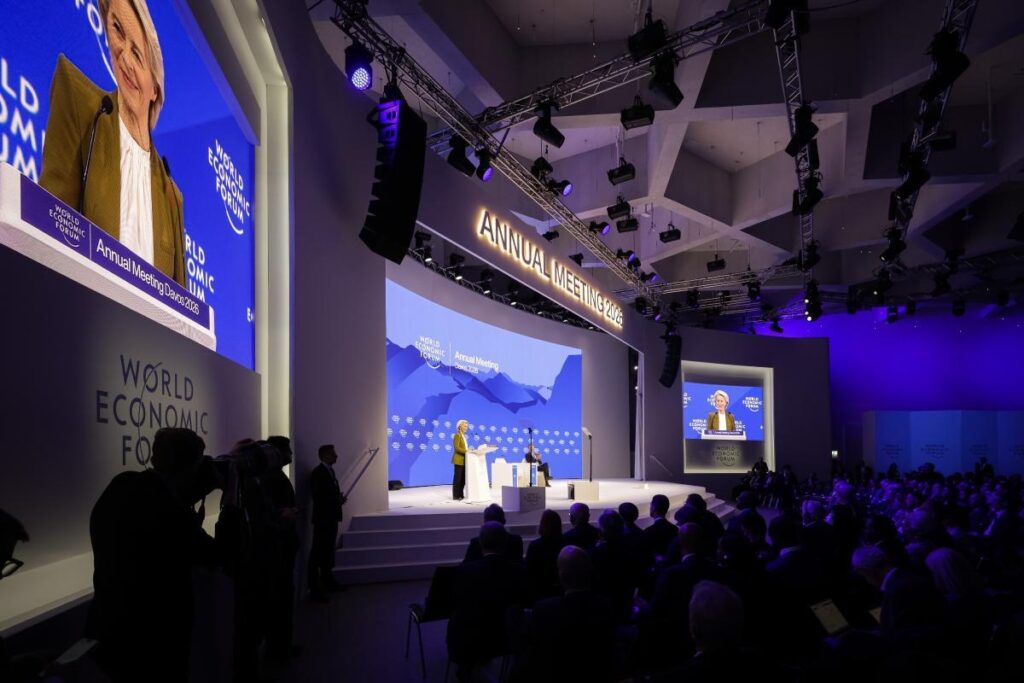
EU President Ursula at the World Economic Forum
The timing could hardly be more significant. The global economy is under pressure from tariff disputes, sanctions, export controls, and the growing use of trade and technology as geopolitical tools. At the same time, the weakening of multilateral dispute settlement has shaken faith in rules-based trade. In this context, India and the EU have opted for structured, long-term cooperation over short-term transactions. For India, the agreement aligns with its growing economic influence and diplomatic self-assurance. For Europe, it signals a push for strategic relevance beyond unilateral regulation. Together, these shifts explain why a deal stalled for decades has now become unavoidable.
The Deal: Anatomy of the India–EU Free Trade Agreement
First launched in 2007, the India–EU free trade talks became one of the world’s longest-running negotiations. Their eventual conclusion is less about last-minute compromise and more about changing global realities that forced both sides to rethink priorities. Together, India and the European Union represent about 1.8 billion people, roughly 22–23 per cent of global GDP, and nearly one-fifth of global merchandise trade.
Trade ties were already substantial. Annual bilateral goods trade stands at around USD 130–135 billion, placing the EU among India’s most important commercial partners. The agreement builds on this base with a wide scope that spans goods, services, investment facilitation, digital trade, regulatory cooperation, and sustainability. Tariff liberalisation has been designed carefully. Instead of sudden market opening, the deal adopts phased and asymmetric reductions to account for pre-FTA differences around 3–5 per cent average tariffs in the EU compared with 10–14 per cent in India.
Services sit at the heart of the agreement, reflecting India’s economic structure, where services contribute nearly 55 per cent of GDP. The EU already takes in about one-quarter of India’s services exports. Investment rules focus on facilitation, transparency, and dispute prevention, reinforcing an already strong relationship: the EU accounts for roughly 17 per cent of cumulative foreign direct investment into India.
Provisions on digital trade, data governance, labour, and sustainability are framed around cooperation and capacity-building rather than penalties. While formal signing and legal scrubbing remain, with entry into force expected by early 2027, the real significance lies in closing a major deal when many global trade negotiations remain frozen.
Strategic Impact: Implications for the Global Order
The significance of the India–EU FTA goes well beyond headline trade numbers. Its real value lies in what it says about how major economies choose to engage at a time when global commerce is increasingly filtered through security and geopolitical concerns.
- The agreement reshapes supply chains. Europe’s push to “de-risk” rather than decouple, and India’s rise as a manufacturing and services hub, are now tied together through an institutional framework that encourages diversification and stability
- The deal helps set rules in newer areas such as digital trade, sustainability, and regulatory transparency. As multilateral bodies struggle to keep pace, large bilateral agreements like this one increasingly define norms by default.
- The FTA subtly shifts dynamics in a multipolar world. It is not aimed at containing any third country. Instead, it offers a model of economic alignment built on rules and cooperation rather than pressure, strengthening strategic autonomy on both sides.
Taken together, the agreement adds predictability and resilience to an unsettled global system, while avoiding zero-sum outcomes.
India–EU FTA: Key Facts & Strategic Metrics
Economic Scale
- Combined population: ~1.8 billion
- Combined GDP (nominal): ~USD 20 trillion
- Share of global GDP: ~22–23%
- Share of global merchandise trade: ~17–18%
Trade Volumes
- India–EU bilateral trade in goods (2024–25): ~USD 130–135 billion
- EU share of India’s total trade: ~11%
- India’s rank as EU trading partner: Top 10
Tariffs and Market Access
- Average EU tariffs on industrial goods: 3–5%
- Average Indian tariffs on industrial goods (pre-FTA): ~10–14%
- Tariff liberalisation: Phased, asymmetric, with sensitive sector exclusions
Services and Mobility
- Services share in India’s GDP: ~55%
- EU share in India’s services exports: ~25%
- Priority sectors: IT & digital services, professional services, financial services, engineering, R&D
Investment
- EU share of cumulative FDI into India: ~17%
- EU among India’s top 3 sources of FDI
- Focus of FTA: investment facilitation, transparency, dispute prevention (not expansive arbitration)
Strategic Domains Covered
- Goods and services trade
- Investment facilitation
- Digital trade and data cooperation
- Sustainable development and climate standards
- Regulatory cooperation and standards alignment
- Supply-chain resilience and diversification
Institutional Architecture
- Joint Trade Committee
- Thematic working groups
- Structured review and dispute-resolution mechanisms
- Built-in upgrade and adaptation clauses
Geo-Morality: The Ethical Fourth Dimension of Geopolitics
The concept of Geo-Morality represents an evolving framework in geopolitical thought that integrates ethical responsibility into the traditional spatial logic of power and strategy. Conventional geopolitics has historically emphasized geography, resources, territorial advantage, and the strategic behaviour of states within physical space. While such analysis explains patterns of power projection and competition, it often remains limited to interest-driven calculations that overlook the moral consequences of geopolitical action. The Geo-Moral perspective seeks to fill this intellectual gap by introducing an ethical dimension into the understanding of geopolitical conduct. It argues that the legitimacy, sustainability, and long-term effectiveness of geopolitical strategies depend not only on territorial advantage or military capability but also on their alignment with broader moral principles such as responsibility, justice, and respect for human dignity. In this framework, geography remains the stage on which power operates, but morality becomes the compass guiding how that power is exercised. The idea therefore conceptualizes morality as a “fourth dimension” of geopolitics an axis that complements physical geography, political authority, and economic capability, thereby enabling a more holistic interpretation of international behaviour. This perspective suggests that geopolitical credibility increasingly derives from the ethical legitimacy of actions taken within geographic space.
As elaborated in the essay Geo-Moral: The Fourth Dimension, the framework proposes that moral considerations should inform strategic thinking in an interconnected world where actions have far-reaching societal consequences. Similarly, the study World at the Edge: The Geo-Moral Cost of Extremes further develops the theoretical foundations of this concept by examining how ethical accountability can reshape geopolitical discourse and practice. Together, these interpretations position Geo-Morality as a conceptual bridge between power and principle, offering a normative lens through which geopolitical behaviour can be assessed and guided toward a more responsible and sustainable global order.
India: The Emerging Geo-Moral Power
The conclusion of the India–EU FTA highlights a quiet but important shift in how India positions itself in the world. Once a cautious and often defensive participant in globalisation, India is increasingly acting as a geo-moral power one that seeks to shape international norms through persuasion, institutional design, and long-term responsibility rather than pressure or coercion. Geo-moral power, in this sense, lies in aligning national interest with the stability and fairness of the wider system.
India’s negotiating posture reflects this evolution. Its emphasis on phased liberalisation, cooperative sustainability commitments, and on-going regulatory dialogue signals a preference for consent-based norm adoption rather than externally imposed standards. These choices are not tactical concessions, but expressions of how India sees its role in global governance.
As a leading economy of the Global South with political credibility across regions, India occupies a rare bridging position between advanced and developing economies. The FTA shows that India can engage deeply with advanced economies while preserving strategic autonomy. This reinforces its legitimacy as a rule-shaper in the evolving global order with confidence intact.
Policy Recommendations
- For India, the real test is institutional readiness. Turning commitments into outcomes will depend on tight coordination between central ministries and state governments, targeted handholding for SMEs, and steady investment in skills, digital public infrastructure, and regulatory capacity. Without this backbone, even well-designed agreements risk underperforming.
- For the European Union, implementation should emphasise capacity-building rather than heavy-handed compliance, especially around sustainability provisions. A cooperative, phased approach rather than rapid enforcement will be key to maintaining credibility and trust with partners over time.
- For the Global South, the agreement offers more than market access. It provides a practical template for engaging advanced economies while preserving policy space, widening strategic options beyond rigid geopolitical alignments (as highlighted by UNCTAD’s trade and development analysis. This flexibility could prove crucial in an increasingly fragmented global economy.
Conclusion: The Quiet Architecture of a New Global Order
The conclusion of the India–EU Free Trade Agreement is more than a commercial success; it is a strategic signal. At a moment when economic ties are increasingly treated as vulnerabilities, India and Europe have chosen cooperation and institution-building over fragmentation and fear. For India, the agreement represents a clear shift from rule-taker to rule-shaper, anchoring its rise as a geo-moral power. For the global system, it reaffirms the value of negotiated, rules-based order. The so-called “mother of all deals” is thus less about tariffs than direction, showing that enduring influence comes from embedding power within credible institutions, not wielding it aggressively alone globally today.