Wednesday, August 12, 2026
Advertise with us
Support us
Write for us
No Result
View All Result
claws
  • Home
  • About Us
    • Director General
    • Additional Director General
    • Jottings by Director General Emiritus
    • CLAWS Membership
    • Faculty
  • Publication
    • Web Articles
    • Issue Briefs
    • Manekshaw Papers
    • Newsletter
    • Essay
    • CLAWS Journal
    • Scholar Warrior
    • Books
    • Intern Articles
    • External Publications
  • Research Areas
    • Global & Regional Security
      • China
      • Pakistan
      • Afghanistan
      • South Asia
      • Indo Pacific
      • US, EU & Russia
      • MENA
      • CAR
    • National Security
      • National Security Strategy
      • Nuclear Deterrence
      • Non Traditional Threats
      • Intelligence
      • Terrorism & Internal Security
      • Grey Z & IW
      • Security Laws
    • Military Studies
      • Military Doctrine
      • Military Strategy
      • Peace Keeping Ops
      • Military History
      • Military Logistics
      • Out of Area Contingency Ops
      • Leadership
    • Military Technology & Defence Acquisition
      • Military Technology
      • Defence Acqn
      • Budgets & Finance
      • Defence Infrastructure
      • Human Resources
    • Multi Domain Studies
      • Jointmanship & Integration
      • Space
      • Cyber
      • Spl Operations
      • Energy & Environment
      • Defence Eco System
      • Defence Diplomacy
      • HADR
  • Web Archive
  • Events
    • Seminars
    • Webinars/RTD
  • PROMEX
  • University Cell
    • About The Initiative
    • Admission: Eligibility and Procedure
    • Guides | Supervisors in the PhD Programme:
    • Important Information
    • Administration
    • Application Fee: Batch – 10 Onwards
  • Careers
  • Contact
  • Home
  • About Us
    • Director General
    • Additional Director General
    • Jottings by Director General Emiritus
    • CLAWS Membership
    • Faculty
  • Publication
    • Web Articles
    • Issue Briefs
    • Manekshaw Papers
    • Newsletter
    • Essay
    • CLAWS Journal
    • Scholar Warrior
    • Books
    • Intern Articles
    • External Publications
  • Research Areas
    • Global & Regional Security
      • China
      • Pakistan
      • Afghanistan
      • South Asia
      • Indo Pacific
      • US, EU & Russia
      • MENA
      • CAR
    • National Security
      • National Security Strategy
      • Nuclear Deterrence
      • Non Traditional Threats
      • Intelligence
      • Terrorism & Internal Security
      • Grey Z & IW
      • Security Laws
    • Military Studies
      • Military Doctrine
      • Military Strategy
      • Peace Keeping Ops
      • Military History
      • Military Logistics
      • Out of Area Contingency Ops
      • Leadership
    • Military Technology & Defence Acquisition
      • Military Technology
      • Defence Acqn
      • Budgets & Finance
      • Defence Infrastructure
      • Human Resources
    • Multi Domain Studies
      • Jointmanship & Integration
      • Space
      • Cyber
      • Spl Operations
      • Energy & Environment
      • Defence Eco System
      • Defence Diplomacy
      • HADR
  • Web Archive
  • Events
    • Seminars
    • Webinars/RTD
  • PROMEX
  • University Cell
    • About The Initiative
    • Admission: Eligibility and Procedure
    • Guides | Supervisors in the PhD Programme:
    • Important Information
    • Administration
    • Application Fee: Batch – 10 Onwards
  • Careers
  • Contact
No Result
View All Result
CLAWS
No Result
View All Result
Home Articles

The Makkah Pact: Style over Substance

Suyash DwivedibySuyash Dwivedi
August 12, 2026
in Articles
A A
0
Post Views: 57
Introduction

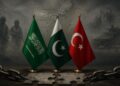
Amid the breakdown of the ceasefire between the USA and Iran and a new agreement between Iran and Oman for the management of the Strait of Hormuz, Saudi Arabia, Türkiye, and Pakistan signed a defence pact called the Makkah Joint Defence Agreement on August 7, 2026. Although the terms of the pact have not been made public, a widely publicised condition is that an attack on either nation will be considered an attack on all three countries. However, the three signatories have been cautious of alarming regional powers like Iran, arguing that the pact is purely defensive rather than a military coalition. Nevertheless, the pact, at least in theory, augments the military power of three countries spread across Eurasia, West Asia, and South Asia and is set to have implications for the geopolitical dynamics in the entire region.

Is it an Islamic NATO?

Many observers and officials, including Pakistan’s Defence Minister Khwaja Asif, have described the Makkah Pact as “Islamic NATO”, quite possibly on the lines of the much advertised Pakistan’s “Islamic” nuclear bomb. However, this agreement should be read beyond the tag of Islamic NATO. The agreement finds its origin in the security dilemma that the Gulf states, like Saudi Arabia, have found themselves in for the last three years. This dilemma solidified in 2025 when Qatar was struck first by Iranian missiles in June and then by Israeli missiles in September. The attacks on Qatar exposed vulnerabilities in the US-provided security umbrella and immediately prompted Saudi Arabia to sign a mutual defence pact with Pakistan. Moreover, during the recent conflict, Iran has bombarded the Gulf states like the UAE, Bahrain, Qatar, Kuwait, and Jordan, exposing limitations of the US air defence in the region. 

Recently, Kuwait, too, has signed a defence agreement with Pakistan and may join the Makkah agreement in the future. Although Qatar has been under an increased US security umbrella, having been struck by Israel in 2025 and being under heavy Iranian fire during the recent conflict, Qatar is another Gulf state that may possibly join the agreement. 

The only country that has been publicly involved in the negotiations and has been invited to join the agreement is Egypt. Egypt’s close ties to Türkiye, Saudi Arabia, and Pakistan further strengthen its candidature. However, Egypt will be wary of upsetting its ties with the USA and peace agreements with Israel. In Syria, the current government is closely allied with Türkiye and faces threats from Israel, Iranian proxies like Hezbollah, and domestic armed militias. Joining the Makkah Pact will certainly improve its defence capabilities. However, the group forming a defence front in the face of a direct Israeli airstrike on Syria appears unprecedented as of now. 

As understated by Iran as a shift in the regional security order, Iran will most definitely not join the grouping in the near future, considering that it is the most imminent threat that the Gulf states are facing currently. Two important Gulf countries, Bahrain and the UAE, are unlikely to sign the pact since they are signatories to the Abraham Accords. Moreover, Iraq and Lebanon, with a huge presence of Iranian proxy groups, are the least likely to sign the agreement without causing a major domestic conflict. Towards the eastern border of Makkah Agreement, Afghanistan is again unlikely to join the pact, considering its ongoing recent border skirmishes with Pakistan. Therefore, the pact currently lacks the required membership or the military capability to be qualified as a grouping similar to NATO. Besides, unlike NATO, the agreement also lacks a common threat to defend against. Going by the precedent of the Central Treaty Organization (CENTO), which was formed with Iran, Pakistan, Turkiye, and the United Kingdom as its members against the common threat of the Soviet Union and was dissolved in 1979 due to a lack of a common interest, such groupings tend to unravel as soon as members’ priorities diverge.

Who is the biggest beneficiary?

The three signatories of the defence pact have quite different military requirements. Currently, Türkiye does not face any significant military threat on its borders. Türkiye is a NATO ally, which implies that no regional power, including Israel and Iran, can carry out an offensive against it without provoking a collective defense under NATO’s Article 5. Internally, Türkiye faces a Kurdish insurgency, supported from across the border with Iraq and Syria. Kurdish militias have been, to an extent, marginalised in Syria and presently only remain in Iraq. The Kurdish threat to Türkiye is not significant enough to require a defence agreement with any country. One practical benefit that Türkiye could possibly derive from this agreement is to intensify defence exports in West Asia as well as North Africa. Another potential advantage for Türkiye is the performance data of its exported drones gained by live combat testing throughout various conflict zones.

Pakistan, on the other hand, faces armed threats on multiple fronts. Pakistan’s policy of employing non-state actors has prompted retaliatory responses from its neighbours like India and Iran. In the last year, it has had several border skirmishes with its western neighbour, Afghanistan. However, Pakistan’s actual threat originates from the presence of various armed insurgents and rebellions across its territory, something that the Makkah Agreement does not clearly address. This is proven by the fact that the Houthis have consistently targeted Saudi infrastructure without provoking any military response from the Makkah Pact signatories. Besides, the possibility of either Türkiye or Saudi Arabia deploying troops to fight Pakistan’s internal or external conflicts lacks historical precedent. Nevertheless, in the future, if Pakistan can maintain a military presence in various Gulf countries through this agreement, it may utilize this arrangement to elevate its diplomatic position in the region.

As of yet, Saudi Arabia appears to be the biggest beneficiary of the defence pact. Although Saudi Arabia maintains one of the strongest armies among the Gulf countries, it lacks the capability to adequately defend its infrastructure from the barrage of missiles, rockets, and one-way drones that is typical of Iran and its proxies. Additionally, in a scenario where Iran is able to acquire a nuclear weapon, Pakistan’s nuclear capability may be extended to Saudi Arabia to create a deterrent. Although it may be hasty to speculate on such a situation, the possibility of the extension of Pakistan’s nuclear umbrella to Saudi Arabia would surely comfort the Saudi regime.

Conclusion

Without some of the major countries in the region, the agreement should not be read as anything more than it currently is – a trilateral defence mechanism. Neither does it have the geographical continuity of NATO, nor does it bring the NATO-like military capability to the table. Moreover, the signatories, except Saudi Arabia, do not face any such threats that can be thwarted by the collective defense. The only threat common to all three is from insurgent groups and non-state actors such as the Houthis and the Baloch Liberation Army (BLA). Since the pact is in the nascent stages, it would be too early to predict whether it will evolve into a military coalition to include counter-insurgency and counter-terrorism (CICT) cooperation. At the present stage, although the defence agreement has teeth to implement a defence mandate, a clear mandate itself is absent. With no clarity over a common threat, the grouping may as well become redundant over time.
Tags: CICTGeopoliticsIranMakkah AgreementMENAPakistanRegional SecurityTurkiyeWest Asia
Previous Post

Beyond the Test-Fire: What Agni-4 means for India’s Strategic Deterrence

Suyash Dwivedi

Suyash Dwivedi

Suyash Dwivedi is a Research Assistant at the Centre for Land Warfare Studies (CLAWS), focusing on strategic and security issues concerning West Asia and Contact Warfare. He pursued a Master's in International Studies from Christ University and has gained nearly two years of experience as a policy consultant. His areas of interest lie in the political landscape and the geopolitics of West Asia. He can be reached at [email protected]

Leave a Reply Cancel reply

Your email address will not be published. Required fields are marked *

Support Us Donate Now

Web Updates

CLAWS MAHE PHD PGME | B – 9 Shortlisted Candidates

Field Marshal Manekshaw Essay Competiton 2026

Promotion Exam Correspondence Pre Course (PROMEX)

Guidelines to Publish with CLAWS

Application Form – Study Mtrl for DSSC 2026

[NEW] Application Form for membership for PROMEX (PART B or D)

  • Trending
  • Comments
  • Latest
Russia-Ukraine War: Lessons from an Electronic Warfare (EW) Perspective

Russia-Ukraine War: Lessons from an Electronic Warfare (EW) Perspective

May 31, 2025
Results | Field Marshal Manekshaw Essay Competition – 2024

Field Marshal Manekshaw Essay Competiton 2025

May 23, 2025
Field Marshal Manekshaw Essay Competiton 2026

Field Marshal Manekshaw Essay Competiton 2026

April 23, 2026
Op Sindoor 2.0: Why & How India Must Prepare for the Next Round?

Op Sindoor 2.0: Why & How India Must Prepare for the Next Round?

May 21, 2025
From Sword Clashes to Drone Strikes: A History of Changing Battlefields

From Sword Clashes to Drone Strikes: A History of Changing Battlefields

15
The Arakan Army and Its Impact on India: Rising Tensions Along the Eastern Frontier 

The Arakan Army and Its Impact on India: Rising Tensions Along the Eastern Frontier 

5

Thwarting  Pakistan’s Nefarious Designs in Bangladesh

5
India’s Pursuit of Self-Sufficiency in Rare Earth and Critical Minerals: South Caucasus as an Option

India’s Pursuit of Self-Sufficiency in Rare Earth and Critical Minerals: South Caucasus as an Option

3
The Makkah Pact: Style over Substance

The Makkah Pact: Style over Substance

August 12, 2026
Beyond the Test-Fire: What Agni-4 means for India’s Strategic Deterrence

Beyond the Test-Fire: What Agni-4 means for India’s Strategic Deterrence

August 12, 2026
Human-Centred Manned-Unmanned Teaming: Lessons From Global Developments and Implications For India’s Land Warfare Capability

Human-Centred Manned-Unmanned Teaming: Lessons From Global Developments and Implications For India’s Land Warfare Capability

August 11, 2026
White Collar Terrorism:The Hijack of India’s Educated Youth

White Collar Terrorism:The Hijack of India’s Educated Youth

August 10, 2026

Popular Stories

  • Russia-Ukraine War: Lessons from an Electronic Warfare (EW) Perspective

    Russia-Ukraine War: Lessons from an Electronic Warfare (EW) Perspective

    0 shares
    Share 0 Tweet 0
  • Field Marshal Manekshaw Essay Competiton 2025

    0 shares
    Share 0 Tweet 0
  • Field Marshal Manekshaw Essay Competiton 2026

    0 shares
    Share 0 Tweet 0
  • Op Sindoor 2.0: Why & How India Must Prepare for the Next Round?

    0 shares
    Share 0 Tweet 0
  • From Sword Clashes to Drone Strikes: A History of Changing Battlefields

    0 shares
    Share 0 Tweet 0

About us

CLAWS

The Centre for Land Warfare Studies (CLAWS), New Delhi, India is an independent think tank on strategic studies and land warfare. The mandate of CLAWS covers national security issues, conventional military operations and sub-conventional warfare.

Browse by Category

  • Articles
  • Autumn 2019
  • Autumn 2020
  • Books
  • Chanakya Defence Dialogue
  • CLAWS Focus
  • CLAWS Journal
  • Essay
  • Events
  • External Publications
  • FMMEC
  • Intern Articles
  • Issue Briefs
  • Jottings by Director General Emiritus
  • Manekshaw Papers
  • Newsletter
  • Round Tables
  • Scholar Warrior
  • Seminars
  • Uncategorized
  • Web Updates
  • Winter 2019
  • YouTube Podcast

Recent News

The Makkah Pact: Style over Substance

The Makkah Pact: Style over Substance

August 12, 2026
Beyond the Test-Fire: What Agni-4 means for India’s Strategic Deterrence

Beyond the Test-Fire: What Agni-4 means for India’s Strategic Deterrence

August 12, 2026
  • Site Map
  • Tenders
  • Advertise With Us
  • Terms of use
  • Privacy Policy
  • Other Think Tanks

© 2008-2026 Centre for Land Warfare Studies (CLAWS).

No Result
View All Result
  • Home
  • About Us
    • Director General
    • Additional Director General
    • Jottings by Director General Emiritus
    • CLAWS Membership
    • Faculty
  • Publication
    • Web Articles
    • Issue Briefs
    • Manekshaw Papers
    • Newsletter
    • Essay
    • CLAWS Journal
    • Scholar Warrior
    • Books
    • Intern Articles
    • External Publications
  • Research Areas
    • Global & Regional Security
      • China
      • Pakistan
      • Afghanistan
      • South Asia
      • Indo Pacific
      • US, EU & Russia
      • MENA
      • CAR
    • National Security
      • National Security Strategy
      • Nuclear Deterrence
      • Non Traditional Threats
      • Intelligence
      • Terrorism & Internal Security
      • Grey Z & IW
      • Security Laws
    • Military Studies
      • Military Doctrine
      • Military Strategy
      • Peace Keeping Ops
      • Military History
      • Military Logistics
      • Out of Area Contingency Ops
      • Leadership
    • Military Technology & Defence Acquisition
      • Military Technology
      • Defence Acqn
      • Budgets & Finance
      • Defence Infrastructure
      • Human Resources
    • Multi Domain Studies
      • Jointmanship & Integration
      • Space
      • Cyber
      • Spl Operations
      • Energy & Environment
      • Defence Eco System
      • Defence Diplomacy
      • HADR
  • Web Archive
  • Events
    • Seminars
    • Webinars/RTD
  • PROMEX
  • University Cell
    • About The Initiative
    • Admission: Eligibility and Procedure
    • Guides | Supervisors in the PhD Programme:
    • Important Information
    • Administration
    • Application Fee: Batch – 10 Onwards
  • Careers
  • Contact

© 2008-2026 Centre for Land Warfare Studies (CLAWS).