Wednesday, October 14, 2026
Advertise with us
Support us
Write for us
No Result
View All Result
claws
  • Home
  • About Us
    • Director General
    • Additional Director General
    • Jottings by Director General Emiritus
    • CLAWS Membership
    • Faculty
  • Publication
    • Web Articles
    • Issue Briefs
    • Manekshaw Papers
    • Newsletter
    • Essay
    • CLAWS Journal
    • Scholar Warrior
    • Books
    • Intern Articles
    • External Publications
  • Research Areas
    • Global & Regional Security
      • China
      • Pakistan
      • Afghanistan
      • South Asia
      • Indo Pacific
      • US, EU & Russia
      • MENA
      • CAR
    • National Security
      • National Security Strategy
      • Nuclear Deterrence
      • Non Traditional Threats
      • Intelligence
      • Terrorism & Internal Security
      • Grey Z & IW
      • Security Laws
    • Military Studies
      • Military Doctrine
      • Military Strategy
      • Peace Keeping Ops
      • Military History
      • Military Logistics
      • Out of Area Contingency Ops
      • Leadership
    • Military Technology & Defence Acquisition
      • Military Technology
      • Defence Acqn
      • Budgets & Finance
      • Defence Infrastructure
      • Human Resources
    • Multi Domain Studies
      • Jointmanship & Integration
      • Space
      • Cyber
      • Spl Operations
      • Energy & Environment
      • Defence Eco System
      • Defence Diplomacy
      • HADR
  • Web Archive
  • Events
    • Seminars
    • Webinars/RTD
  • PROMEX
  • University Cell
    • About The Initiative
    • Admission: Eligibility and Procedure
    • Guides | Supervisors in the PhD Programme:
    • Important Information
    • Administration
    • Application Fee: Batch – 10 Onwards
  • Careers
  • Contact
  • Home
  • About Us
    • Director General
    • Additional Director General
    • Jottings by Director General Emiritus
    • CLAWS Membership
    • Faculty
  • Publication
    • Web Articles
    • Issue Briefs
    • Manekshaw Papers
    • Newsletter
    • Essay
    • CLAWS Journal
    • Scholar Warrior
    • Books
    • Intern Articles
    • External Publications
  • Research Areas
    • Global & Regional Security
      • China
      • Pakistan
      • Afghanistan
      • South Asia
      • Indo Pacific
      • US, EU & Russia
      • MENA
      • CAR
    • National Security
      • National Security Strategy
      • Nuclear Deterrence
      • Non Traditional Threats
      • Intelligence
      • Terrorism & Internal Security
      • Grey Z & IW
      • Security Laws
    • Military Studies
      • Military Doctrine
      • Military Strategy
      • Peace Keeping Ops
      • Military History
      • Military Logistics
      • Out of Area Contingency Ops
      • Leadership
    • Military Technology & Defence Acquisition
      • Military Technology
      • Defence Acqn
      • Budgets & Finance
      • Defence Infrastructure
      • Human Resources
    • Multi Domain Studies
      • Jointmanship & Integration
      • Space
      • Cyber
      • Spl Operations
      • Energy & Environment
      • Defence Eco System
      • Defence Diplomacy
      • HADR
  • Web Archive
  • Events
    • Seminars
    • Webinars/RTD
  • PROMEX
  • University Cell
    • About The Initiative
    • Admission: Eligibility and Procedure
    • Guides | Supervisors in the PhD Programme:
    • Important Information
    • Administration
    • Application Fee: Batch – 10 Onwards
  • Careers
  • Contact
No Result
View All Result
CLAWS
No Result
View All Result
Home Articles

Beyond the Passex: Indonesia’s Hedging Strategy and the Limits of Alignment

Arushi AnthalbyArushi Anthal
October 14, 2026
in Articles
A A
0
Views: 54

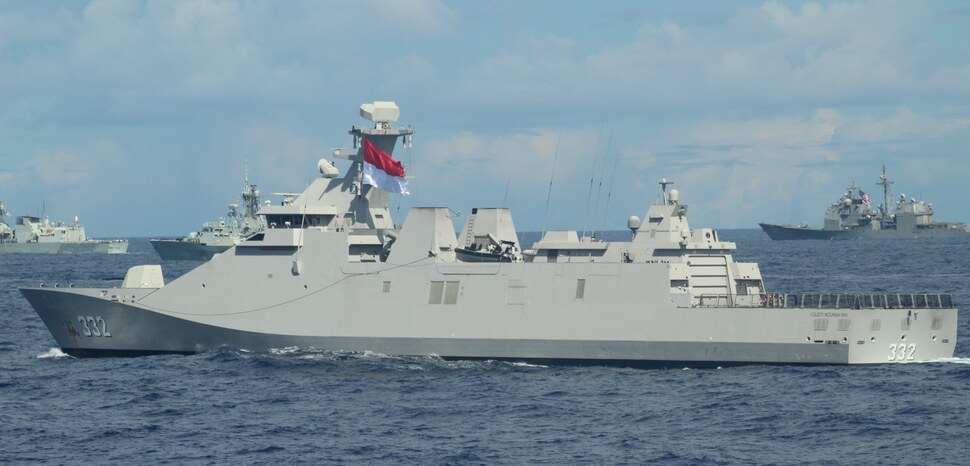
Source: https://www.geopoliticalmonitor.com/indonesias-passex-with-china-a-cautionary-tale/

Introduction

The Chinese and the Indonesian navies conducted a naval navigation exercise in the waters east of Taiwan on 12 August 2026. It included Indonesian Navy frigate KRI I Gusti Ngurah Rai and Chinese Navy’s guided missile frigate Honge (Hull523). According to the PLA Eastern Theatre Command, this was a maritime passage exercise wherein “the two frigates formed a formation and carried out exercises including maritime communications, formation maneuvering, replenishment at sea and a farewell ceremony.” This exercise was the first such drill and is of immense significance as it highlights “China’s sovereign rights and jurisdiction over the exclusive economic zone east of Taiwan island.” This also comes after the Chinese PLA Navy’s Task Group’s goodwill visit to Indonesia from 2-6 August which primarily included training ship Qijiguang (Hull 83) and amphibious dock landing ship Kunlunshan (Hull 998). While China presented this passage exercise as the “two navies’ willingness and capability to conduct practical cooperation and jointly contribute to regional peace and stability”, Indonesia referred to it as routine maritime diplomacy. The Head of the Indonesian Navy Information Service First Admiral Tunggul stated that, “Passing exercises are common goodwill engagements conducted by navies worldwide as a manifestation of naval camaraderie and maritime diplomacy inherent in warship operations.” It is also important to note that Indonesia and China have had high level economic meetings in July 2026, the most significant being the MoU signed between China’s Ministry of Trade and Indonesia’s Coordinating Ministry for Economic Affairs, “two countries twin park”. Indonesia, a founding member of China’s World Artificial Intelligence Cooperation Organisation (WAICO), is looking at Huawei as its potential strategic partner in AI, telecom infrastructure etc.

At the outset, this might seem to be a minor naval interaction but it reveals the contemporary Southeast Asian strategic dynamics wherein Indonesia is pursuing a hedging posture by deepening economic ties and cautiously expanding military engagements with China and at the same time expanding defence cooperation with Russia, US and others. This PASSEX illustrates a diversified pattern of engagement especially since the Indonesian Navy frigate was returning after conducting Orruda 2026, second Joint Naval Exercise conducted by Russia and Indonesia in the Sea of Japan. What is important to note in this Passex drill is that while no weapons were fired, three nations had different interpretations about it. While Beijing looked at it as an expression of its sovereign rights and jurisdiction, Jakarta described it as a passing exercise. Most importantly, Taiwan did not take it lightly and the Ministry of Foreign Affairs, Taiwan sought a clarification from Indonesia regarding this naval exercise. MoFA Taiwan condemned China’s “arbitrary and irresponsible” behaviour and emphasised its determination to safeguard its sovereignty in the waters east of Taiwan. Even the US State Department spokesperson urged “Beijing to cease its continuous military pressure against Taiwan and instead engage in meaningful dialogue with Taiwan”.  

Developments since August 2026 have reinforced this pattern. Just 9 days after this exercise Chinese Foreign Minister Wang Yi met his Indonesian counterpart for the first Conference of China-Indonesia Comprehensive Strategic Dialogue in Jakarta wherein Sugiono stated Indonesia’s firm adherence to “one-China policy” and declared support for China’s cause of reunification. Additionally, even Russian Pacific Fleet detachment visited Jakarta from 30 September 2026 to 4th October 2026.

What the Narratives Reveal: Hedging in Practice

These instances reflect a broader strategy of partnerships in Southeast Asia as a region. The characterisation of the PASSEX as a routine naval engagement by Indonesia aligns with its ‘free and active’ foreign policy usually referred to as “bebas dan aktif”. This largely means Indonesia not joining any permanent bloc or side but at the same time staying friendly with major powers on its own terms. Therefore, terming this passage exercise as a routine naval engagement can be understood as a deliberate strategic choice wherein Indonesia tried to minimise any geopolitical significance attributed to it without explicitly mentioning China. This type of engagement is looked at with caution from scholars around the world. For instance, Muhammad Zulfikar Rakhmat, Director of China-Indonesia Desk at Center of Economic and Law Studies in Jakarta, pushes for caution stating that, “being free and active still needs to be accompanied by a plan, a sense of how far to go with one side before stopping to think about what the other side will think. Without that plan, free and active turns into something looser: leaning hard toward the United States and just as hard toward China at once, with no clear line telling either side, or Indonesia itself, when to stop. That is free and active without a strategy.” On one hand, Indonesia became a founding member of World Artificial Intelligence Cooperation Organisation in July 2026 and since then it has deepened defence-industrial engagement with China and agreed to establish joint production facilities in Indonesia with Chinese technology transfer at the second Joint Foreign and Defence Ministerial Dialogue (2+2) in August 2026. On the other, it signed a Major Defense Cooperation Partnership with the United States in April 2026 which included three foundational pillars, vis-a-vis, “military modernisation and capacity building, training and professional military education, and exercises and operational cooperation”. Indonesia has also hosted the Russian Navy from 29 March to 2 April and then from 30 September to 4 October, 2026.

Broader Implications and Takeaways

Indonesia’s ability to hedge its way by engaging with US, China and Russia at the same time highlight the utility of hedging as a strategy especially for Indonesia. For instance, this has worked for Indonesia as its “bebas dan aktif’ policy has provided it the space to extract benefits from nations like China and the US but at the same time remain strategically autonomous. This is evident from the developments in the weeks after the Passex. From agreeing to create joint facilities for munitions factory in Indonesia to expecting its first J-10CE fighter jets “Vigorous dragon” in April 2027 from China; to being part of the annual Super Garuda Shield Exercise with US and its allies; to also hosting Russian Pacific Fleet detachment places Indonesia in a strategically advantageous disposition. It is also important to note that while this ambiguity gives Indonesia a room to maneuver, each of its partners leans Indonesia’s neutrality in its own favour. Most significant of all, is that this hedging challenges ASEAN’s stated position of ‘ASEAN centrality’ and ‘consensus-based decisions’. Instead of consolidating its disposition as a bloc posture, Indonesia is managing its relationship on its own terms and compartmentalising it based on issues. Therefore, it is important to acknowledge the limits of alignment in Southeast Asia. For partners like India, Indonesia is a significant anchor to its Act East architecture and a stable maritime order in the Indo-Pacific but expecting it to ‘commit’ instead of ‘cooperate’ does not seem feasible considering the contemporary global scenario as every nation is looking after its own national interests.

Tags: Association of South East Asian Nations (ASEAN)ChinaIndonesiaSoutheast Asia
Previous Post

Operation Dawn of Yemen and Saudi Arabia’s Available Options

Arushi Anthal

Arushi Anthal

Arushi Anthal is a Research Assistant at the Centre for Land Warfare Studies (CLAWS), where her research focuses on Southeast Asia and the Indo-Pacific. She is also a Ph.D. Research Scholar at the Amity Institute of Defence and Strategic Studies (AIDSS), Amity University, Uttar Pradesh, India. She holds an M.Phil. in Strategic and Regional Studies and Master's degree in Political Science from the University of Jammu. She is also a recipient of the University Grants Commission's Junior Research Fellowship (UGC-JRF) in Political Science. Alongside her doctoral research, she has served as a Visiting Faculty at the Amity Institute of Defence and Strategic Studies, Amity University. Her research interests include Southeast Asia, the Indo-Pacific, maritime security, and strategic affairs. She has authored commentaries, peer-reviewed research articles, and book chapters published by reputed academic and policy platforms. She has also presented her research at numerous national and international conferences and seminars. Email - [email protected]

Leave a Reply Cancel reply

Your email address will not be published. Required fields are marked *

Support Us Donate Now

Web Updates

CLAWS MAHE PHD PGME | B – 9 Shortlisted Candidates

Field Marshal Manekshaw Essay Competiton 2026

Promotion Exam Correspondence Pre Course (PROMEX)

Guidelines to Publish with CLAWS

Application Form – Study Mtrl for DSSC 2026

[NEW] Application Form for membership for PROMEX (PART B or D)

  • Trending
  • Comments
  • Latest
Russia-Ukraine War: Lessons from an Electronic Warfare (EW) Perspective

Russia-Ukraine War: Lessons from an Electronic Warfare (EW) Perspective

May 31, 2025
Field Marshal Manekshaw Essay Competiton 2026

Field Marshal Manekshaw Essay Competiton 2026

April 23, 2026
Results | Field Marshal Manekshaw Essay Competition – 2024

Field Marshal Manekshaw Essay Competiton 2025

May 23, 2025
The Silent High Ground: India’s Space Warfare Imperative

The Silent High Ground: India’s Space Warfare Imperative

October 1, 2026
The Silent High Ground: India’s Space Warfare Imperative

The Silent High Ground: India’s Space Warfare Imperative

32
From Sword Clashes to Drone Strikes: A History of Changing Battlefields

From Sword Clashes to Drone Strikes: A History of Changing Battlefields

15
The Arakan Army and Its Impact on India: Rising Tensions Along the Eastern Frontier 

The Arakan Army and Its Impact on India: Rising Tensions Along the Eastern Frontier 

5

Thwarting  Pakistan’s Nefarious Designs in Bangladesh

5
Beyond the Passex: Indonesia’s Hedging Strategy and the Limits of Alignment

Beyond the Passex: Indonesia’s Hedging Strategy and the Limits of Alignment

October 14, 2026
Operation Dawn of Yemen and Saudi Arabia’s Available Options

Operation Dawn of Yemen and Saudi Arabia’s Available Options

October 13, 2026
Myanmar Post 2025–2026 General Elections: President Min Aung Hlaing’s Visit to India Bilateral Implications and China’s Strategic Response

Myanmar Post 2025–2026 General Elections: President Min Aung Hlaing’s Visit to India Bilateral Implications and China’s Strategic Response

October 12, 2026

CLAWS – Cyberpeace Chair of Excellence | Essay Competition 2026

October 12, 2026

Popular Stories

  • Russia-Ukraine War: Lessons from an Electronic Warfare (EW) Perspective

    Russia-Ukraine War: Lessons from an Electronic Warfare (EW) Perspective

    0 shares
    Share 0 Tweet 0
  • Field Marshal Manekshaw Essay Competiton 2026

    0 shares
    Share 0 Tweet 0
  • Field Marshal Manekshaw Essay Competiton 2025

    0 shares
    Share 0 Tweet 0
  • The Silent High Ground: India’s Space Warfare Imperative

    0 shares
    Share 0 Tweet 0
  • Op Sindoor 2.0: Why & How India Must Prepare for the Next Round?

    0 shares
    Share 0 Tweet 0

About us

CLAWS

The Centre for Land Warfare Studies (CLAWS), New Delhi, India is an independent think tank on strategic studies and land warfare. The mandate of CLAWS covers national security issues, conventional military operations and sub-conventional warfare.

Browse by Category

  • Articles
  • Autumn 2019
  • Autumn 2020
  • Books
  • Chanakya Defence Dialogue
  • CLAWS Focus
  • CLAWS Journal
  • Essay
  • Events
  • External Publications
  • FMMEC
  • Intern Articles
  • Issue Briefs
  • Jottings by Director General Emiritus
  • Manekshaw Papers
  • Newsletter
  • Round Tables
  • Scholar Warrior
  • Seminars
  • Uncategorized
  • Web Updates
  • Winter 2019
  • YouTube Podcast

Recent News

Beyond the Passex: Indonesia’s Hedging Strategy and the Limits of Alignment

Beyond the Passex: Indonesia’s Hedging Strategy and the Limits of Alignment

October 14, 2026
Operation Dawn of Yemen and Saudi Arabia’s Available Options

Operation Dawn of Yemen and Saudi Arabia’s Available Options

October 13, 2026
  • Site Map
  • Tenders
  • Advertise With Us
  • Terms of use
  • Privacy Policy
  • Other Think Tanks

© 2008-2026 Centre for Land Warfare Studies (CLAWS).

No Result
View All Result
  • Home
  • About Us
    • Director General
    • Additional Director General
    • Jottings by Director General Emiritus
    • CLAWS Membership
    • Faculty
  • Publication
    • Web Articles
    • Issue Briefs
    • Manekshaw Papers
    • Newsletter
    • Essay
    • CLAWS Journal
    • Scholar Warrior
    • Books
    • Intern Articles
    • External Publications
  • Research Areas
    • Global & Regional Security
      • China
      • Pakistan
      • Afghanistan
      • South Asia
      • Indo Pacific
      • US, EU & Russia
      • MENA
      • CAR
    • National Security
      • National Security Strategy
      • Nuclear Deterrence
      • Non Traditional Threats
      • Intelligence
      • Terrorism & Internal Security
      • Grey Z & IW
      • Security Laws
    • Military Studies
      • Military Doctrine
      • Military Strategy
      • Peace Keeping Ops
      • Military History
      • Military Logistics
      • Out of Area Contingency Ops
      • Leadership
    • Military Technology & Defence Acquisition
      • Military Technology
      • Defence Acqn
      • Budgets & Finance
      • Defence Infrastructure
      • Human Resources
    • Multi Domain Studies
      • Jointmanship & Integration
      • Space
      • Cyber
      • Spl Operations
      • Energy & Environment
      • Defence Eco System
      • Defence Diplomacy
      • HADR
  • Web Archive
  • Events
    • Seminars
    • Webinars/RTD
  • PROMEX
  • University Cell
    • About The Initiative
    • Admission: Eligibility and Procedure
    • Guides | Supervisors in the PhD Programme:
    • Important Information
    • Administration
    • Application Fee: Batch – 10 Onwards
  • Careers
  • Contact

© 2008-2026 Centre for Land Warfare Studies (CLAWS).