Monday, September 28, 2026
Advertise with us
Support us
Write for us
No Result
View All Result
claws
  • Home
  • About Us
    • Director General
    • Additional Director General
    • Jottings by Director General Emiritus
    • CLAWS Membership
    • Faculty
  • Publication
    • Web Articles
    • Issue Briefs
    • Manekshaw Papers
    • Newsletter
    • Essay
    • CLAWS Journal
    • Scholar Warrior
    • Books
    • Intern Articles
    • External Publications
  • Research Areas
    • Global & Regional Security
      • China
      • Pakistan
      • Afghanistan
      • South Asia
      • Indo Pacific
      • US, EU & Russia
      • MENA
      • CAR
    • National Security
      • National Security Strategy
      • Nuclear Deterrence
      • Non Traditional Threats
      • Intelligence
      • Terrorism & Internal Security
      • Grey Z & IW
      • Security Laws
    • Military Studies
      • Military Doctrine
      • Military Strategy
      • Peace Keeping Ops
      • Military History
      • Military Logistics
      • Out of Area Contingency Ops
      • Leadership
    • Military Technology & Defence Acquisition
      • Military Technology
      • Defence Acqn
      • Budgets & Finance
      • Defence Infrastructure
      • Human Resources
    • Multi Domain Studies
      • Jointmanship & Integration
      • Space
      • Cyber
      • Spl Operations
      • Energy & Environment
      • Defence Eco System
      • Defence Diplomacy
      • HADR
  • Web Archive
  • Events
    • Seminars
    • Webinars/RTD
  • PROMEX
  • University Cell
    • About The Initiative
    • Admission: Eligibility and Procedure
    • Guides | Supervisors in the PhD Programme:
    • Important Information
    • Administration
    • Application Fee: Batch – 10 Onwards
  • Careers
  • Contact
  • Home
  • About Us
    • Director General
    • Additional Director General
    • Jottings by Director General Emiritus
    • CLAWS Membership
    • Faculty
  • Publication
    • Web Articles
    • Issue Briefs
    • Manekshaw Papers
    • Newsletter
    • Essay
    • CLAWS Journal
    • Scholar Warrior
    • Books
    • Intern Articles
    • External Publications
  • Research Areas
    • Global & Regional Security
      • China
      • Pakistan
      • Afghanistan
      • South Asia
      • Indo Pacific
      • US, EU & Russia
      • MENA
      • CAR
    • National Security
      • National Security Strategy
      • Nuclear Deterrence
      • Non Traditional Threats
      • Intelligence
      • Terrorism & Internal Security
      • Grey Z & IW
      • Security Laws
    • Military Studies
      • Military Doctrine
      • Military Strategy
      • Peace Keeping Ops
      • Military History
      • Military Logistics
      • Out of Area Contingency Ops
      • Leadership
    • Military Technology & Defence Acquisition
      • Military Technology
      • Defence Acqn
      • Budgets & Finance
      • Defence Infrastructure
      • Human Resources
    • Multi Domain Studies
      • Jointmanship & Integration
      • Space
      • Cyber
      • Spl Operations
      • Energy & Environment
      • Defence Eco System
      • Defence Diplomacy
      • HADR
  • Web Archive
  • Events
    • Seminars
    • Webinars/RTD
  • PROMEX
  • University Cell
    • About The Initiative
    • Admission: Eligibility and Procedure
    • Guides | Supervisors in the PhD Programme:
    • Important Information
    • Administration
    • Application Fee: Batch – 10 Onwards
  • Careers
  • Contact
No Result
View All Result
CLAWS
No Result
View All Result
Home Articles

Decoding India’s Taliban-led Afghanistan Calculus: Three theories, One National Interest

Janavi Mohanraj JagajothibyJanavi Mohanraj Jagajothi
September 28, 2026
in Articles
A A
0
Post Views: 59

Introduction

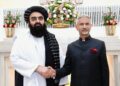
A news article from Afghanistan International dated, 1st September 2026, reports that across all the southern provinces of Afghanistan currently only three female medical specialist remain. On the contrary, on 18th September, there was an attack at a mosque in Khyber Pakhtunkhwa Province, and the responsibility was claimed by a faction of Pakistan Taliban. Meanwhile, another major happening that made headlines with respect to Afghanistan is the Saudi Delta International Energy Deal, despite the fact that it was not a deal between Afghanistan and Saudi Arabia, but Afghanistan and a private company. All the above events, define the complex and compelling state of the Islamic Emirate of Afghanistan, which makes it difficult for the policy makers of India to formulate a cohesive and unified policy. The article aims to analyse India’s policy towards the Taliban-led regime in Afghanistan theoretically.

Realism would as a theory works on State survival and National Interest. Hence the moral component of any state practice is beyond the realm of decision making. Given, the well-established fact that with the Operation SINDOOR in May 2025; India has taken both kinetic and non-kinetic action against Pakistan. Similarly, in October 2025, after a heavy clash along the Durand line, both Pakistan and Taliban-led regime of Afghanistan closed the border crossing between two countries. Thus, 2025 was a catastrophic year for Pakistan as it was successful in antagonising its two neighbours and brought a two-front threat on itself. For any Waltzian – Mearsheimer policy maker in India, this could be the best outcome against Pakistan. Thus, India’s strategic engagement with the Taliban regime, can be best explained under this theory. 

While the English School of International relations operate on the relationships among norms, legitimacy and recognition. The International Society as described by Hedley Bull, works on a simple principle; any state that wants to be part of this society shall follow the basic norms such as non-aggression and protecting the basic rights of its citizen. This, in turn, shall enable the state to gain legitimacy in the eyes of the International Society, which leads to recognition that is visible and formal. This is where the normative dilemma plays a vital role for any policy maker and state. In case of the Taliban-led Afghan government, the two most normative issue that makes Afghanistan an outlier are their policies with respect to human rights, women rights and terrorism. And this explains why, except Russia, no other country has formally recognised Afghanistan to extended full diplomatic relations. The Indian government’s act of not appointing an ambassador to Afghanistan, and not formally recognising the Taliban-led regime is in lines with how United Nations engages with the Taliban-led government as the “de facto authorities”, despite the fact that its legitimacy to represent the people of Afghanistan at UN is non decided. Afghanistan is still a member state of UN, but the indecision is about its legitimacy to represent its people which can be gained only if the member states of UN grants recognition by following the due process in the United Nations General Assembly. With respect to Indian governments act of upgrading the technical mission of India in Kabul to that of an Embassy on 21st October 2025 with immediate effect could be an outcome of a realist policy making rather than as an act to recognise or legitimate the Taliban-led government.

The engagement of institutions like UN, through UNAMA with the Taliban- led Afghan government, with focus on administering humanitarian aid and assistance can be explained under the theory of Liberal Institutionalism. It is because this theory focuses on the state’s ability to function along with other states on mutually beneficial issues. One important difference is that, while Liberal institutionalism focuses on how institutions are critical as they play a vital role in reducing the transactional cost incurred in the process of making these rules and its eventual enforcement and monitoring. Thus, unlike the English School of International Relations which focusses on legitimacy or recognition, the Liberal Institutionalism does not focus on these normative aspects. Hence, the engagement between Taliban-led regime and India via institutional mechanism such as the Moscow format consultation on Afghanistan, where India sits on the sample table as China and Pakistan to discuss on counter terrorism, regional security, political order, women’s security and anti-drug efforts is the classic example of how states can co operate with each other via institutions despite different national interest in the realm of state security.

Conclusion

India’s policy with respect to Afghanistan is one among the most pragmatic engagement that the policy makers have followed. It focusses on national interest as advanced by realist thought, while restraining legitimizing a regime with normative issues in the international society, but engaging with the same regime through institutional mechanism that shall be of low cost. This calibrated engagement is focussed on the India’s national interests and the strategic advantage of engaging with the Taliban-led regime. While the moral ambiguity of such engagement is questioned in various forums, it is answered via India’s act of withholding legitimacy and pressuring the Taliban-led regime to make calibrated steps towards adhering to the norms of the International Society to gain legitimacy. Thus, the current Indian policy towards Afghanistan is a coherent policy aimed to address its national interest, where restraint and cooperation act as the carrot and stick to serve the realist national interest of the Nation.

Tags: AfghanistanCalculusIndiaIndia’s National Security ChallengesNational InterestSouth AsiaTaliban
Previous Post

A New Space Arms Race? U.S. On-Orbit Weapons and the Implications for India’s Space Security

Next Post

The Atlantic Brief | Volume I | Issue No. 02

Janavi Mohanraj Jagajothi

Janavi Mohanraj Jagajothi

Janavi MOHNRAJ JAGAJOTHI is currently serving as a Research Assistant at the Centre for Land Warfare Studies (CLAWS), New Delhi. Her research primarily focuses on Africa, Latin America, and Energy Security, with particular interest in strategic affairs, geopolitical developments, and India’s evolving external engagements with the Global South. She is motivated to pursue her doctoral studies in the field of International Relations and Strategic Studies. Prior to joining CLAWS, she was an Erasmus+ ICM scholarship holder and undertook an academic exchange at the Université Catholique de Lille, France. She completed her Master’s in International Relations from Loyola College, Chennai, where she developed a strong academic foundation in international security, foreign policy analysis, political communication, area studies, and International Relations theory. With a multidisciplinary academic background and a focus on contemporary global strategic dynamics, Janavi brings analytical depth to her work on Africa, Latin America, energy policy, and broader geopolitical and security issues.

Next Post
The Atlantic Brief | Volume I | Issue No. 02

The Atlantic Brief | Volume I | Issue No. 02

Leave a Reply Cancel reply

Your email address will not be published. Required fields are marked *

Support Us Donate Now

Web Updates

CLAWS MAHE PHD PGME | B – 9 Shortlisted Candidates

Field Marshal Manekshaw Essay Competiton 2026

Promotion Exam Correspondence Pre Course (PROMEX)

Guidelines to Publish with CLAWS

Application Form – Study Mtrl for DSSC 2026

[NEW] Application Form for membership for PROMEX (PART B or D)

  • Trending
  • Comments
  • Latest
Russia-Ukraine War: Lessons from an Electronic Warfare (EW) Perspective

Russia-Ukraine War: Lessons from an Electronic Warfare (EW) Perspective

May 31, 2025
Field Marshal Manekshaw Essay Competiton 2026

Field Marshal Manekshaw Essay Competiton 2026

April 23, 2026
Results | Field Marshal Manekshaw Essay Competition – 2024

Field Marshal Manekshaw Essay Competiton 2025

May 23, 2025
Op Sindoor 2.0: Why & How India Must Prepare for the Next Round?

Op Sindoor 2.0: Why & How India Must Prepare for the Next Round?

May 21, 2025
From Sword Clashes to Drone Strikes: A History of Changing Battlefields

From Sword Clashes to Drone Strikes: A History of Changing Battlefields

15
The Arakan Army and Its Impact on India: Rising Tensions Along the Eastern Frontier 

The Arakan Army and Its Impact on India: Rising Tensions Along the Eastern Frontier 

5

Thwarting  Pakistan’s Nefarious Designs in Bangladesh

5
India’s Pursuit of Self-Sufficiency in Rare Earth and Critical Minerals: South Caucasus as an Option

India’s Pursuit of Self-Sufficiency in Rare Earth and Critical Minerals: South Caucasus as an Option

3
The Magic of Small Tubes: Where Are We?

The Magic of Small Tubes: Where Are We?

September 28, 2026
The Atlantic Brief | Volume I | Issue No. 02

The Atlantic Brief | Volume I | Issue No. 02

September 28, 2026
Decoding India’s Taliban-led Afghanistan Calculus: Three theories, One National Interest

Decoding India’s Taliban-led Afghanistan Calculus: Three theories, One National Interest

September 28, 2026
A New Space Arms Race? U.S. On-Orbit Weapons and the Implications for India’s Space Security

A New Space Arms Race? U.S. On-Orbit Weapons and the Implications for India’s Space Security

September 28, 2026

Popular Stories

  • Russia-Ukraine War: Lessons from an Electronic Warfare (EW) Perspective

    Russia-Ukraine War: Lessons from an Electronic Warfare (EW) Perspective

    0 shares
    Share 0 Tweet 0
  • Field Marshal Manekshaw Essay Competiton 2026

    0 shares
    Share 0 Tweet 0
  • Field Marshal Manekshaw Essay Competiton 2025

    0 shares
    Share 0 Tweet 0
  • Op Sindoor 2.0: Why & How India Must Prepare for the Next Round?

    0 shares
    Share 0 Tweet 0
  • From Sword Clashes to Drone Strikes: A History of Changing Battlefields

    0 shares
    Share 0 Tweet 0

About us

CLAWS

The Centre for Land Warfare Studies (CLAWS), New Delhi, India is an independent think tank on strategic studies and land warfare. The mandate of CLAWS covers national security issues, conventional military operations and sub-conventional warfare.

Browse by Category

  • Articles
  • Autumn 2019
  • Autumn 2020
  • Books
  • Chanakya Defence Dialogue
  • CLAWS Focus
  • CLAWS Journal
  • Essay
  • Events
  • External Publications
  • FMMEC
  • Intern Articles
  • Issue Briefs
  • Jottings by Director General Emiritus
  • Manekshaw Papers
  • Newsletter
  • Round Tables
  • Scholar Warrior
  • Seminars
  • Uncategorized
  • Web Updates
  • Winter 2019
  • YouTube Podcast

Recent News

The Magic of Small Tubes: Where Are We?

The Magic of Small Tubes: Where Are We?

September 28, 2026
The Atlantic Brief | Volume I | Issue No. 02

The Atlantic Brief | Volume I | Issue No. 02

September 28, 2026
  • Site Map
  • Tenders
  • Advertise With Us
  • Terms of use
  • Privacy Policy
  • Other Think Tanks

© 2008-2026 Centre for Land Warfare Studies (CLAWS).

No Result
View All Result
  • Home
  • About Us
    • Director General
    • Additional Director General
    • Jottings by Director General Emiritus
    • CLAWS Membership
    • Faculty
  • Publication
    • Web Articles
    • Issue Briefs
    • Manekshaw Papers
    • Newsletter
    • Essay
    • CLAWS Journal
    • Scholar Warrior
    • Books
    • Intern Articles
    • External Publications
  • Research Areas
    • Global & Regional Security
      • China
      • Pakistan
      • Afghanistan
      • South Asia
      • Indo Pacific
      • US, EU & Russia
      • MENA
      • CAR
    • National Security
      • National Security Strategy
      • Nuclear Deterrence
      • Non Traditional Threats
      • Intelligence
      • Terrorism & Internal Security
      • Grey Z & IW
      • Security Laws
    • Military Studies
      • Military Doctrine
      • Military Strategy
      • Peace Keeping Ops
      • Military History
      • Military Logistics
      • Out of Area Contingency Ops
      • Leadership
    • Military Technology & Defence Acquisition
      • Military Technology
      • Defence Acqn
      • Budgets & Finance
      • Defence Infrastructure
      • Human Resources
    • Multi Domain Studies
      • Jointmanship & Integration
      • Space
      • Cyber
      • Spl Operations
      • Energy & Environment
      • Defence Eco System
      • Defence Diplomacy
      • HADR
  • Web Archive
  • Events
    • Seminars
    • Webinars/RTD
  • PROMEX
  • University Cell
    • About The Initiative
    • Admission: Eligibility and Procedure
    • Guides | Supervisors in the PhD Programme:
    • Important Information
    • Administration
    • Application Fee: Batch – 10 Onwards
  • Careers
  • Contact

© 2008-2026 Centre for Land Warfare Studies (CLAWS).