

Introduction
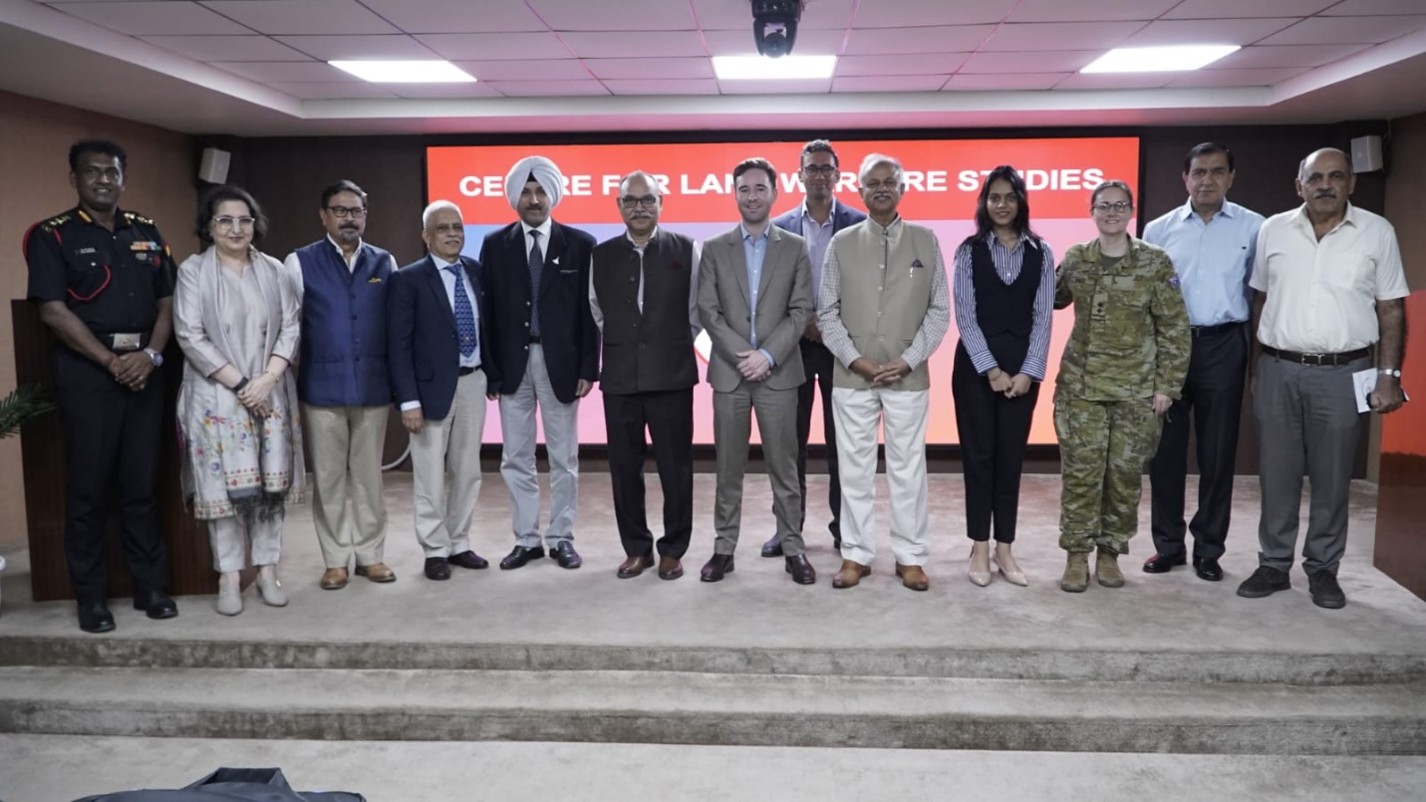
CLAWS hosted a roundtable discussion on India–Australia relations on 16 July 2026, receiving a delegation from the Australian High Commission comprising Mr. Arzan Tarapore (Scholar, Stanford University), Mr. Dean Channells (First Secretary, Defence), Brig Damian Hill and Ms. Akanshi Bansal. The Indian panel comprised Lt Gen P S Rajeshwar (Retd), Lt Gen Rajeev Sabherwal (Retd), Maj Gen Vivek Sehgal (Retd), Vice Adm AB Singh (Retd) and Air Mshl GS Bedi (Retd), offering complete representation of the Army, Navy, Air Force and joint staff. The engagement came days after Prime Minister Narendra Modi’s visit to Melbourne (8–10 July 2026) for the Third India–Australia Annual Summit, whose Joint Statement placed defence and maritime cooperation at the centre of the bilateral agenda through a Joint Declaration on Defence and Security Cooperation and a Maritime Security Collaboration Roadmap.
Discussion
Mr. Channells assessed the defence industry relationship as the least developed strand of the partnership, though the most important to get right, citing Australia’s niche strengths in autonomous underwater and air platforms, progress in the DSTG–DRDO project, and the new arrangement on the provision of defence articles and services enabling transfer of sensitive technologies. He singled out the Joint Declaration’s language on consultation on regional developments as its most significant element. Mr. Tarapore observed that India–Australia ties are accelerating alongside India–Japan, Australia–Japan and European partnerships “probably not an accident” with defence industry integration emerging as a common pillar. On the changing character of war, he questioned India’s theory of victory: since the PLA pursues systems confrontation and systems destruction, the answer lies not in restoring manoeuvre but in competitive denial — dispersed, autonomous operations that remain combat-effective under non-contact and electronic warfare conditions. He also reported findings from a recent table-top exercise: friction in Link 16 track hand-offs, and the fact that many foundational agreements remain untested, requiring routine peacetime staff interaction.
Lt Gen Rajeshwar recalled prior interactions with Gen Angus Campbell and Gen Simon Stuart, noting that visiting delegations invariably ask about India’s northern border. He argued the genuine opportunity in defence technology lies with India’s start-ups in Bengaluru, Hyderabad, Pune and Delhi rather than in G2G research channels alone, and raised the Five Eyes constraint candidly as an inhibiting factor that India nonetheless accepts. On doctrine, he noted India’s released multi-domain doctrine and the need to build joint operations concepts, tailored differently for the northern and western borders, with the theatre commander sequencing effects across domains.
Lt Gen Sabherwal argued that strategic convergence has largely been achieved, but technical convergence and operational interoperability remain outstanding and cannot rest on agreements or exercises alone. He proposed treating the information space as the superset of which the maritime domain is a subset, and set out five areas: defence digital interoperability, electromagnetic spectrum operations, autonomous systems and AI, redefined interoperability measured by common standards and encryption rather than common platforms, and trusted supply chains for semiconductors and critical minerals. He further urged joint work on space, cyber and quantum, and the inclusion of industry and users in technology groups.
Vice Adm AB Singh emphasised that most effort sits in the domain of white shipping, whereas the requirement is grey and dark shipping, an area where Indian start-ups are already active. He identified underwater domain awareness as a chain that could link India, Indonesia, Australia and New Zealand, proposed Christmas Island for mutual-use development, and raised the induction of retiring Indian Navy technical manpower, cross-servicing arrangements and coast guard collaboration on best practices.
Maj Gen Sehgal argued for moving from the maritime to the land domain, noting the shift from manoeuvre to attrition evident in Ukraine. Since anything visible can now be targeted, the priority is how manoeuvre is to be reinstated, an area where the Australian land warfare doctrine offers scope for collaboration. Responding to Mr. Tarapore, he held that demonstrated capability itself creates deterrence, and that neutralising the systems China depends upon is complementary to, not opposed to, restoring manoeuvre.
Air Mshl GS Bedi framed the issue as how to counter China in the absence of the US shadow, given US commitments elsewhere. He urged partners to stop viewing India through the lens of cheap labour, since deterrence requires high-end technology flows. Noting that Pitch Black and Tarang Shakti remain episodic, he called for seamless interoperability including air-to-air refuelling and cross-servicing, and prioritised advanced materials, laser/directed-energy systems for affordable counter-drone defence, and hypersonics.
Outcome
Both delegations converged on the principal challenges. DG CLAWS noted that the same question on ITAR had been posed to a US delegation received at CLAWS three days earlier, yielding an identical answer, and observed that partners often find agreements easier to conclude with the United States than with Australia. He identified drone manufacturing and co-development as areas offering mutually agreeable near-term outcomes, given the surprising extent of existing cooperation in the drone sector. The proceedings concluded with the presentation of a memento to the Australian delegation as a token of appreciation and goodwill from CLAWS, followed by a group photograph.