
Introduction
On the 3rd of July 2026, two People’s Liberation Army (PLA) officers were promoted to the rank of General by Xi Jinping, in his capacity as Chairman of the Central Military Commission (CMC). These included Wang Gang, commander of the People’s Liberation Army Air Force (PLAAF), and Zhang Shuguang, who was also revealed to be the secretary of the CMC discipline inspection commission and director of the CMC supervision committee. Both these officers had previously been seen sitting at the front of the section reserved for senior military officers, at a gala commemorating 105 years of the founding of the Communist Party of China, signalling their increased seniority and fuelling speculations on their possible promotions.
This revelation of Zhang Shuguang’s appointments carries significant value, as General Zhang Shengmin, who remains the only active uniformed member of the CMC under Xi and its Vice Chairman, was the previous secretary of the CMC discipline inspection committee. Indeed, this is the only transition of responsibilities in the current CMC that has not involved disappearances and corruption-related charges, with General Zhang Shengmin, who handed over his portfolio to General Zhang Shuguang, present at the promotion ceremony. With this appointment, General Zhang Shuguang now oversees the department responsible for enforcing Xi’s anti-corruption measures within the PLA, which have now purged over 100 senior officers within the PLA’s leadership.
Who is the PLA’s New ‘Enforcer-In-Chief’?
In this light, understanding who General Zhang Shuguang is, and his career record, helps understand why he was chosen to rise to the PLA’s penultimate rank, and what this reveals about the priorities the CMC, and its Chairman, Xi Jinping, has set for the PLA. These appointments, at the helm of the PLA, also have ramifications for the PLA’s ambitious military reforms that began in 2015, and seek to transform the PLA into a “world-class military” by 2049.
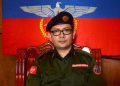
Publicly available data is sparse, and the earliest public information about General Zhang Shuguang’s career dates to 2017, when he appeared publicly in a televised interview as a deputy corps leader grade officer, with the rank of Major General. At the time, he was revealed to be the director of the Discipline Inspection and Supervision Bureau of the CMC’s Discipline Inspection Committee, in which capacity he would have served directly under his predecessor and current CMC Vice Chairman General Zhang Shengmin. After this tenure, he next appears as the Secretary of the PLA Ground Force Discipline Inspection Commission. In 2022, he served as a delegate to the 20th Communist Party Congress. In October 2022, he became a member of the 20th Central Commission for Discipline Inspection, and a Deputy Secretary-General of the Sixth Council of the China Association for Discipline Inspection and Supervision.
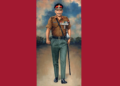
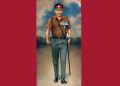
This publicly available information can also be supplemented by a visual analysis of the ribbons he wore on his uniform during his promotion ceremony. His ribbons include the PLA Ground Force service ribbon, alongside a PLA Air Force (PLAAF) service ribbon, indicating he served a tenure in the PLAAF, a routine practice for many PLA political track officers who often switch services at times in their career. His ribbons also showcase a variety of staff appointments, with a tenure as director of staff organisations across the group army/corps, theatre and CMC organisation grades. In addition, his ribbons also indicate service as part of staff organisation at the group army/corps and division/brigade/regiment grades. His command education and training ribbons span across the senior, intermediate and junior levels, indicating he very likely possesses a postgraduate or equivalent level of education. The last two ribbons indicate years of service, spanning between 45-49 years of service, and would place his joining the PLA at roughly the late 1970s and early 1980s, right in the aftermath of the Cultural Revolution, and the tumultuous power struggles that would culminate in the rise of Deng Xiaoping as China’s paramount leader.
General Zhang Shuguang’s career reflects a career spent in staff postings, enforcing discipline across the PLA’s various organs. His known postings indicate that he is very likely a political track officer; however, it is extremely unlikely that he has ever served as a political commissar/instructor of a unit. Indeed, one conspicuous absence on Zhang’s uniform is that of any ribbon indicating command experience (in the case of political officers, used to denote tenures as political commissars/instructors at various formation levels). However, he does seem to have extensive experience enforcing the party’s discipline across the PLA, with his promotion coming barely a week after 6 key general officers were purged from the party on corruption-related charges.
Conclusion
As the PLA grapples with a disruption of the ranks of its senior leadership, the appointment of Zhang Shuguang could be interpreted as an attempt to position a loyal enforcer in a key role and with enough seniority to make a potential addition to the CMC during the next National Party Congress of the Communist Party of China, scheduled to take place next year in 2027. It could also be aimed at reducing the responsibility on an ageing Zhang Shengmin, who turns 68 next month, and no doubt has increased responsibilities as a Vice Chairman, and being the only uniformed active member of the CMC. However, it remains to be seen how long Zhang Shuguang remains in his role, given that since 2022, 87% of PLA 3-star generals have been purged.
As of now, the elevation of Zhang Shengmin, the previous head of the CMC discipline inspection commission, to the position of Vice Chairman of the CMC, when combined with the swift filling up of the CMC discipline inspection commission’s helm, while only about 21 percent of the PLA’s key leadership positions remain filled, shows the importance Xi has attached to enforcing loyalty across the PLA, over operational expertise. This has also been reinforced by Xi’s recent purge of Generals Zhang Youxia and Liu Zhenli, both highly respected operational commanders, with combat experience in Vietnam. Nevertheless, it remains to be seen whether the CMC discipline inspection committee is treated as a bastion of loyalists, given that 2 deputy secretaries of the CMC discipline inspection committee have been purged.
The PLA’s leadership turmoil of the past years shows that the 2015 round of reforms, the most ambitious since the PLA’s 1955-56 military reforms, seems destined to suffer a fate similar to that suffered by its illustrious predecessor at the hands of the Cultural Revolution, which undid most of the reforms as a consequence. There remains a deep-seated fear of the consequences of the depoliticization of the PLA, with Chinese academics attributing the fall of the Soviet Union, to, among other factors, the depoliticization of the Soviet military, with Xi himself opposing the de-politicisation of the PLA. Thus, this latest appointment, when taken together with recent trends in the PLA, makes it extremely likely that the PLA will revert to its legacy role of being the pillar of loyalty to the party, instead of transitioning to a more professionalised army, as had been conceived by the architects of China’s military reforms.