
Introduction
Year Hare Affair (那年那兔那些事儿, Yuè Tù Shìjiàn) is a Chinese animated series, developed in cooperation with the People’s Liberation Army (PLA), that covers historical events in the 20th and 21st centuries. The show uses anthropomorphic animals to represent different countries, and is popular amongst Chinese Youth, with the show earning appreciation from both online audiences and official Chinese state media. Indeed, The Global Times even reported a story of one of the PLA’s soldiers, killed in the Galwan clashes of 2020, who used a character from the show as his profile picture on WeChat. As such, the show provides key insights into perceptions about different countries and helps understand the extent of deviance from its official narratives that the Chinese Communist Party is willing to tolerate.
Understanding the Characters
The various animals used to represent countries in the show, and their behaviour, reveal Chinese perceptions about these countries. China itself is represented by a Hare, with the scholarly consensus agreeing that this is due to the reputation of a hare as being a gentle-looking creature, but one that retains the ability to fight back if necessary. In addition, the animated character of the hare, with its fluffy features, child-like voice and language, all serve to endear the character to the audience.
Most western nations are represented by a combination of official and unofficial mascots and national animals. The United States, for example, is represented by the Bald Eagle, and is portrayed as an arrogant yet incredibly powerful character. Similarly, the United Kingdom is represented by a Bull. The Soviet Union is shown as a Bear, bearing the hammer and sickle on its chest. Similarly, the post-Soviet States are represented as Bears, with Russia as a Bear with the number ‘1’ written on it, to represent it as the first son of the Soviet Union, Ukraine with the number ‘2’ on it and Belarus as the number ‘3’ on it. These characters are often portrayed as capable, intelligent and as key players in the international arena.
Characters representing Africa and Asia, however, are depicted in an insulting and racist manner. Japan, for example, is represented as a chicken/rooster, which insists that it is, in fact, a crane, and is presented consistently as an evil villain that runs to the Eagle (US), addressing it as ‘Dad’. The two Koreas are represented by sticks, based on the Chinese word ‘Bangzi’, an ethnic slur used for Koreans, with the two Koreas being distinguished by their headgear. Gulf nations are represented by Camels, with variations for different nations. African Nations are depicted in the most insulting manner, with a Hippopotamus being used to depict them, again with variations for different nations in the region. The Hippos are shown to be particularly unintelligent, lacking even the ability to solve 1 + 1. The show even states that the Hare (China) only became friends with the Hippo (African nations) after the other characters would not talk to the Hare. The Hare keeps remarking on how ‘Simple-Minded’ the Hippos are, and the Hippos are also made the target of practical pranks played by the Hare.
India in Year Hare Affair
The first season of the show has an episode dedicated to events in the Indian Subcontinent through the 1960s and 70s. Here, India is represented by a white Elephant, wearing a turban. The Elephant is portrayed as a clumsy character, who constantly eats and litters the place with banana peels. Another characteristic of the Elephant is the constant highlighting of its military prowess, harking back to its successes in the Second World War, and the Elephant, emboldened by these achievements, pursues an aggressive policy vis-à-vis the Hare, and constantly provokes the Hare into a fight. The episode also shows how the Elephant sees the Hare being busy with the Taiwan issue, and seeks to take advantage of the Hare’s preoccupation with the same. When the Elephant and Hare actually do come to blows (representing the India-china War of 1962), the Elephant is revealed as a mere paper tiger, with the Hare saying that “Even the Baldy (euphemism for the KMT) is enough for you”. The Elephant is then shown to go on a shopping spree of weapons from both the Eagle and the Bear (Soviet Union). Now feeling powerful, armed with new weaponry, the Elephant immediately seeks out a fight; however, it is cowed by the recent defeat it suffered at the hands of the Hare, viewing it as a scary monster. Thus, its attention then turns to Pakistan as a soft target. Pakistan, in the show, is depicted in a manner similar to China, via a childlike goat, based on the Markhor, Pakistan’s national animal. The Goat, like the Hare, also speaks in a childlike voice and has childlike behaviour. The Elephant, thus, sees it as an easy target, and attacks it to prove its strength. Pakistan tries to put up a fight, but gets knocked down (in what is probably a euphemism for Pakistan’s crushing defeat in the 1971 Bangladesh Liberation War). The Hare, seeing this, presents an ultimatum to the Elephant, causing it to back down. After this, the Hare offers its ‘toys’, shaped like tanks and aircraft (referring to Sino-Pakistani Arms transfers), telling the Goat that these were the latest model that the Hare itself uses. Seeing this, the Goat breaks down into tears and hugs the Hare. The Two promise to stand together no matter the odds, followed by a montage highlighting Sino-Pakistani cooperation over the ages and the China-Pakistan Economic Corridor (CPEC), and the JF-17 fighter developed jointly by the two nations.
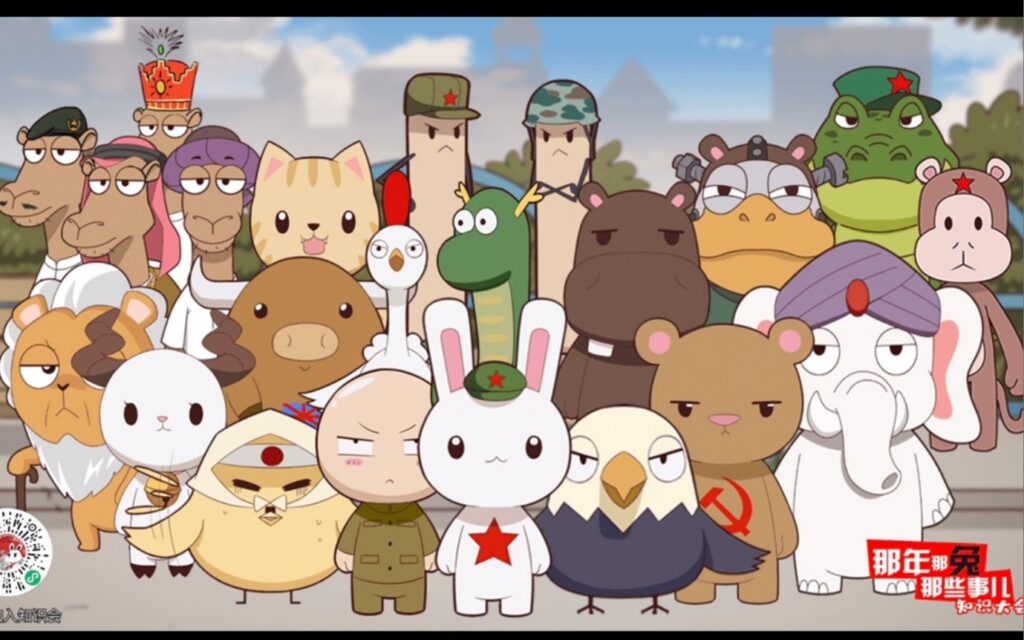
Image: Various Characters in Year Hare Affair. In order (L-R, Lowest Row: Goat-Pakistan, Chicken/Crane-Japan, Bald Man- KMT, Hare- Communist China, Bald Eagle- USA, Bear- Soviet Union, Elephant- India). Image Credits: Baidu.
Conclusion: What the Show Reveals
One of the main takeaways of the show is how old propaganda narratives can be repackaged to better appeal to a youth demographic, and the power of new forms of media. Traditional Chinese Propaganda narratives, built on China’s experiences through decades of war and famine, no longer remain resonant amongst the younger populace, who have only seen prosperity in the aftermath of China’s economic liberalisation. Here, the affectionate and childlike character of the hare makes viewers form an emotional attachment to the Hare. Consequently, the struggles of the Hare are not abstract historical concepts, but affect the viewers at a deeply personal level. Thus, this repackaging of the old narratives is better able to resonate with the viewers.
In addition, the Hare is shown to be incredibly cunning while dealing with the other characters. This points to how in today’s day and age, idealistic behaviour is often seen as naivety, with people feeling that states must use whatever tools at their disposal in order to get ahead. This also plays into existing Chinese beliefs of the Chinese people being extremely cunning, and could serve to reinforce that self-image, and motivate Chinese youth in their ability to find new and innovative ways to compete against the United States, which dominates in terms of its economic, technological and military might.
The show also reveals crucial aspects of how the Chinese populace perceives different nations, alongside the normalisation of racism within the Chinese psyche. The Western and industrialised nations, while satirised, are still presented as examples that the Chinese should seek to emulate. However, African and Asian nations are often represented in a demeaning manner, using racial stereotypes. The representation of African nations alongside the manner in which the show itself admits the Chinese state taking advantage of the African nations’ natural resources runs counter to Chinese narratives about its relationship with Africa being based on mutual respect and sincerity. This, in turn, presents an interesting conundrum: while the show is not directly a product of state media, all productions in China must play within the boundaries set by the party. Thus, the popularisation of this alternate narrative does show a certain amount of tolerance with regard to deviance from the official propaganda narrative.
The Depiction of India in the show, particularly when paired with other examples of racist depictions of Indians in Chinese media, sheds light on how racist conceptualisations of the Indian populace have become deeply ingrained in the Chinese Psyche. The Elephant’s behaviour constantly plays on racist tropes about Indians focusing on chest-thumping and littering the place. The episode on the Indian subcontinent also deliberately twists history, with outright falsehoods inserted as well to suit Chinese narratives. There is no mention of the Chinese construction of a highway through the Indian Territory of Aksai Chin, with India being portrayed as an aggressor who was out looking for a fight. Similarly, India is also shown as the aggressor against a helpless Pakistan, while conveniently overlooking the atrocities committed by the nation against the Bengali populace in East Pakistan. Even the supposed Chinese role in ceasing hostilities as shown is a work of pure fiction, with the war ending decisively in a total Indian Victory. Indeed, the show employs the same strategies to create an endearing representation of Pakistan, as it used in its own character of the Hare, with striking similarities in appearance and behaviour, and presents Pakistan as a younger brother to China, while attempting to portray India as a neighbourhood bully. Thus, the show reinforces the state’s narrative, especially for the younger generations, while also shedding light on social perceptions that are far more blunt and cynical than official narratives.