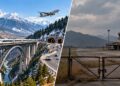

Picture two travellers setting out on the same winter morning, one on each side of the Line of Control. The first boards a train that rolls through tunnels and over gorges that once cut the Kashmir Valley off from the rest of India. The second is heading for Muzaffarabad, where there is no railway to catch and no flight to board, because the airport has been closed since 2006. You don’t need a spreadsheet to see the gap between the two halves of Kashmir. You can see it in what gets built. One side is laying track, drilling through mountains and widening runways, while the other waits on plans that never left the drawing board. Nowhere is the divide easier to see, or to feel, than in how people get from one place to another.
A railway through the mountains
In June 2025, Jammu and Kashmir (J&K) completed the 272-km Udhampur–Srinagar–Baramulla rail line, ending a project that had run for decades. It took 36 tunnels and 943 bridges and an investment of ₹43,780 crore. The centrepiece is the Chenab Bridge, the world’s highest railway arch bridge. It stands 359 metres above the river, higher than the Eiffel Tower. Since its opening on 6 June 2025, Vande Bharat trains have run between Katra and Srinagar, cutting the trip to about three hours. For the first time, the Kashmir Valley has an all-weather rail link to the rest of India. Across the Line of Control, Pakistan-occupied Jammu and Kashmir (PoJK) has no railway at all. A planned link via Murree was shelved. Gilgit-Baltistan (GB) is no better, with a line to China through Khunjerab only proposed.
Roads that stay open in winter
Snow has long cut off Kashmir for months at a time. J&K is changing that. The 6.5-km Z-Morh tunnel near Sonamarg opened on 13 January 2025. It is part of a project to give round-the-year links between Kashmir and Ladakh, which stay closed in winter because of heavy snowfall. Sonamarg, a popular hill resort, can now receive visitors in the snowy months. The bigger prize is the Zojila tunnel, now under construction. At 14.15 km, it is billed as Asia’s longest bi-directional tunnel and will take the 32 km from Sonamarg to Minamarg in under 40 minutes, instead of four hours. When it opens, the road to Ladakh will stay open through the winter too.
Runways: open and shut
The air travel contrast is even starker. Srinagar’s airport handled 3.38 million passengers in 2025-26, already more than its current capacity of 2.5 million. A ₹1,667-crore project will lift that capacity to 10 million passengers a year. In PoJK, the two airports at Muzaffarabad and Rawalakot are shut. Pakistan’s Defence Ministry told the National Assembly that both have been closed since 2006. Revival has been floated before, but in April 2025 the Pakistan Airports Authority said no airport project was under consideration for Muzaffarabad.
Why roads, rails and runways matter
Infrastructure shapes who can reach a market, a clinic or a classroom. J&K recorded 23.5 million tourists visits in 2024, against 3.21 million in PoJK. Visitors need ways in, and a Valley with a railway, winter-proof roads and a growing airport can host them in more seasons. The same logic applies to local residents. J&K has about 601 people per hospital bed, against 1,487 in PoJK, and its 12 medical colleges and two AIIMS are easier to reach when travel does not stop for the winter.
The pattern is consistent across every sector. Where roads, rails and runways exist, trade, tourism and services follow.
The verdict on the ground
J&K is building connections that did not exist a few years ago: a railway through the Himalaya, tunnels that keep roads open in winter, and an airport expanding to four times its capacity. PoJK’s airports are shut, its railway was never built, and its only rail link is a shelved plan. One side is travelling forward, and the other is still waiting at the station.