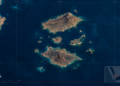

In the middle of September 2026, Houthi rebels carried out and completed a campaign that made a strategic statement out of what were largely uninhabited islands. The group expanded its presence in the region by the capture of the Greater and Lesser Hanish Islands in the Southern Red Sea furthering its ability to control integral maritime shipping route in blows to Saudi Arabia’s oil exports. This capture came mere days after the mainland port city of Mokha and island of Perim were taken by Houthi fighters. This happened after nearly 1000 government aligned troops stationed at Hanish and Zuqar islands withdrew to flee to Djibouti. What on paper could perhaps look like a clean up operation against retreating government forces is the latest in line of case studies on how non-state actors could turn narrow to small territorial footholds and gains into leverage that can rival that of mid-sized navies. It is to be seen what impacts these developments have over trade or energy and its own military trajectory.
Strategic importance of the Islands
On their own the Hanish Islands do not hold too extensive of significance. However, it matters more where the islands are located. The islands are roughly 160 kilometres north of Bab el-Mandeb, lending the Houthis deployed on the islands access to this strait which has become more critical as an alternative to the Strait of Hormuz owing to the wider West Asia conflict. This capture effectively gives full control of the Red Sea Coast to the Houthis. Hence, the islands are not just an isolated garrison, they are a part of a contiguous coast, and this is what turns the control of land into a strategic move that has maritime reach. For Houthis it is more imperative to have territory that creates and generates radar coverages, sightlines, missile launch positions etc along shipping lanes than to hold territory just to generate revenue or for control of population. Measurement of the territorial loss in square kilometres by the government ends up missing what the Houthis have potentially optimized for. With the capture Houthis possibly get uninterrupted line of sight down on one of the busiest sea lanes on earth.
Increasing geographical importance
The price of Bab el-Mandeb, one of the world’s great chokepoints, has risen overtime. With the onset of the Iran war, the Strait of Hormuz has been under US or Iranian blockade effectively rendering Gulf oil bound for Asia and Mediterranean bound cargo having nowhere else to go but through Bab el-Mandeb. Thus, the strait is more crucial now. Houthis with their control of the islands that flank this substitute artery occupy a position as a militia with no navy that ordinarily a state would need a carrier group to hold. Here, geography itself is doing the work that is usually done by firepower which is aiding the Houthi’s in only needing a vantage point to be in sitting astride the only viable route for fleets without having to defeat one.
Impose without Approach
The mechanism by which this position is turned into coercion is what is increasingly called non-contact attack by analysts. Earlier the Houthis had physical seizure as their signature move for example the most notorious helicopter boarding of the Galaxy Leader in November 2023. Now, however, their current arsenal has allowed them to impose costs without ever even approaching any vessel. Built on a range of Iranian supplied as well as homemade weapons, this amounts to selective denial against the vessels that seek to pass through the strait. A substantial toolkit exists in which there are long range Typhoon/toofan ballistic remains (reminiscent of Iranian Qadr class), a Quds series of land attack cruise missiles. There are dedicated systems, Asef and Falaq (missile and radar for air defence and electronic warfare), for sea defiance modelled on Iran’s anti-ship missile the Khalij e Fars alongside drones Samad and Wa’id. Here, in the same layered architecture a distinct gap is filled by each system. The shipping lanes are held at risk ballistic missiles while anything that is closer to shore is threatened by drones. Dedicated anti-ship munitions give the Houthis a closer to actual navy strike potential despite not having warships. This, in practice, this means that missile strikes near merchant vessels using Iran-supplied weapons and targeting assistance have continued with explosive drone boats sinking cargo ships outright. Spanning 40 documented Houthi naval attacks, this progression escalated from grenades propelled by rockets to weaponry increasing complicated supplied via the same pathways that had armed Hezbollah with C-802 missiles during the Lebanon war in 2006. This is evidence that this is a model that’s transferable within the broader framework for Iran and is not a provision that’s uniquely Yemeni and that other affiliated groups could plausibly replicate this where geography would cooperate. In any of this there was no requirement of ships, crew or perhaps even contact with target because the threat alone is repricing insurance. The threat is lengthening transit time, while making ships detour around Africa, which adds nearly ten to fourteen days along with significant fuel cost to a single voyage.
The feedback loop: leverage begets resupply begets leverage
The Hanish campaign is more than a battlefield footnote. It creates a feedback loop. The territorial control produces coercive leverage for the Houthis over trade and energy. It creates a situation whereby this leverage produces negotiation power for the Houthis along with external backing and a mounting pressure on Saudi Arabia’s own oil export routes. Effectively this makes the regional and global actors to treat Houthis as an entity worth negotiating with instead of suppressing. A signal that the militia’s coastal moves are perhaps now shaping the calculus of a great global power miles away would be China, as a major oil importer for the Middle East, calling the attacks on Saudi energy infrastructure by Houthis “unacceptable” and voicing deep concerns over further escalations. The resupply and legitimacy that has let the group expand its drone-boat fleet and unveil new missile systems has been sustained by this external attention. Every round of coercion is thus doing dual duty. It advertises capability to patron suppliers for next generation of weapons and it extracts disruptions or concessions in the near-term. In other words, territorial control may not be the endpoint in the Houthi strategy. It is the nidus in a cycle where leverage begets resupply and conversely resupply also begets sharper leverage.
Implications for India
For India the Hanish seizure hold implications that must be studied and understood. Approximately 30% of India’s imports and 50% of its exports move through the Red Sea corridor through the Bab el-Mandeb and the Suez Canal. This means that Houthi tightening its grip on the strait impacts the Indian shipping costs, crude procurement from West Asia and delivery timelines directly. This is already being treated as a standing problem rather just a passing crisis by the Indian Navy. Described as its largest peacetime mission in seven decades, a dozen warship alongside drones across nearly 4 million square kilometres of the Arabian Sea and long-range surveillance aircraft are being maintained by the force. Publicly, officials have flagged the commercial vessels being targeted as a threat to the trade linkages India has and to the safety of our seafarers. The full length of Yemen’s Red Sea coast is now controlled by the Houthis instead of just contested pockets. With this the focus for Indian planners shifts from managing disruptions in episodes to catering for a semi-permanent chokepoint tax on a principal trade artery for the country.
Conclusion
The capture of Hanish islands highlights a pattern that goes beyond this particular war. Here, a non-state actor with about a fraction of the state’s resources are achieving stat-level strategic gains for its geometry by having territorial ambitions instead of economy. Further, by pairing this territory with deniable, cheap stand-off weapons it feeds into this strategic leverage. It turns out, chokepoints require only someone willing to sit on the shore and hold missiles to achieve what would otherwise entail a full blue water navy manning the waters.