Tuesday, September 15, 2026
Advertise with us
Support us
Write for us
No Result
View All Result
claws
  • Home
  • About Us
    • Director General
    • Additional Director General
    • Jottings by Director General Emiritus
    • CLAWS Membership
    • Faculty
  • Publication
    • Web Articles
    • Issue Briefs
    • Manekshaw Papers
    • Newsletter
    • Essay
    • CLAWS Journal
    • Scholar Warrior
    • Books
    • Intern Articles
    • External Publications
  • Research Areas
    • Global & Regional Security
      • China
      • Pakistan
      • Afghanistan
      • South Asia
      • Indo Pacific
      • US, EU & Russia
      • MENA
      • CAR
    • National Security
      • National Security Strategy
      • Nuclear Deterrence
      • Non Traditional Threats
      • Intelligence
      • Terrorism & Internal Security
      • Grey Z & IW
      • Security Laws
    • Military Studies
      • Military Doctrine
      • Military Strategy
      • Peace Keeping Ops
      • Military History
      • Military Logistics
      • Out of Area Contingency Ops
      • Leadership
    • Military Technology & Defence Acquisition
      • Military Technology
      • Defence Acqn
      • Budgets & Finance
      • Defence Infrastructure
      • Human Resources
    • Multi Domain Studies
      • Jointmanship & Integration
      • Space
      • Cyber
      • Spl Operations
      • Energy & Environment
      • Defence Eco System
      • Defence Diplomacy
      • HADR
  • Web Archive
  • Events
    • Seminars
    • Webinars/RTD
  • PROMEX
  • University Cell
    • About The Initiative
    • Admission: Eligibility and Procedure
    • Guides | Supervisors in the PhD Programme:
    • Important Information
    • Administration
    • Application Fee: Batch – 10 Onwards
  • Careers
  • Contact
  • Home
  • About Us
    • Director General
    • Additional Director General
    • Jottings by Director General Emiritus
    • CLAWS Membership
    • Faculty
  • Publication
    • Web Articles
    • Issue Briefs
    • Manekshaw Papers
    • Newsletter
    • Essay
    • CLAWS Journal
    • Scholar Warrior
    • Books
    • Intern Articles
    • External Publications
  • Research Areas
    • Global & Regional Security
      • China
      • Pakistan
      • Afghanistan
      • South Asia
      • Indo Pacific
      • US, EU & Russia
      • MENA
      • CAR
    • National Security
      • National Security Strategy
      • Nuclear Deterrence
      • Non Traditional Threats
      • Intelligence
      • Terrorism & Internal Security
      • Grey Z & IW
      • Security Laws
    • Military Studies
      • Military Doctrine
      • Military Strategy
      • Peace Keeping Ops
      • Military History
      • Military Logistics
      • Out of Area Contingency Ops
      • Leadership
    • Military Technology & Defence Acquisition
      • Military Technology
      • Defence Acqn
      • Budgets & Finance
      • Defence Infrastructure
      • Human Resources
    • Multi Domain Studies
      • Jointmanship & Integration
      • Space
      • Cyber
      • Spl Operations
      • Energy & Environment
      • Defence Eco System
      • Defence Diplomacy
      • HADR
  • Web Archive
  • Events
    • Seminars
    • Webinars/RTD
  • PROMEX
  • University Cell
    • About The Initiative
    • Admission: Eligibility and Procedure
    • Guides | Supervisors in the PhD Programme:
    • Important Information
    • Administration
    • Application Fee: Batch – 10 Onwards
  • Careers
  • Contact
No Result
View All Result
CLAWS
No Result
View All Result
Home Articles

The Evolution of Russia’s Support for Myanmar’s Military Regime Since 2021

Dhanapriya Devi ChungkhambyDhanapriya Devi Chungkham
September 15, 2026
in Articles
A A
0
Post Views: 49

Among the ‘extra-regional’ powers present in Myanmar, Russia’s strategic presence is often understudied. Since the 2021 unrest, Russia has emerged as a substantial ‘extra-regional’ player in the country. This directly impacts the course of the Myanmar civil war, the military regime’s stability, and the prospects for peace. The article aims to look at the trajectory of this emerging defence and strategic partnership by monitoring how Russia’s role has evolved over the last 5 years. The article addresses two key questions: How has Russian support evolved from conventional arms transfers into broader assistance during the civil war? What impact did it have on the survival of the military regime?

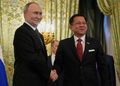
Since the latest coup, Russia has moved beyond selling weapons. It now provides systemic and institutional support to Myanmar in the form of airpower, training, intelligence, drone technology, and diplomatic protection. Since 2021, Russians have emerged as a “multi-domain” wartime enabler. This has enabled the struggling regime to “compensate” somewhat for the loss on the ground with “superior aerial”, “drone,” and technological prowess. As a result, Myanmar’s Tatmadaw has endorsed Moscow’s invasion of Ukraine as a “consolidation of Russian sovereignty”. It is in this light that the August 2026 visit of Min Aung Hlaing must be seen as a means to strengthen defence and strategic ties.

From Arms Supplier to Wartime Enabler

According to one estimate, between February 2021 and December 2022, Myanmar’s military imported around one billion dollars’ worth of supplies. Russia was the largest supplier during this period. Russia, according to one estimate, “contributed $406 million to the Myanmar military”. Among the Russian supplies were Yak-130 fighter jets, Mi-35 attack helicopters, and weapon systems like the Pantsir-S1 missiles.

Another key support to the regime historically has been in the form of military training and technical support. This support is essential for the civil war efforts of the military regime. Russians trained around 7,000 military officers from Myanmar during this decade. Similarly, Myanmar constantly sends military personnel to Russia to improve their technical expertise.

However, this defence relationship is not based on mere economic logic but also has strategic undercurrents. This is evident if we observe how Russia, along with China, has sheltered Myanmar from any UN-led action. In exchange, the military regime provided the most vocal support to the Russian invasion of Ukraine.

This strategic partnership only deepened throughout 2023 and 2024. During the period, the junta came under severe pressure due to coordinated activities of the opposition and their ethnic allies. The Russian support became vital for maintaining air superiority and the joint combat readiness of the Tatmadaw. In December 2023, “two Sukhoi-30SME multirole fighter jets were supplied”. Similarly, in late 2024, “another two jets were provided by the Russians to the regime” whose troops were struggling on the ground. At such a critical juncture, these weapon systems proved to be of strategic importance, as these advanced jets stationed at the capital’s air base provide the regime with countrywide coverage. These deliveries were accompanied by technical support that enabled the smooth integration and operational readiness of these systems in the existing structure.

One development that marked a significant enhancement of ties was the escalation of Joint Military Exercises between the two states. In November 2023, the first-ever joint Naval exercise was completed in the Andaman Sea. Another round of joint naval exercises was conducted in October 2024.

By the year 2025, it is clear that the partnership is much deeper than transactional ties. Instead, it is strategic in nature, which involves the “institutionalisation of defence ties”. Russian Security Council Secretary Sergei Shoigu visited Myanmar to sign a “comprehensive five-year military cooperation agreement”, cementing defence ties until 2030. The agreement ensures that the military regime receives continuous military and international support from the Russians.

Another significant factor in these ties is Russian support for Myanmar in the domain of drone warfare. Myanmar’s civil war, according to a recent LSE report, is the “second-biggest” drone fight in the world. As a result, Russians are heavily involved in arming and training Myanmar’s government forces. For example, the junta has relied heavily on Russian expertise to counter resistance drone swarms. Recently, both states also conducted a joint exercise named “Tiger 2026,” wherein the primary focus area was drone warfare and unmanned systems. Both states ran joint operations employing drones to carry out pre-emptive strikes and reconnaissance operations. The procurement of the Russian Mi-38 T helicopters in November 2025 also provided the regime with better troop movement capabilities.

In 2025, during General Hlaing Russia visit, a “joint satellite-imagery analysis centre was announced”, and Russians offered to share reconnaissance imagery for military purposes; its operational status remains unclear. Min Aung Hlaing’s visit to Russia in August 2026 must be viewed in the context of the growing defense and strategic ties between the two states. Hlaing, accompanied by Myanmar’s aerospace agency, signals growing cooperation between the two states on satellite intelligence, further boosting the regime’s surveillance capabilities.

Russian Support and the Regime’s Resilience

As far as Myanmar’s military regime is concerned, its logic behind this endearment towards Russia is “twofold”. Firstly, they seek to secure as much military support as possible from foreign powers to ensure their survival. Secondly, this partnership reduces their dependence on China without antagonising their most important partner.

The Russian ties are key in maintaining aerial superiority over the resistance forces. The military has suffered severe “manpower shortages”, “battlefield losses”, and “defections”, prompting the introduction of conscription in 2024. The Tatmadaw’s total force size has plummeted over the course of the conflict. In such a challenging environment, Russian support has contributed substantially to the regime’s endurance both domestically and internationally. Domestically, by enhancing Tatmadaw’s surveillance and targeting capabilities and improved troop mobility. Internationally, Russians have strengthened the regime’s diplomatic position.

Conclusion

Russia’s growing strategic engagement in Myanmar as an ‘extra-regional’ power is a significant development. For Myanmar, these engagements go beyond mere survival of the regime. The strategic partnership is also about Myanmar trying not to over-rely on China. Ultimately, Russia’s importance lies less in delivering a decisive Tatmadaw victory than in making the military regime sufficiently resilient to continue fighting, thereby prolonging Myanmar’s civil war. This also shows how the involvement of outside actors complicates civil wars and makes conflict resolution a difficult proposition.

Tags: EAOSExtra Regional PowerMilitaryMyanmarRussiaUS
Previous Post

Germany’s Strategic Focus on India: Charting the Future of Bilateral Cooperation

Dhanapriya Devi Chungkham

Dhanapriya Devi Chungkham

Dhanapriya Devi Chungkham is currently serving as a Research Assistant at the Centre for Land Warfare Studies (CLAWS), New Delhi. She completed her PhD from Centre of Indo-Pacific Studies, School of International Studies (JNU). Her research focuses primarily on security and strategic studies of India’s eastern frontier, with particular interest in the Act East Policy, India-Myanmar relations, borderland dynamics, Northeast India and the evolving geopolitical landscape of Southeast Asia and the Indo-Pacific. She specialises in fieldwork-based research and qualitative methodologies.

Leave a Reply Cancel reply

Your email address will not be published. Required fields are marked *

Support Us Donate Now

Web Updates

CLAWS MAHE PHD PGME | B – 9 Shortlisted Candidates

Field Marshal Manekshaw Essay Competiton 2026

Promotion Exam Correspondence Pre Course (PROMEX)

Guidelines to Publish with CLAWS

Application Form – Study Mtrl for DSSC 2026

[NEW] Application Form for membership for PROMEX (PART B or D)

  • Trending
  • Comments
  • Latest
Russia-Ukraine War: Lessons from an Electronic Warfare (EW) Perspective

Russia-Ukraine War: Lessons from an Electronic Warfare (EW) Perspective

May 31, 2025
Field Marshal Manekshaw Essay Competiton 2026

Field Marshal Manekshaw Essay Competiton 2026

April 23, 2026
Results | Field Marshal Manekshaw Essay Competition – 2024

Field Marshal Manekshaw Essay Competiton 2025

May 23, 2025
Op Sindoor 2.0: Why & How India Must Prepare for the Next Round?

Op Sindoor 2.0: Why & How India Must Prepare for the Next Round?

May 21, 2025
From Sword Clashes to Drone Strikes: A History of Changing Battlefields

From Sword Clashes to Drone Strikes: A History of Changing Battlefields

15
The Arakan Army and Its Impact on India: Rising Tensions Along the Eastern Frontier 

The Arakan Army and Its Impact on India: Rising Tensions Along the Eastern Frontier 

5

Thwarting  Pakistan’s Nefarious Designs in Bangladesh

5
India’s Pursuit of Self-Sufficiency in Rare Earth and Critical Minerals: South Caucasus as an Option

India’s Pursuit of Self-Sufficiency in Rare Earth and Critical Minerals: South Caucasus as an Option

3
The Evolution of Russia’s Support for Myanmar’s Military Regime Since 2021

The Evolution of Russia’s Support for Myanmar’s Military Regime Since 2021

September 15, 2026
Germany’s Strategic Focus on India: Charting the Future of Bilateral Cooperation

Germany’s Strategic Focus on India: Charting the Future of Bilateral Cooperation

September 15, 2026
India’s BRICS Moment: Navigating a Changing Global Order

India’s BRICS Moment: Navigating a Changing Global Order

September 10, 2026
National Capacity for Maneuver: India’s Strategic Perspective

National Capacity for Maneuver: India’s Strategic Perspective

September 10, 2026

Popular Stories

  • Russia-Ukraine War: Lessons from an Electronic Warfare (EW) Perspective

    Russia-Ukraine War: Lessons from an Electronic Warfare (EW) Perspective

    0 shares
    Share 0 Tweet 0
  • Field Marshal Manekshaw Essay Competiton 2026

    0 shares
    Share 0 Tweet 0
  • Field Marshal Manekshaw Essay Competiton 2025

    0 shares
    Share 0 Tweet 0
  • Op Sindoor 2.0: Why & How India Must Prepare for the Next Round?

    0 shares
    Share 0 Tweet 0
  • From Sword Clashes to Drone Strikes: A History of Changing Battlefields

    0 shares
    Share 0 Tweet 0

About us

CLAWS

The Centre for Land Warfare Studies (CLAWS), New Delhi, India is an independent think tank on strategic studies and land warfare. The mandate of CLAWS covers national security issues, conventional military operations and sub-conventional warfare.

Browse by Category

  • Articles
  • Autumn 2019
  • Autumn 2020
  • Books
  • Chanakya Defence Dialogue
  • CLAWS Focus
  • CLAWS Journal
  • Essay
  • Events
  • External Publications
  • FMMEC
  • Intern Articles
  • Issue Briefs
  • Jottings by Director General Emiritus
  • Manekshaw Papers
  • Newsletter
  • Round Tables
  • Scholar Warrior
  • Seminars
  • Uncategorized
  • Web Updates
  • Winter 2019
  • YouTube Podcast

Recent News

The Evolution of Russia’s Support for Myanmar’s Military Regime Since 2021

The Evolution of Russia’s Support for Myanmar’s Military Regime Since 2021

September 15, 2026
Germany’s Strategic Focus on India: Charting the Future of Bilateral Cooperation

Germany’s Strategic Focus on India: Charting the Future of Bilateral Cooperation

September 15, 2026
  • Site Map
  • Tenders
  • Advertise With Us
  • Terms of use
  • Privacy Policy
  • Other Think Tanks

© 2008-2026 Centre for Land Warfare Studies (CLAWS).

No Result
View All Result
  • Home
  • About Us
    • Director General
    • Additional Director General
    • Jottings by Director General Emiritus
    • CLAWS Membership
    • Faculty
  • Publication
    • Web Articles
    • Issue Briefs
    • Manekshaw Papers
    • Newsletter
    • Essay
    • CLAWS Journal
    • Scholar Warrior
    • Books
    • Intern Articles
    • External Publications
  • Research Areas
    • Global & Regional Security
      • China
      • Pakistan
      • Afghanistan
      • South Asia
      • Indo Pacific
      • US, EU & Russia
      • MENA
      • CAR
    • National Security
      • National Security Strategy
      • Nuclear Deterrence
      • Non Traditional Threats
      • Intelligence
      • Terrorism & Internal Security
      • Grey Z & IW
      • Security Laws
    • Military Studies
      • Military Doctrine
      • Military Strategy
      • Peace Keeping Ops
      • Military History
      • Military Logistics
      • Out of Area Contingency Ops
      • Leadership
    • Military Technology & Defence Acquisition
      • Military Technology
      • Defence Acqn
      • Budgets & Finance
      • Defence Infrastructure
      • Human Resources
    • Multi Domain Studies
      • Jointmanship & Integration
      • Space
      • Cyber
      • Spl Operations
      • Energy & Environment
      • Defence Eco System
      • Defence Diplomacy
      • HADR
  • Web Archive
  • Events
    • Seminars
    • Webinars/RTD
  • PROMEX
  • University Cell
    • About The Initiative
    • Admission: Eligibility and Procedure
    • Guides | Supervisors in the PhD Programme:
    • Important Information
    • Administration
    • Application Fee: Batch – 10 Onwards
  • Careers
  • Contact

© 2008-2026 Centre for Land Warfare Studies (CLAWS).